

You Can Still Watch 3D Movies At Home, Just Not On A TV
We may receive a commission on purchases made from links.
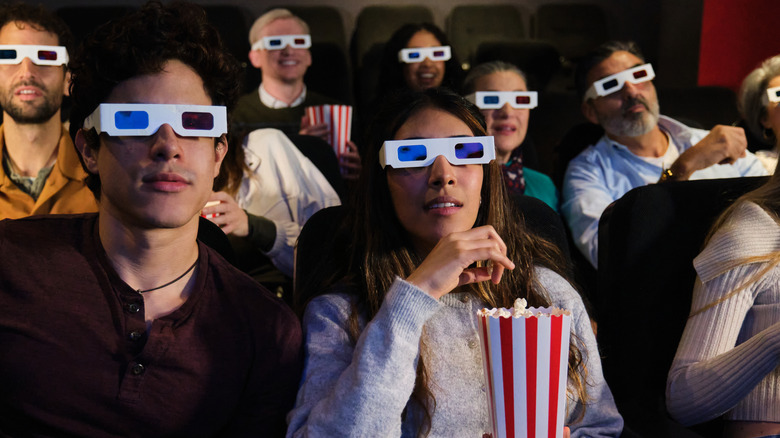
Home theater fads come and go, leaving many of us riddled with junk drawers and closets packed to the brim with antiquated gear. While the days of plasma TVs are far behind us, there's one picture feature that has completely vanished: 3D. Back in the 2010s, there were a ton of 3D-capable TVs on the market, and most of these sets even included one or several pairs of 3D glasses.
But as we got into the back half of the decade, manufacturers began focusing less on three-dimensional immersion and more on pushing the envelope in overall picture quality. This paved the way for some of the best smart TVs on the market, but it also spelled the end of an era for those who loved the frills of 3D cinema. Not all hope is lost, as you can still enjoy 3D media today: you just need to invest in a 3D projector, a 3D Blu-ray player, and a compatible set of 3D glasses.
Projectors are common, but not all of them have lenses that can project a 3D image. You'll need to pay extra-close attention to specs and features. Be on the lookout for "3D-ready" labels, and be ready to dig deeper than whatever surface-level features are advertised. The same goes for Blu-ray players, especially since "4K UHD" doesn't automatically translate to "3D-ready." That might also mean you'll end up ordering a used or refurbished player from a third-party site like eBay.
Don't forget about 3D accessories, audio, and room setup
It actually isn't that difficult to find brand-new 3D glasses on sites like Amazon; just make sure the pairs you're purchasing will work with the projector you chose. Active and passive glasses are the two technologies you'll have to choose between, and, generally speaking, it's the former that's supported by most 3D projectors. Active 3D glasses are battery-operated, which makes them the pricier option, too.
There's also the matter of a projector screen to sort out. You can project an image onto a flat, white wall, but you could end up sacrificing picture details, especially sharpness. Even if you only have funds for a cheap screen that gets stowed away after movie night, it'll be better than the living room wall. We should also advise that 3D glasses often reduce the brightness of whatever you're watching, so you may want to look at screens with built-in ambient light rejection (ALR).
Rooms with sunny windows will attempt to tarnish your 3D movies, too, but a decent pair of blackout curtains can help to preserve the brightness, colors, and contrast of your content. Projectors also aren't exactly revered for sound output. Some models will include a built-in speaker or two, but depending on the size of your theater space, a soundbar or external speaker may be warranted.