

Soundbar Vs. Speakers: Which Is Better For Your TV's Audio?
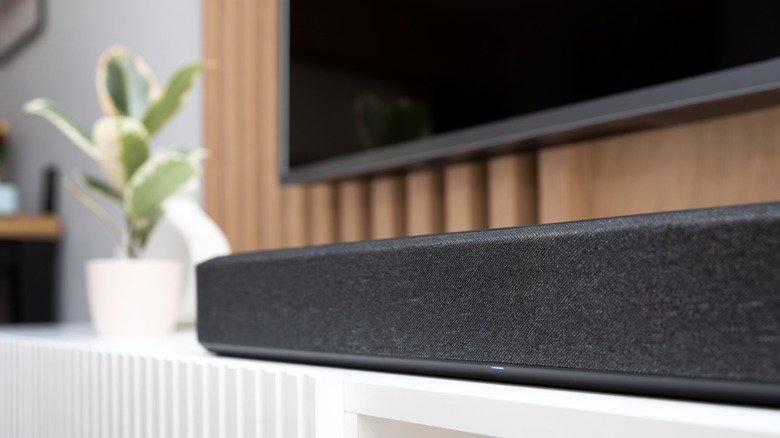
Even if you're floored by the picture quality of your brand-new TV, you probably can't say the same about its audio performance. That's to be expected, as TVs are thinner than ever these days, and built-in speakers have gotten less powerful. Fortunately, you can upgrade your TV audio, and there are two main ways to do so: adding a soundbar or installing a dedicated speaker system.
There are pros and cons to both of these audio products, and which is best for you will depend on factors like what you like to use your TV for (e.g., streaming apps, video games, watching old DVDs), room size, furniture, and how "cinematic" you want your movies and shows to sound. Generally speaking, though, a soundbar is designed to enhance dialogue, overall clarity, and volume, while a dedicated speaker system will deliver a wider, more immersive soundstage, making it feel like you're a part of the movie or show you're watching.
If you're more the "set it and forget it" type, the plug-and-play design of many soundbars will be a huge benefit. The lion's share of systems connect to your TV via HDMI ARC/eARC or digital optical; this ensures that all AV components plugged into your TV route audio to the soundbar, including your TV's built-in apps. Features like HDMI-CEC should also allow you to control the soundbar volume with your TV remote, and many bars have a dedicated center speaker for boosting dialogue and vocals.
When convenience and cost aren't priorities
The name of the game is simplicity as far as most soundbars go. They're a great investment for small to medium-sized spaces, and a considerate choice for apartment dwellers. Even if you have the real estate for a complete surround rig, the lower frequencies that many 3.1 and 5.1 configurations achieve can easily travel through floors and ceilings. This isn't to say that no soundbar will produce enough bass to be problematic, but because of their front-of-the-soundstage emphasis, that tends to be more the exception than the rule.
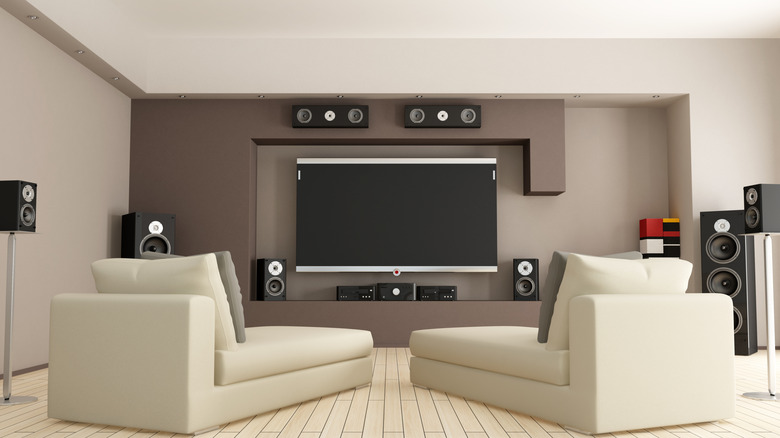
Sure, a dedicated speaker system entails more than just speakers; you'll need to invest in an AV receiver, wiring, and potentially installation costs if you're not interested in doing the job yourself. If that doesn't bother you, though, it's hard to deny the sonic immersion of classic surround sound. Even the most high-end soundbars can struggle to deliver the directional audio and spatial effects you'll get with true surround.
Again, soundbars often include a dedicated center, and there are midrange and premium models that contain up and side-firing drivers, too. But at best, these designs are still challenged by the bar enclosure. Physical, separated speakers are frequently preferred for directional sound and spatial immersion, allowing sound to travel front to back, side to side, and up and down more naturally and cinematically. And while there are a handful of soundbars that can virtualize a larger speaker setup, it's hard to trump what even a small-scale, wired 5.1 configuration is capable of.
Starting small and scaling up is a solid path forward
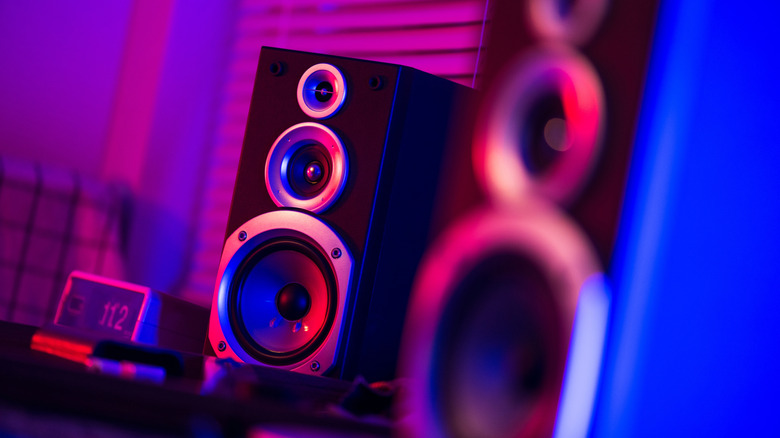
You don't need to purchase every part of your surround system at once. You can start with the bare essentials — an AV receiver with two front speakers — and gradually add other pieces as your budget opens up. On the one hand, wiring up a surround system isn't as straightforward as connecting a soundbar to your TV, but the ability to scale your system up or down is near-limitless.
There are upgradeable soundbars, too. Brands like Samsung often sell soundbar-subwoofer combos that you can expand with wireless rear speakers, though they need to be a specific pair of Samsung speakers. Sonos is another audio provider that prioritizes scalability, and linking rears and a subwoofer to bars like the Sonos Arc Ultra or Sonos Beam Gen 2 is a quick and easy process. JBL even makes a soundbar with detachable, battery-powered speakers that will last up to 10 hours on a full charge (you attach them to the soundbar to charge them).
There's also the alternative of connecting a wireless, powered speaker to your TV. Just like a soundbar, these devices require AC power to operate, but the upside is that powered speakers are often portable enough to travel between rooms. There are even some models that feature Wi-Fi and Bluetooth connectivity for music streaming and voice controls (e.g., Alexa, Google Home). When all is said and done, soundbars and speakers are both great for your TV's audio, but the former tends to prioritize dialogue, clarity, and way less wires, whereas the latter puts cinematic immersion front and center.