

This Is What A 5MB Hard Drive Cost In The 1980s
We may receive a commission on purchases made from links.
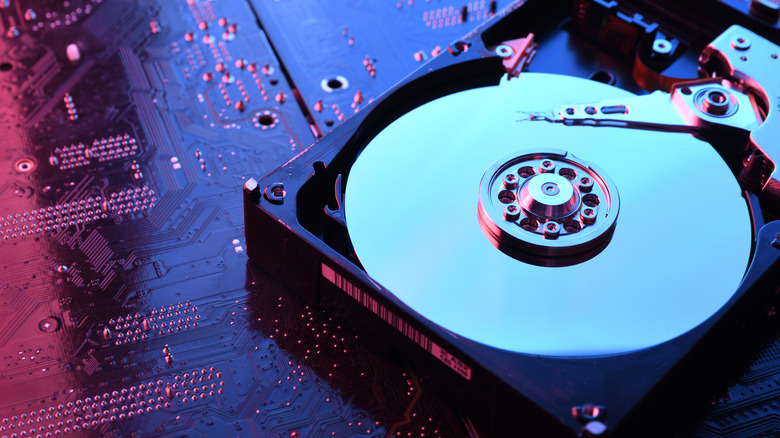
Even with component shortages raging in 2026, you can buy a one-terabyte solid-state drive for less than $200, and that's no fluke — there are a ton of options out there for around that price range. Storage has become much more capable over the years, in capacity and read-write speeds, and much cheaper, too. You can now find an ultra-compact drive solution that plugs right into your smartphone to back up photos. That wasn't always the case. In the early 1980s, when computers were still in their infancy, hard drives were not only ridiculously expensive, but they also had a limited storage capacity. Apple's first hard drive, called the ProFile, was released in 1981 and held only five megabytes of data for a price of $3,499.
If you do the math, that's about $700,000 per gigabyte of storage back then. What's most alarming, however, is that the drive would barely hold the average smartphone photo from today. A two-megapixel HD photo, at a 1920 by 1080 resolution, would be about two megabytes in size — most phones take photos at a significantly higher resolution, which means Apple's drive would hold two photos, if that.
Storage has largely been governed by something called Kryder's Law, which is not unlike Moore's Law, a principle you may already recognize. By comparison, Moore's Law states that processing and memory power doubles via improvements to semiconductors or transistors per chip every eighteen months. Kryder's Law addresses the exponentially larger and faster growth of storage capabilities, with disk density doubling every 13 months. Kryder's Law has purportedly slowed since about 2012, but compared to the original costs and capabilities of storage, that matters little.
What does the future of storage look like?
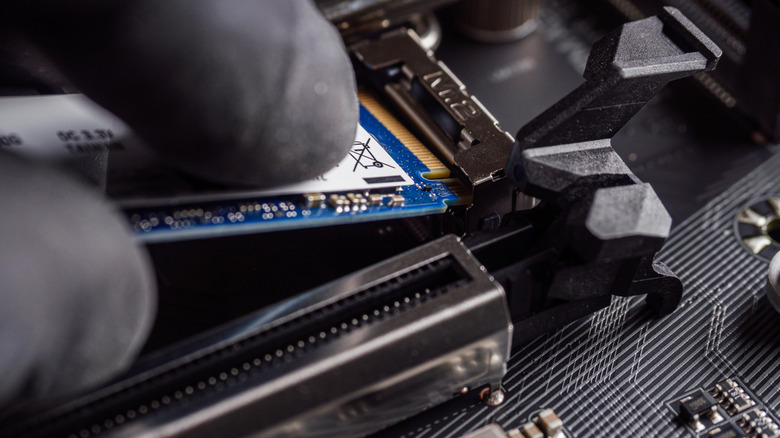
While solid-state drives in varying formats have shrunk considerably in size, including small drives with flash storage, they still have their limits. That's why you can't just buy a petabyte hard drive and may not be able to for quite some time. To increase the capacity of physical drives, manufacturers need to increase the platter size or the number of platters in an enclosure. The bigger the platter or drive, the more heat generated and the larger the overall size of the device. The same applies to adding many hard drives to a single system to increase capacity, like in a server rack. They can't just keep making hard drives bigger and bigger physically, and it has slowed progress. Conversely, reducing platter size to accommodate stacking more of them together without expanding physical size or overheating runs into the diminishing returns of Kryder's Law.
That doesn't mean nothing is happening behind the scenes or that there are no innovations going on. For large data centers, and AI data centers especially, more storage is going to be necessary. Companies like Seagate, Toshiba, and Western Digital — the only current hard drive manufacturers — are working towards bigger and better solutions. Energy-assisted magnetic recording (EAMR) technologies are one focus, with each company adopting its own methods to achieve larger drive capacities. Heat-assisted magnetic recording (HAMR), for example, will be used by Toshiba and Western Digital, with platters made of glass and material alloys like iron-platinum (FePt). Seagate has achieved a 6.9-terabyte per-platter capability in a research setting with HAMR. Estimates claim 100-terabyte drives will be achieved between 2030 and 2031 if everything stays on track.
Data centers are built on physical infrastructure

While using cloud storage can feel somewhat magical, storing your photos, videos, and files online and enabling accessibility from any device, its foundation is still physical infrastructure. Somewhere remote is a data center with servers, and in those servers are physical hard drives, which is where all that data is being stored or backed up. When you use iCloud storage, for instance, your data is being backed up to Apple's data centers, which may offload some of their storage capacity to physical drives somewhere else. That is precisely why there are some files you should never upload to cloud storage.
But what this also means is that, as cloud services and online platforms become bigger and more capable, so too must the data centers powering them — they'll need more storage and computing power to keep up. The demands for more storage are being spurred by the overall market, which is why hard drives will likely continue improving in capabilities and capacity for years to come. That's also why storage may become a problem for new phones, new devices, and future computers — the competition for storage chips, and thus their prices, looks like it will continue to grow.
The largest and most advanced drives will likely only be available to commercial and enterprise customers, which has really always been the case. Prices may continue to climb as overall demand increases, but the good news for consumers is that today's enterprise-level tech will likely become standard (or substandard) fare for tomorrow's everyday gadgets ... just like that $3,500 Apple HDD from 1981.