

A Deleted Star Wars Scene Would Have Changed A Defining Jawa Characteristic
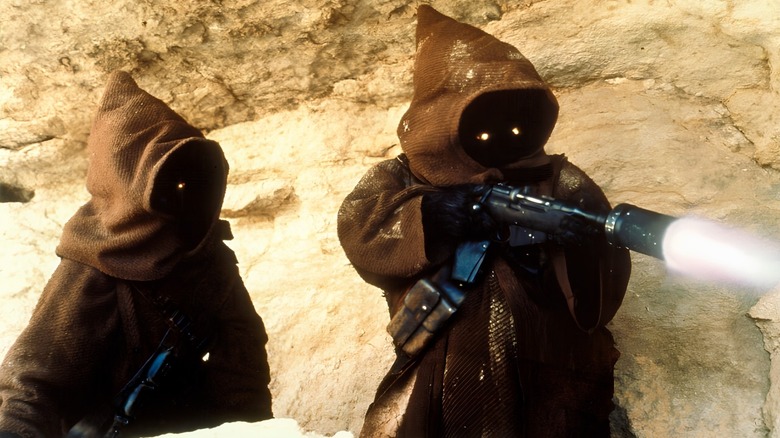
When thinking about the binary sunset of Tatooine in "Star Wars: Episode IV – A New Hope", one of the first things that might spring to mind is Jawas. These hooded, glowing-eyed wanderers and scrap dealers never seem to stop traveling, living as nomadic scavengers who traverse the sands of Tatooine, and call giant Sandcrawler vehicles home. This lifestyle of collecting mechanical debris, stripping starships, and trading with moisture farmers will continue in some of the most exciting "Star Wars" movies and series currently in development.
However, behind-the-scenes details reveal that Jawas nearly lived a more stationary lifestyle in a scrapped production sequence that would have rewritten their cultural identity by giving them permanent homes. George Lucas ended up abandoning the concept during early development, before his camera crew took a single shot on-location in Tunisia. This single decision nearly changed how we see the home world of Anakin and Luke Skywalker, fundamentally altering how one of the series' most iconic alien species would be depicted on a desert planet in a galaxy far, far away.
George Lucas envisioned a permanent home for Jawas
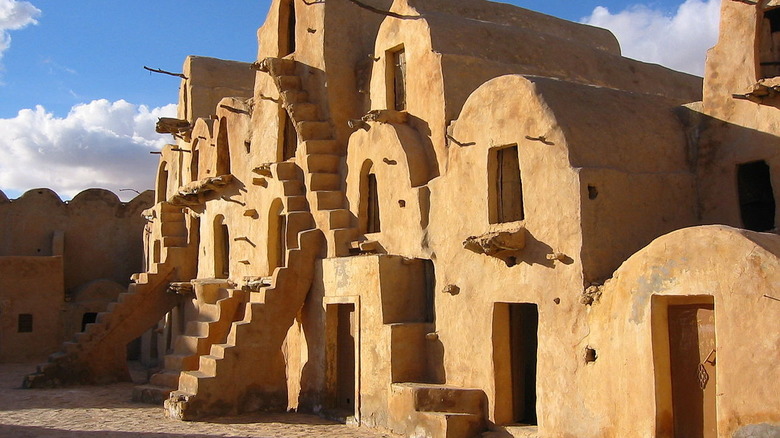
During early location scouting in Tunisia, the "Star Wars" production crew stumbled upon unique native architecture that completely reshaped the director's initial vision. George Lucas detailed this discovery in an interview with Rolling Stone, explaining that his team found grain houses standing four stories high. The structures featured tiny doors and windows, with Lucas describing the location as a hobbit village. It prompted him to create a scene featuring an entire Jawa village, filled with "these little hobbit-world slum dwellers" living together in a community.
Instead of being a nomadic tribe, Jawas would have been more like established townspeople or aborigines, according to Lucas. These grain houses would later be used as the location for the slave quarters for Anakin and Shmi Skywalker in "Star Wars: Episode I – The Phantom Menace". But the reality of a tight production budget kept fans from seeing this unique scene on the big screen. The chosen Tunisian location was too far away from the main filming site. So, Lucas — who expected audiences to hate "Star Wars" — cut the entire sequence, a decision that led to the Jawas becoming the wandering scavengers we know today.
A video game brought the idea back to life
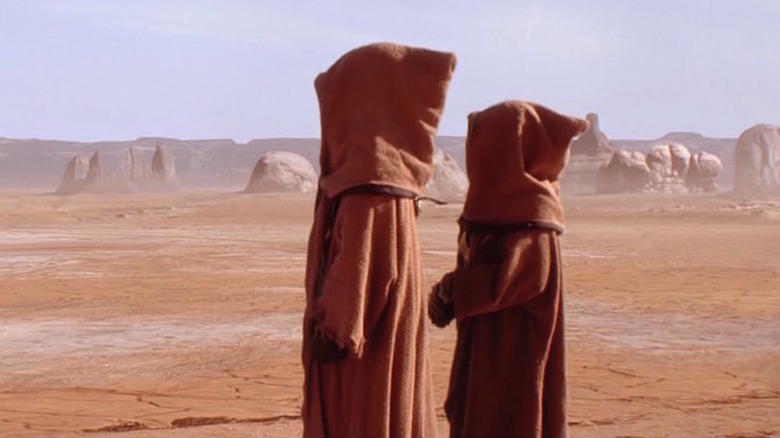
Even though it didn't make it to the big screen, the concept of a stationary Jawa community didn't disappear entirely from the "Star Wars" universe. In the "Star Wars Galaxies" video game, the idea of a stationary home for the Jawas came back to life as a trade outpost. Though "Star Wars Galaxies" is classed as Legends, and not part of the official "Star Wars" Canon, the Jawa Mountain Fortress, also known as the Jawa Trading Outpost, from the game gave fans a glimpse of what Jawas could be outside their nomadic culture.
It's a great example of just how much "Star Wars" lore exists in video games, comics, books, board games, and more. Although the Jawa Mountain Fortress isn't Canon, it shows that the species could thrive outside of their mobile Sandcrawlers. Like Jodie Foster nearly being cast as Princess Leia, this Jawa community would have certainly changed key story beats from the first "Star Wars" film.