

Why Some U.S. Navy Submarines Use Xbox Controllers To Operate High-Tech Periscopes
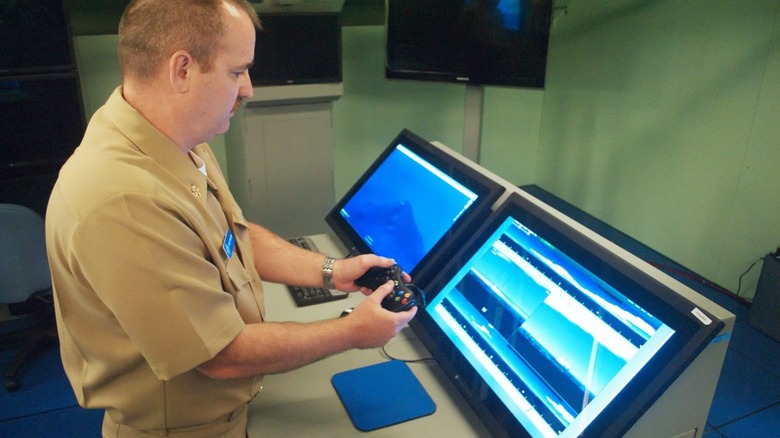
Military submarines are extremely complicated vehicles. Each submarine uses a suite of tricks to hide from enemy sonar, and nuclear-powered subs can stay submerged for months by producing their own oxygen. As such, they require more knobs and buttons than most seafaring vessels. These controls require funding and training, so the Navy decided to save time and money by using a video game controller to manage the modern equivalent of the periscope.
In 2018, the U.S. officially welcomed the USS Colorado into active duty. The vessel was the 15th Virginia-class submarine built for the Navy, but unlike its predecessors, the Colorado doesn't implement traditional control schemes to man its twin photonic masts (high-tech sensors that replaced old-fashioned periscopes). The Navy decided to install an Xbox controller, and not the then-modern Xbox One controller; the Navy went with the older (but more iconic) Xbox 360 controller. The reasoning behind this decision was twofold. First, there's the price. Xbox 360 controllers maxed out at around $30, whereas a proper dedicated control panel would have cost about $38,000.
The Navy also decided to go with this controller because many crewmembers already have experience using it. The logic was that this prior knowledge would cut the amount of training time from hours to minutes – about the same time most gamers need to grasp control schemes in new games. The controller also isn't as clunky and heavy as original photonic mast controls would have been. The Navy went ahead and adopted this Xbox 360 control scheme for subsequent Virginia-class subs, including the USS Indiana.
The origins of the Xbox-controlled photonic mast
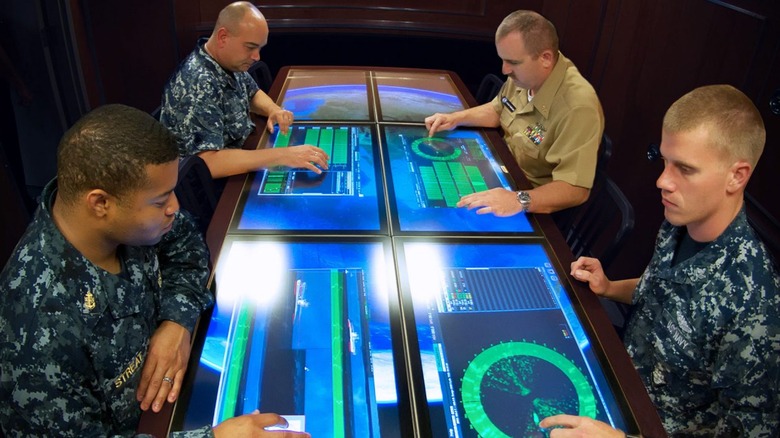
The idea to replace obtrusive controls with Xbox controllers didn't just spring up from the aether. The original concept spawned out of the test lab known as "Area 51" (not to be confused with the Area 51 in Nevada), where Lockheed Martin and the U.S. Navy tested commercial software and hardware and their applications in Virginia-class submarines. There, researchers dabbled in all sorts of control schemes, including tablets, touch tables, and even the Microsoft Kinect (possibly one of the most clever uses for an old Kinect).
The lab's motto was simple: "How might we integrate what already works?" So they went with a piece of tech that was a formative part of many modern soldiers' lives. Now you might think that using an old Xbox controller for a piece of military tech is a novel idea, but it isn't. You know what they say: Great minds think alike. The U.S. Army also uses Xbox 360 controllers to pilot Small Unmanned Ground Vehicles (SUGVs) and even flying drones – yet more cool things you didn't know Xbox controllers could do.
However, the Defense Department has its own controller-like peripheral, the Freedom of Movement Control Unit (FMCU). This device looks like a chunky, rugged third-party Xbox controller with extra buttons and has been integrated into systems such as the Maneuver-Short Range Air Defense vehicle. However, with the rise of autonomous drones, who knows how much longer these devices have left?