

3 Disadvantages Of The Kindle Colorsoft You Should Know About
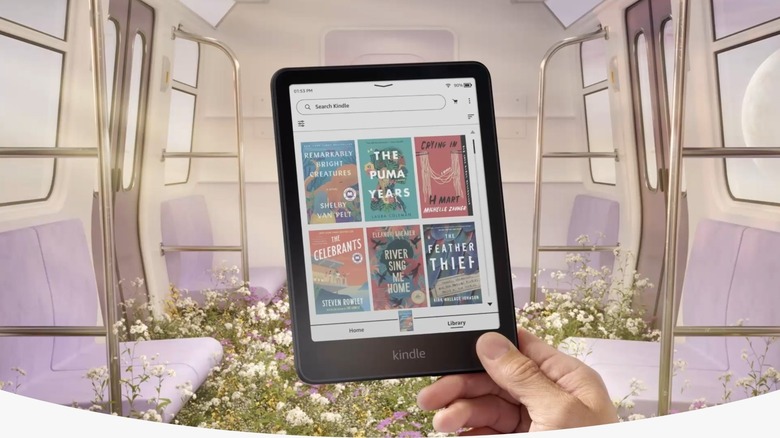
When it comes to moving from traditional paperbacks to digital reading, many readers reach for a Kindle, and for good reason. Its e-ink screen is easy on the eyes, it can hold thousands of books without filling up your room, and its reading interface is highly customizable to your liking. But some users argue that the black-and-white Kindle looks too boring and less engaging than the vibrant displays on phones and tablets.
That's where the Kindle Colorsoft comes into the picture. The Colorsoft seems like the perfect middle ground between an e-ink e-reader and a full-color tablet. It keeps that paper-like screen that makes reading on your Kindle better than on a smartphone. And thanks to its splash of color, your library and colored magazines, comics, and manga become more visually pleasing.
Behind these benefits, though, the Kindle Colorsoft also comes with a couple of drawbacks. These may or may not matter depending on your preferences. But before you ditch your basic Kindle or Paperwhite for a Colorsoft or buy Colorsoft as your first Kindle, you should keep in mind these trade-offs.
It has a shorter battery life

If there's one thing Kindles are known for, it's their long-lasting battery. They can easily go for weeks on a single charge (especially if you turn on airplane mode on your Kindle), so you won't have to stay tethered to a wall outlet as you dive into your books. The Kindle Colorsoft is no exception to this expectation. Both the basic Colorsoft and the Colorsoft Signature Edition can run for up to eight weeks. This assumes you only read for 30 minutes a day in airplane mode, with the brightness at 13. Eight weeks seems to be a long time already, but if you look at the battery life of the other Kindle models, you'll realize the Colorsoft's is actually shorter.
For instance, the Paperwhite and Paperwhite Signature Edition are both tested to last a maximum of 12 weeks on the same conditions as the Colorsoft. That's about a full month longer than the Colorsoft. The new Kindle Scribe (without a front light), on the other hand, has a runtime of 16 weeks, double that of the Colorosft. The only model the Colorsoft beats is the basic Kindle, which is designed for just six weeks of battery life. On the bright side, the Colorsoft's charge time is similar to that of the models. It takes roughly 2.5 hours for it to fully charge and be ready for your next read again, so you're not exactly punished with a long downtime.
The Colorsoft can feel pricey for what you get

The Colorsoft isn't exactly the most expensive Kindle as of this writing. That goes to the Kindle Scribe family, which costs upwards of $430. But that doesn't change the fact that the Colorsoft still has a significantly higher price tag compared to the monochrome Paperwhite and basic Kindle models. You can get the basic Kindle for $110, the Paperwhite for $160, and the Paperwhite Signature Edition for $200. Meanwhile, the Colorsoft starts at $250 and goes up to $280 for the more premium Colorsoft Signature Edition.
This price jump might not feel worth it for everyone. After all, for the non-comic/manga reader, the only main benefit you get out of the Colorsoft is colored book covers and colored highlights. Sure, the book covers in color look more attractive and make it easier to choose a book to read. The different colored highlights also keep things more organized. But outside of these use cases, the Colorsoft works just like the more affordable Paperwhite. If you frequently read colored comics, graphic novels, and manga, though, the premium price might be well worth it, as you can really make the most out of the Colorsoft.
If you're a standard novel reader and still want to experience reading on a Colorsoft, you can always keep an eye out for discounts before buying one. Amazon regularly runs promotions, where you can get the Colorsoft for as low as $170.
The display is different from the Paperwhite's

Both the Colorsoft and Paperwhite come with the same 7" screen size, but the technologies behind these displays are entirely different. If you've read on a Paperwhite before, you'll see some subtle differences that can put the Kindle Colorsoft at a slight disadvantage. For one, users say the Paperwhite offers much better clarity than the Colorsoft. The text is noticeably sharper and crisper on the Paperwhite, but that doesn't necessarily mean reading on the Colorsoft is torture. Its text is still pretty readable — it's just a touch softer. In fact, if you haven't used a Paperwhite before, you might not even pick up on the difference.
When it comes to reading plain text, the page turns on the Colorsoft and Paperwhite feel the same. But for colored pages, it's a different story. There's a bit of a lag when turning the pages on the Colorsoft than on the Paperwhite. But then again, you'll eventually get used to the speed over time, so it might not be a real issue.
In terms of warmth and brightness, the Colorsoft looks a bit darker at the lowest brightness level and has a tinge of a cool blue tone. Meanwhile, the Paperwhite is already bright even at Brightness Level 0, and it looks more neutral rather than warm or cool. That said, you might have to up the brightness a bit on the Colorsoft when you're reading in a well-lit room or outdoors.