

5 Of The Coolest Reveals From Nvidia's 2026 Computex Event
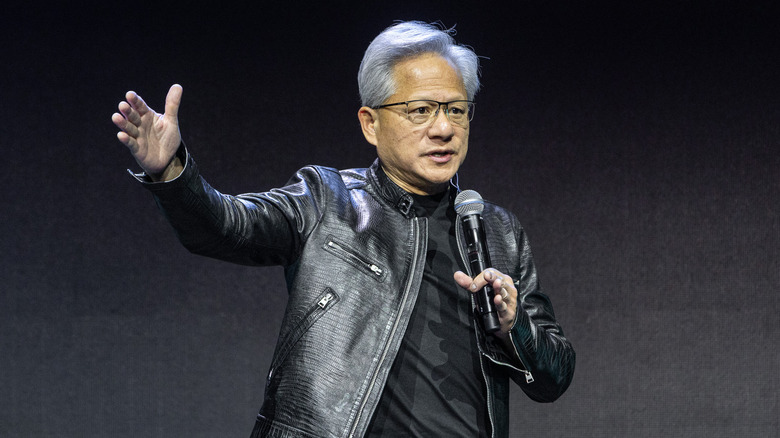
If you want a glimpse into the future of various technologies and industries, you only have to check out expos and conventions. If you're after the latest in computer tech, look no further than Computex Taipei. The expo has been running strong for several decades, and to open the 2026 convention, Nvidia founder and CEO Jensen Huang took to the stage as a keynote speaker.
If you play PC games, you probably know Nvidia for its graphics cards. The company sells incredible flagship GPUs, the RTX 5080 and 5090, but it is also known for technologies such as Deep Learning Super Sampling (DLSS) and G-Sync. The former uses AI to improve image quality without sacrificing frame rates, while the latter works in tandem with compatible displays to reduce input lag and image tearing. For two hours, Huang discussed upcoming products from Nvidia, including new game rendering technologies and AI. Here are the reveals we think were the coolest.
RTX Spark
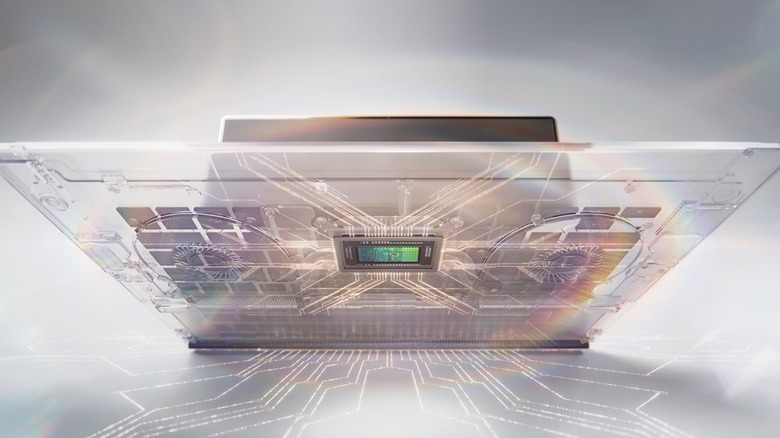
Nvidia rolled out its RTX line of graphics cards in 2018. These GPUs were the first cards capable of delivering real-time ray tracing, a rendering technique that simulates how light behaves for improved visual fidelity, to the general gaming populace (the "RT" in "RTX" stands for "Ray Tracing," after all). And now, the next evolution of the RTX line is upon us.
One of the biggest takeaways from Nvidia's 2026 Computex event was the RTX Spark, a "superchip" that Jensen Huang claims will "reinvent the PC." This new chip will provide up to 128 GB of memory and a whole petaflop of computational power. AI will be at the forefront of the chip's design, and computers that utilize RTX Spark will be geared toward "AI agents." Furthermore, Nvidia is working closely with Microsoft to develop this component and its capabilities with Windows in mind. However, Nvidia isn't about to abandon the demographic that made the company a household name in the first place: PC gamers.
Ultimately, the RTX Spark will bring more powerful RTX graphics, which should satisfy most PC owners. Huang promises that the RTX Spark will power modern AAA games with 1440p resolution, complete with ray tracing and DLSS, all at over 100 fps. And since Nvidia and Microsoft are collaborating on the chip, the Xbox brand will get to see some kickback. According to the VP of Next Gen at Xbox, Jason Ronald (yes, that's his title), the RTX Spark will provide more access to Xbox titles on computers that use the superchip.
DLSS 4.5 Ray Reconstruction
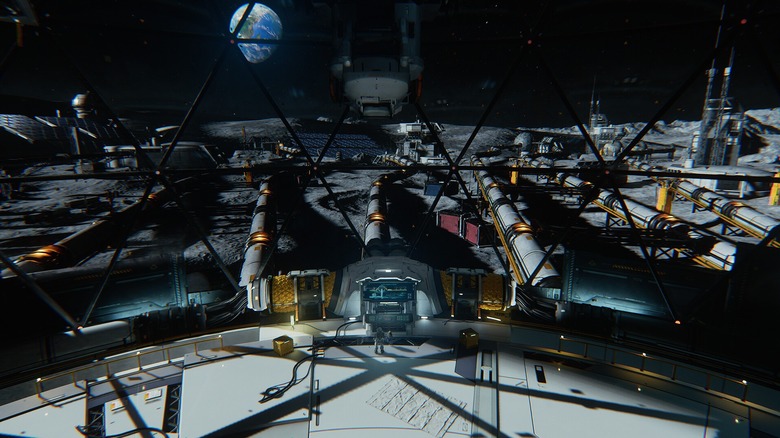
Nvidia's DLSS has been a key feature in its RTX line of GPUs since September 018, and the company has been iterating on the system ever since. The latest version, DLSS 4, introduced Multi Frame Generation, which uses AI to "boost frame rates" and "generate up to five frames per rendered frame." While DLSS 5 is nowhere to be seen, Nvidia is ready to move forward with DLSS 4.5.
Nvidia announced DLSS 4.5 Super Resolution during CES 2026, but Jensen Huang used Computex 2026 to announce the next big feature of DLSS 4.5: Ray Reconstruction. The technology takes the neural rendering capabilities of all modern GeForce RTX GPUs and applies them to ray tracing. According to videos Nvidia released, DLSS 4.5 will provide cleaner particle effects with less ghosting across titles such as "Alan Wake 2" and "Pragmata."
DLSS 4.5 is said to bring more than just improved ray tracing. The update will also supercharge computational capabilities across the board, as well as provide enhanced spatial awareness that purportedly improves lighting accuracy. Nvidia GPU owners can expect DLSS 4.5 to roll out in August 2026 for all RTX GPUs. While only a handful of titles will utilize DLSS 4.5 at launch, plenty of upcoming games are scheduled to release with DLSS 4.5 support, and the teams behind games such as "Marvel Rivals" are working with Nvidia to upgrade their engines to include DLSS 4.5 features.
Alpamayo 2 Super
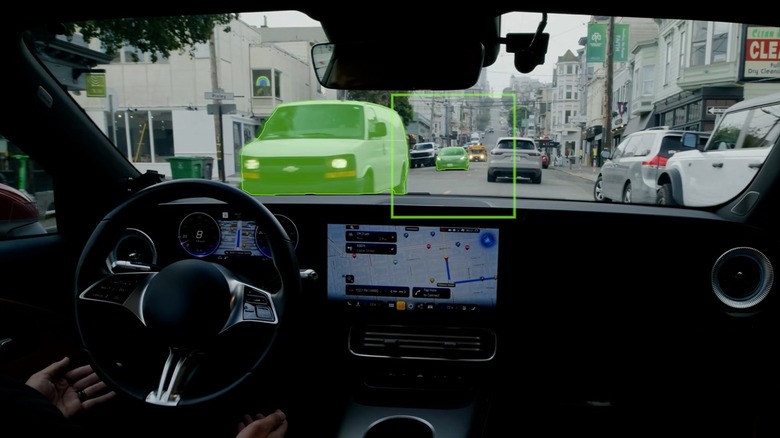
Several Silicon Valley companies are developing a robotaxi of some sort, and that includes Nvidia. While the company is most often associated with PC gaming, Nvidia plans to soon compete with Elon Musk's Tesla by way of autonomous vehicle technology. And Jensen Huang laid out the next phase of those plans during Computex 2026.
Instead of building its own cars, Nvidia will provide the tools to make autonomous vehicles safer and more capable. One such tool will be the newly announced Alpamayo 2 Super, an "open 32-billion-parameter reasoning VLA model" for robotaxis that will serve as a framework for future autonomous vehicle infrastructures. According to Nvidia, the Alpamayo 2 Super will deliver "humanlike perception, reasoning, and action" so cars can reason as effectively and quickly as many human drivers.
Alpamayo 2 Super will also be tied to another upcoming AI system, AlpaGym. Whereas Alpamayo will run on robotaxis, AlpaGym will help train their AI models using "AlpaSim." This program continuously runs various actions and decisions through a model that determines all the ways they can alter the local environment, thereby potentially reducing the compounding errors of rival training models. Jensen Huang stated that manufacturers such as Nissan, Hyundai, and Mercedes-Benz will install models of Nvidia's Drive Hyperion — the company's autonomous vehicle platform — that were made with Alpamayo 2 Super. By his calculations, the manufacturers of about 80% of the world's cars have signed up to build Nvidia Drive Hyperion cars.
Isaac GR00T Reference Humanoid Robot
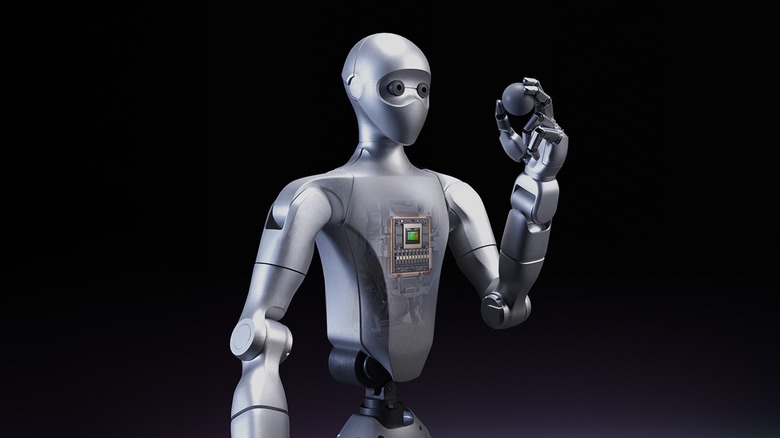
What's cooler than an autonomously driving car? How about an autonomous robot? Yes, there are concerns that future robot companions will actually be piloted by human strangers, but Nvidia has a potential solution.
During the Nvidia event, Jensen Huang announced the Nvidia Isaac GR00T Reference Humanoid Robot. This isn't a solo project by Nvidia, but a veritable concert of technologies working in harmony. The robot takes a Unitree H2 Plus humanoid robot chassis, gives it Sharpa Wave tactile five-finger hands, and installs the Nvidia Jetson Thor module loaded with Nvidia Isaac GR00T software.
True to its name, the Isaac GR00T Reference Humanoid Robot isn't meant to be its own robot, but an "open humanoid robot reference design" intended to help "democratize frontier humanoid robotics research." Nvidia wants the android to help bring "physical AI" (AI designed to interact with the physical world) to various industries and "make breakthrough discoveries toward general-purpose physical intelligence," all without the need for proprietary technology. Imagine a future where a lunar colony exists and is run by robots trained using Isaac GR00T. The less oxygen its workers need (because they're robots), the more moon dust can be transformed into rocket fuel.
Cosmos 3
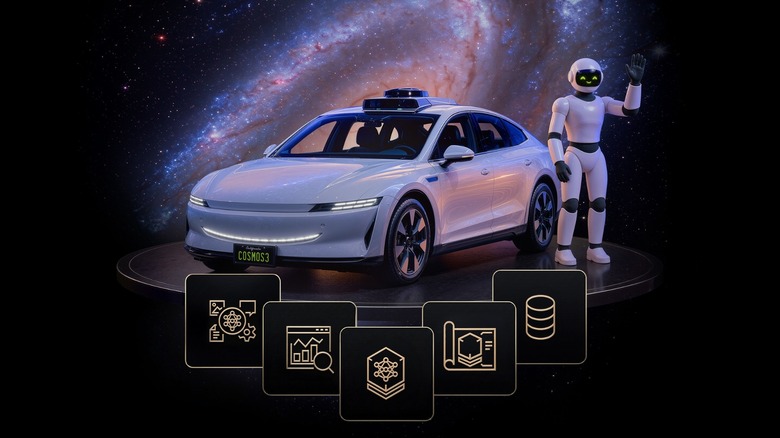
As you have no doubt gathered, AI was a recurring topic among Nvidia's announcements during Computex 2026, keeping with the expo's theme for the year, "AI Together." While Nvidia's AlpaGym is designed to train the AI models of robotaxis, it isn't the company's only AI meant to help autonomous devices understand the physical world.
Announced during Computex 2026, Nvidia Cosmos 3 is the "world's first fully open omnimodel" that natively translates text, pictures, videos, and sounds into actions in the physical world. The modality (the type of data) doesn't matter, as Cosmos 3 can "generate and reason across them."
So what's so impressive about Cosmos 3? According to Nvidia, the model is designed to tackle what the company calls a "fundamental challenge" of training physical AIs: helping various platforms "generalize in the real world with limited training data and fragmented simulation stacks." The model pairs reasoning with generation transformers to help platforms understand how objects interact, move, and relate to one another within space-time. And that's before it starts using physics to predict trajectories. Several companies have already signed up to train robots, autonomous vehicles, and everything in between on Cosmos 3, and also use it to develop even more advanced physical AI models.