

Motorola Razr+ (2026) Review: A Slightly Awkward Middle Child
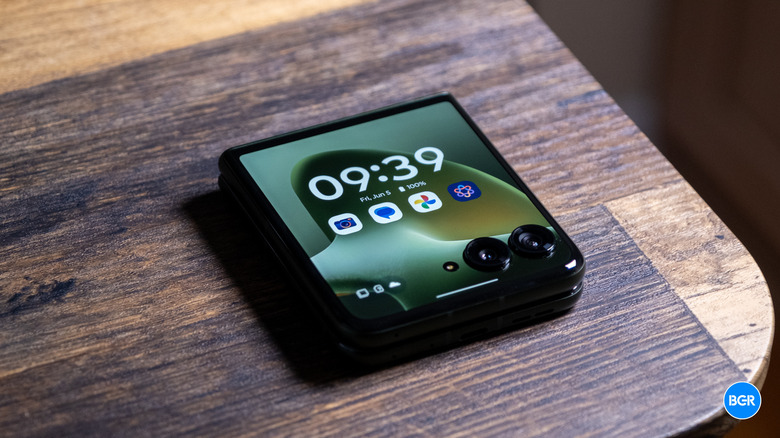
Motorola's flip-style foldables can't help but feel slightly forgotten this year, and if there's one model that's already prone to being ignored, it's the Razr+ — it's more expensive than the base model, but not as powerful as the Razr Ultra. This year is no different, and to make matters worse, the 2026 iteration of the Razr+ has a $100 price bump over last year's model.
Its price point, however, puts the Razr+ in direct competition with the Samsung Galaxy Z Flip 7, which retails at the same price. It offers a number of upgrades over the base model, including a higher-end chip and more durable build. But are there enough upgrades to justify the price increase? Or is the 2026 Motorola Razr+ truly the device to be forgotten?
Design
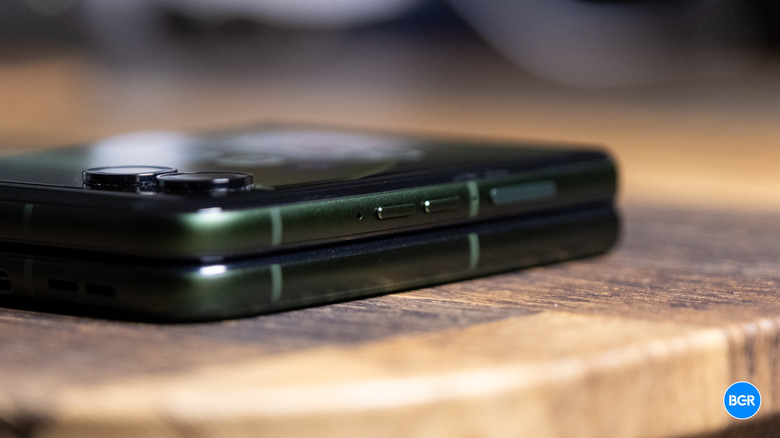
Not much has changed about the design of the Motorola Razr+ compared to last year, but that's not necessarily a huge issue. The phone measures 88.1 x 74 x 15.3mm folded and 171.4 x 74.0 x 7.1mm unfolded, which makes it slightly thinner than the base Razr. It's definitely not a dramatic difference, though -– most users won't notice it at all.
Like last year, the phone has an aluminum frame, but it couples that with a titanium hinge to help with durability — a necessity for a phone that will be folded and unfolded thousands of times. I never found that the phone felt low-quality or weak, and I was never worried about the hinge breaking, but to be fair, that's the case on plenty of other foldables too.
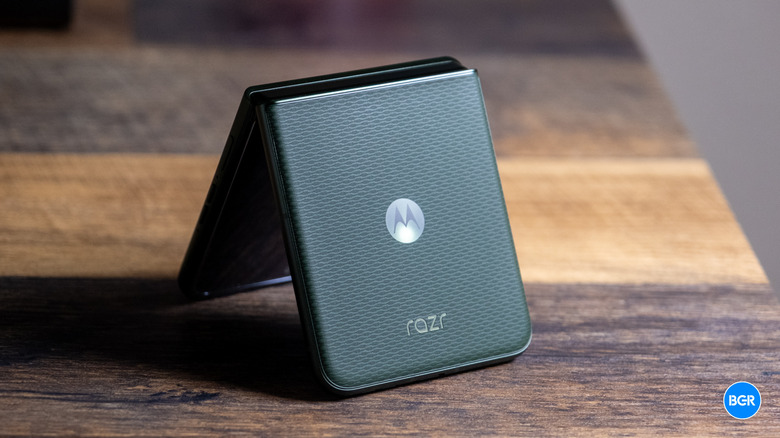
The front display is protected by Gorilla Glass Victus, and the back is vegan leather, which Motorola has been using for a few generations now. It continues to be one of the better-feeling rear panels on any phone. It picks up less grime than glass, feels warmer to the touch, and gives Motorola's foldable devices a more unique look.
Durability is rated IP48 — the same as last year's model and the same as the Galaxy Z Flip 7. That's dust-resistant against larger particles and submersible in fresh water, but it's not the full IP68 you'd get on a non-folding flagship. Foldables are getting closer to parity here, but they're not there yet.
Like other foldable devices, there's a crease on the inner screen, but you'll get used to it. It's certainly not hard to notice, and it's deeper than some foldable devices, but I don't really mind it. It's simply a limitation of a phone with this form factor right now.
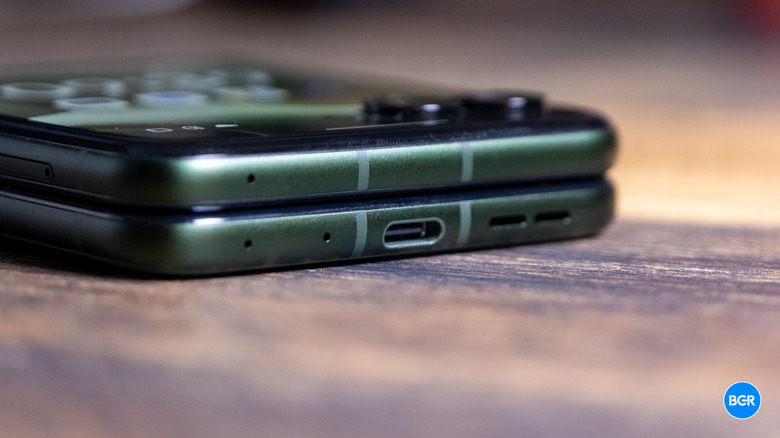
Everything else about the design of the phone is similar to previous models. It has a USB-C port on the bottom, while the power button and volume rocker sit on the right side. The power button houses a fingerprint sensor, which was fast and accurate in my testing.
Display
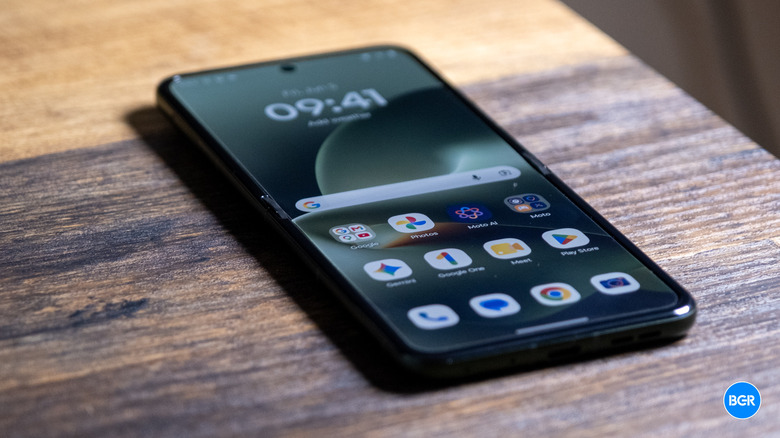
The Motorola Razr+ has a dual display setup. On the inside, there's a 6.9-inch LTPO AMOLED at 1084 x 2640 (414 PPI), with adaptive refresh from 1Hz all the way up to 165Hz. That's a meaningful step up from the base Razr's 120Hz panel, and it matches the more expensive Razr Ultra. Scrolling is smooth, animations feel fluid, and the LTPO panel means it can drop the refresh rate down for static content to save battery. That said, I can't really notice the difference between a 120Hz panel and a 165Hz panel. Perhaps you can, but even then, it will only range up to 165Hz in certain apps anyway.
On the outside of the phone is a 4.0-inch LTPS AMOLED screen with a 1272 x 1080 resolution (417 PPI) running at 30-165Hz. Display quality is good, with one caveat — the inner display's brightness was actually higher than Motorola's rated 3,000 nits. I measured it at up to 3,200 nits in certain scenarios. The catch is that you'll only get that in certain situations and when auto brightness is turned off. Brightness tops out at around 500 nits for SDR content, which means it might be difficult to see content in direct sunlight, especially on that highly reflective plastic screen covering.
Other aspects of the inner display were impressive, though. Colors were relatively accurate, and most people won't have any issues with the screen experience as a whole. The outer screen is solid, too, and it's larger than the outer screen on the Motorola Razr (2026), thanks to the fact that it doesn't have the forehead that's present on the base model.
Performance
The Razr+ (2026) is powered by the Qualcomm Snapdragon 8s Gen 3, which is an upgrade over the base 2026 Razr but the same chip as the one found in the 2025 Razr+ — and the 2024 model from two years ago. It may perform better than the base Razr, but typically, a chip bump is the bare minimum when it comes to year-over-year upgrades.
In day-to-day use, it shouldn't be an issue. The 8s Gen 3 paired with 12GB of RAM handles everything the average user will throw at it — apps open quickly, multitasking is fine, and software feels properly responsive. Internal storage comes in at 256GB, which is the only configuration on offer. That said, if you do use the phone for more demanding tasks, you might notice a difference in performance when compared to phones with more modern chips.
In benchmarks, the Razr+ is clearly ahead of the base Motorola Razr, which is to be expected. That said, it's still well and truly short of similarly priced slab phones that score well ahead of the device. It certainly doesn't perform poorly, though. The Snapdragon 8s Gen 3 is head and shoulders above the chip that you'll get in the base model — and for most, using the device for things like web browsing, social media, and light gaming, it's more than capable enough. Just don't expect it to perform as impressively as more expensive flip devices — and if you try and use it for more demanding tasks, expect it to heat up a little.
Battery and charging
The battery in the Motorola Razr+ is upgraded from 4,000mAh on the 2025 model to 4,500mAh on the 2026 model. That makes a difference. The device lasted longer in video playback tests than the base 2026 Razr. Most will easily get through a full day of moderate usage without needing to top up. Heavy usage, however, makes for the need to charge by the end of the day. This probably isn't a multi-day device. It's also behind the Razr Ultra when it comes to battery performance.
The phone has faster charging than the base Razr too, though again, unchanged compared to the 2025 Razr+. Wired charging is 45W and wireless is 15W. 45W is the Razr+'s biggest charging advantage over the Z Flip 7, which tops out at 25W wired.
After around 30 minutes of charging, the battery was sitting at 70%. The phone was fully charged in around 50 minutes, which isn't bad at all. It's also a fair bit better than the more expensive Galaxy Z Flip 7 — though that's not necessarily a very high bar.
Camera
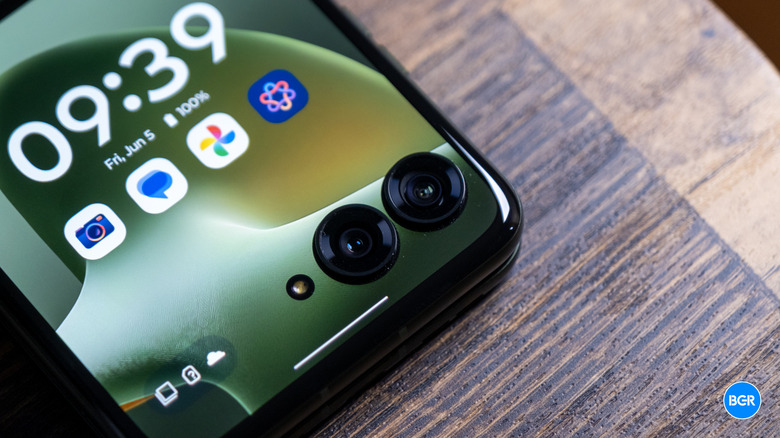
The camera setup might be where Motorola has made the most consequential change. The Razr+ (2026) drops the 2x telephoto camera from last year's model and replaces it with an ultra-wide. You now get a 50-megapixel main camera with a 1/1.95" sensor at f/1.8, and a 50-megapixel ultrawide at f/2.0 on a 1/2.76" sensor. The selfie camera is a 32-megapixel f/2.4 unit, and max digital zoom is 10x.
That's a real trade-off. If you used the telephoto regularly for portraits or tighter framing on subjects across a room, you've going to feel its absence. There's no optical reach anymore, just digital crop from the main sensor, which is fine in good light and not great anywhere else.
Thankfully, for the most part, the camera performs pretty well. Colors are accurate enough, and image sharpness is pretty good, especially in good lighting. In low lighting, of course, you do lose some of that detail. But unless you zoom in a fair bit, images will still be mostly usable.
The ultra-wide camera on the device isn't necessarily amazing, but it's fine. It certainly doesn't perform as well as the main camera on the phone, and the ultra-wide camera on the Galaxy Z Flip 7 is better. But for most usage, it does the job.
I will say that I'd love to see foldable devices in this price range start to get telephoto cameras at some point in the near future. This is a high price to pay for a phone that doesn't have a telephoto camera. I completely understand the fact that there are issues with the space available on a flip-style phone, but it's not my job to design phones. The fact is that you can get a far more versatile, far higher-quality camera from a phone that can't fold. At this price, you shouldn't have to make those kinds of sacrifices.
Software
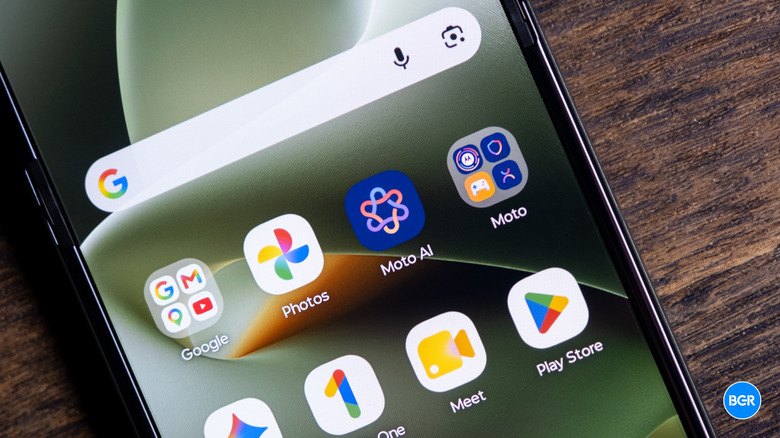
The Razr+ runs Motorola's relatively light My UX skin on top of Android, and it remains one of the more pleasant Android experiences in terms of restraint. Everything is more or less where you would expect it to be, and it looks fairly clean.
As you'd expect in 2026, there's a heavy emphasis on AI. Moto AI is Motorola's hub for its own AI features, but it sits alongside Gemini, which most people will find more useful. The AI tools are fine, but if you're anything like me, you won't reach for them very often. There's some bloatware too — Perplexity, WhatsApp, Adobe Scan, and a handful of Motorola's own apps come pre-installed — but it's far from the worst I've seen. The non-Motorola apps can be uninstalled if you don't want them, but the Motorola ones are mostly there to stay.
Conclusions
The Motorola Razr+ (2026) sits in kind of an awkward position. It's not quite the flip phone for those who simply want their device to fold at the lowest price possible. That title goes to the base Motorola Razr. And it's not the device for those who want the best flip phone they can buy. For that, you'll need to step up to the Razr Ultra tier. I'd argue that the middle ground makes more sense for slab phones than for foldables.
That certainly doesn't make the Razr Plus a bad phone, though. On the contrary, it has some things going for it, like its decent performance and solid display. It's not really the best at anything it does, but it's good enough at everything it does.
The competition
The obvious rival is Samsung's Galaxy Z Flip 7 at the same $1,099.99 price point. The Razr+ counters with a bigger, higher-resolution cover screen, faster wired charging, and a titanium build, while the Z Flip 7 features a stronger chip, faster USB-C 3.2 data transfer, a larger main camera sensor, and a more polished software experience.
As with the base Razr, though, the fact remains that if you're not dead set on a flip phone, the same money — or less — buys you a far more capable traditional phone like a OnePlus 15 or a Galaxy S26. The form factor is the reason to buy this, not the spec sheet.
Should I buy the Motorola Razr+ (2026)?
Yes, if you want a solid flip phone at around this price point.