

5 Reasons Why People Ditch Their Mini LED Monitors
We may receive a commission on purchases made from links.
The gaming PC market is undergoing massive change right now. But while everyone is focused on rising prices for RAM and storage, there's another shift that's resulting in manufacturers winding down production on certain gaming monitors. Big brands are starting to move away from backlit panel technology, which used to be great for high-dynamic-range content and still offers the best peak brightness and text clarity, to technology that produces light at the pixel level. OLED panels are becoming the new normal in gaming monitors, especially considering that manufacturers can see higher profit margins in OLED monitor production versus bigger OLED TVs.
Many gamers are taking to online forums to highlight that they're discarding their LED, mini LED, and older IPS screens for this technology, which is making the market evolve rapidly. It's mostly down to OLED panels providing better color representation, near-infinite contrast, and fantastic responsiveness. While OLED has its pros and cons, like the risk of burn-in, no other screen technology can compete with it in these areas. And with big brands increasingly adopting the technology, it's only a matter of time before we see OLED monitors creep into mid-range and some budget monitors. But what are the main sticking points that are putting gamers off mini LED gaming monitors? Here are five main reasons for readers to consider before buying one.
Blooming

Arguably the biggest problem that drives users to upgrade their mini LED displays is artifacting or blooming. Because this technology relies on dividing a backlight into localized clusters of tiny LEDs, it can't control lighting on an individual pixel level. When a bright icon, such as a mouse cursor or a line of white text, moves across a dark background, the light bleeds into the surrounding zones. This manifests as mouse cursors having distracting glows when moving across darker backgrounds. Also known as haloing, this is a serious problem for people who work and play close to their monitors. While the strong brightness on living room TVs works well to hide this flaw, the curtain of illusion falls apart at closer desk distances.
And though high-zone premium mini LED models mitigate this substantially, these blooming and halo effects can still reduce immersion during dark scenes in movies and games. Instead of experiencing deep blacks, users can end up looking at a cloudy mess of gray halos around every bright object on the screen. It's a glaring aesthetic compromise that makes mini LED technology poorly suited for dark-room use compared to OLED, prompting users to either look into panel upgrades or make the best of it by researching how to best calibrate their desktop monitors or fix problematic settings for better lighting and color accuracy.
Inconsistent lighting

Creative professionals seem to be slowly abandoning mini LED monitors thanks to limitations in color accuracy. Graphic designers, photographers, and video editors need a dependable display that provides perfectly laid out, uniform color and contrast across the entire panel. When it comes to Mini-LED displays, the dimming algorithms constantly adjust the brightness of individual zones based on what's on the screen. When manipulating small design elements or scrolling through a timeline, the constant dimming and brightening make it difficult to judge contrast accurately.
While they tend to be brighter and have no risk of burn-in that plagues OLEDs, the lack of stability found on mini LED panels can force creators into a frustrating workflow bottleneck. A color value might look correct in one section of the screen, but appear altered if a bright menu panel opens up and causes a local dimming zone adjustment, which can cause issues with professional grading. By contrast, OLED panels usually offer more accurate color and lighting, alongside the best contrast ratio and those inky blacks.
Slower pixel response times

For gaming and general motion clarity, mini LED panels aren't considered as good at keeping up with the demands of modern software as OLED panels, including needing higher and clearer refresh rates. The technology still relies on a traditional liquid crystal display layer to block or reveal light from the back-end LEDs. This physical setup introduces a small delay as the liquid crystal shifts positions, resulting in visible ghosting and motion blur during fast gaming moments. When playing hectic competitive games or scrolling through text-heavy websites, the trailing artifacts degrade the overall sharpness of the image. Even PlayStation 5 demands gaming monitors with refresh rates over 60Hz.
When consumers look at OLED screens providing near-instantaneous pixel responses, it's easy to see why mini LED monitors are often sold by budget brands and aimed at consumers who don't need or want OLED panels. While it may not be an issue for budget buyers, the backlight-reliant monitor means discerning users often have to put up with faint streaks behind moving objects, while OLED monitors eliminate trailing by providing light from the pixel itself. It's a noticeable performance gap that gives OLED panels better clarity during fast-paced scenes and gameplay.
The physical limitations of the zone count problem

The fundamental engineering problem with mini LED desktop monitors is a lack of precision control over light. While there's still room for innovation, current desktop monitors with mini LED panels feature far fewer zones than necessary to deliver a flawless high-dynamic-range experience. Most mini LED panels on the market only offer a few hundred to a thousand physical local dimming zones, at the very most. It sounds like a lot, but it's actually a significant shortfall that leaves these panels unequipped to match the performance of self-emitting OLED panels.
In fact, to truly match the per-pixel lighting control of a self-emitting OLED display at a standard 4K resolution, a display would theoretically need a massive arrangement of tens of thousands of controlled dimming zones. It is most likely economically and physically challenging to produce a panel with this level of complexity for any manufacturer. It's similar to why there are massive price differences between 4K and 1440p displays.
The test screenshot above is designed to show that to light up a small light-colored artifact on a mini-LED screen, a slightly larger dimming zone needs to be illuminated. This results in haloing and glowing around said artifacts, thanks to the visible mismatch between the resolution of the image and the resolution of the backlight.
The market for premium mini LED monitors is shrinking
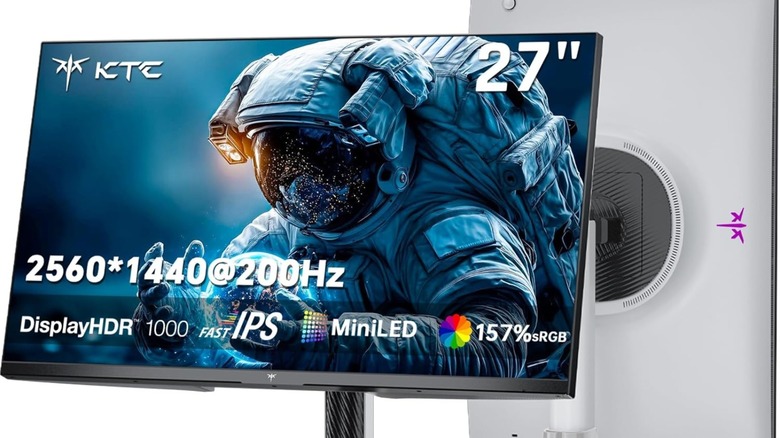
With buyers abandoning mini-LED technology, premium mini-LED monitor offerings are looking thin. Major corporations are moving away from this kind of panel development and manufacturing to focus on self-emissive panels such as OLED, which means high-end mini LED options are disappearing from retail shelves. This has resulted in a frustrating bottleneck for many consumers, with premium brands stopping production and only being able to find budget and low-end mini LED monitors, which just don't do the job.
That means there's next to no new choices on the premium end of monitors that receive top-tier mini-LED displays, active firmware updates, optimized processing algorithms, and long-term customer support. As a result, budget brands and lower-end panels are picking up mini-LED technology as a budget-friendly alternative. Rather than trying to push the technology for dominance at the top of a premium market, it's now more of an entry-level gateway for basic HDR content.
It's important to note that anyone building a budget setup can still find fantastic value in a mini-LED-powered monitor, such as standard 1440p panels featuring high refresh rates for less than $300. However, anyone looking to "future-proof" with a high-end desktop gaming or design rig will probably need to look for an OLED. Without active development from top-tier monitor brands, many current gamers and creative professionals are considering switching teams. Others, who enjoy the superior brightness, text quality, and lack of burn-in that comes with mini LED, are still happy with their choices.