

The Pros And Cons Of Using OLED Monitors For Gaming

We may receive a commission on purchases made from links.
One of the most common OLED TV myths is that this type of display is not good for gaming. This misconception hardly applies to desktop monitors designed specifically for high-end PCs, though. In fact, OLED technology in general has come a long way. While there are certainly pros and cons, using an OLED monitor for gaming is a perfectly viable decision.
But what if you want to make extra sure that you're getting the best display for your gaming setup? Let's go over the standout benefits and potential downsides that gamers will experience with OLED monitors. Many of the arguments for either side overlap with the pros and cons of buying a used OLED TV, but there are unique considerations that gamers should keep in mind when shopping for monitors. These are the factors that will make or break the immersiveness and practicality of the next panel you purchase.
Pro: OLED monitors provide the best visuals for gaming
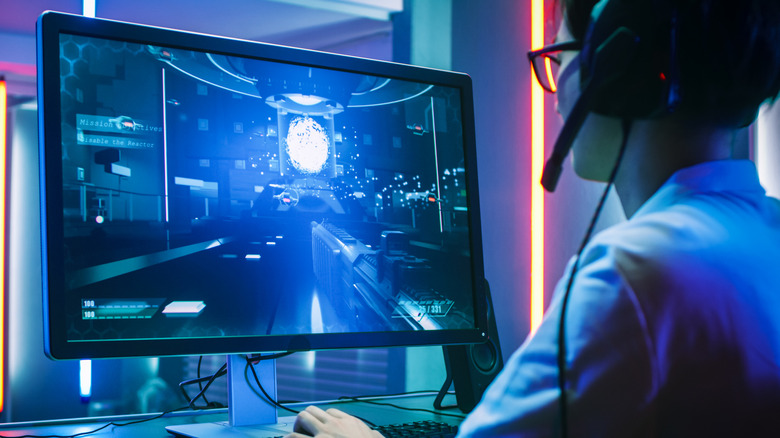
The diodes in an OLED screen emit their own light when powered by an electric current, so there's no need for a backlight in the panel. The result is a high-contrast image with deeper blacks and a lower likelihood of the "color bleeding" that may occur in other monitors. Also known as "light bleeding," this phenomenon causes on-screen colors to blur together because of backlight seeping in. By comparison, OLED monitors reliably produce a sharper image.
If you're playing an open-world exploration game, you want to enjoy the full majesty of each artfully crafted vista you discover throughout the adventure. If you're immersing yourself in a heart-racing horror game, nothing will pull you deeper into the experience than a monitor that conveys true darkness. OLED monitors can deliver on those kinds of experiences, and they also tend to have excellent viewing angles that impart the full quality of the image even when you're not staring at the screen straight on.
A sharp image is more than just a feast for the eyes. Visual clarity is also important for facilitating strong gaming performance. Whether searching for hidden items or staring down the sights of a virtual weapon, having a flawless image on screen is an advantage. Of course, this quality comes at a price, which is why OLED TVs are so expensive.
Con: Other screens achieve higher peak luminance

Due to the lack of a backlight, OLED screens have historically been less bright. This holds true to this day; last year's Samsung S95F OLED TV clocks in at under 400 nits of brightness (via TechRadar), while high-end mini-LED TVs were reaching as high as 600 nits last year. Additionally, the light-emitting elements of an OLED panel are made of organic components that degrade over time, so they will continue to dim as the years go by. High brightness is crucial for visibility in brightly lit spaces and optimizing video game image quality, which is one reason why some people justifiably believe that OLED TVs are not always worth the money.
Admittedly, if you've ever used an OLED monitor, you might not have noticed that it's less bright than alternatives. This is because our eyes perceive OLED screens as brighter due to higher contrast, even if their luminance is technically lower. This means that the perceived clarity of an OLED monitor may still be high, but its lower luminance may make it more susceptible to glare in bright environments. Opting for a monitor with a matte finish rather than a glossy one could alleviate the problem to some extent.
Pro: OLED monitors have superior response time

Response time is the time it takes for a monitor's pixels to change color. A faster response time means that the screen is displaying an up-to-the-moment image of the action, whereas a slow response time means there may be a minuscule mismatch between what's happening in the game and what's being shown on-screen.
OLED panels can exhibit a response time of less than 0.1 milliseconds, which even puts them ahead of twisted nematic LCD monitors. This is because OLED pixels are self-luminous and don't rely on other components, such as backlights and liquid crystals, to generate light. The entire process of generating photon emission for an OLED pixel is typically 1,000 times faster than the response time of a typical LCD pixel.
This translates into a direct advantage and, overall, a more enjoyable experience for gamers. In a competitive setting, the combatant with a faster screen will have greater situational awareness. Though it may only be a fraction of a second, that brief moment can sometimes be the deciding factor.
Con: Long gaming sessions may cause screen burn-in

Screen burn-in has always been the biggest chip on every OLED monitor's shoulder. Nowadays, major monitor brands offer OLED burn-in protection. Even so, nothing can fully change the fact that OLED pixels are organic compounds that degrade more the harder they work. If there is a persistent image on the screen, the pixel remains consistently lit in that color until it "burns in," and a ghostly silhouette of the image is retained on the screen.
Burn-in can be particularly troublesome for dedicated gamers. Video games tend to have a lot of static elements that remain on-screen for the entirety of a gaming session: a minimap in the top corner, a heads-up display along the bottom edge, or a player character permanently fixed in the middle of the screen, to name a few. If you remember the key ways to avoid OLED screen burn-in, it becomes less of a problem. Still, it's worth keeping in mind if you're shopping for a monitor you plan to use for a long time.