

Why Some TV Shows And Movies Have Black Bars At The Top And Bottom
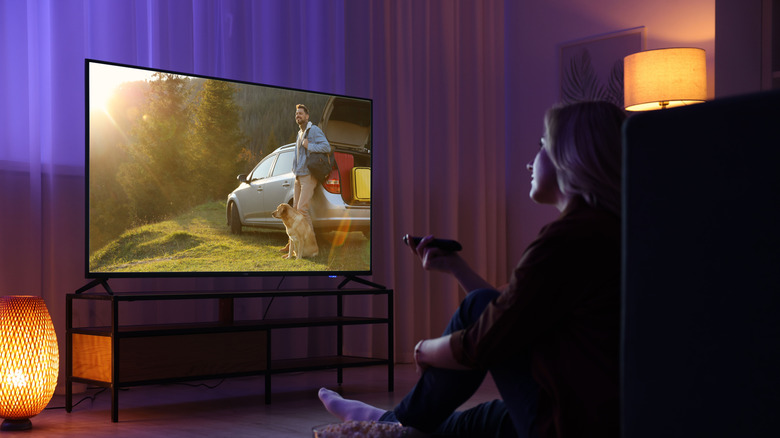
Have you ever wondered why there are black bars at the top and bottom of the screen when watching certain movies and TV shows? This doesn't always occur, but when it does, it's because the content creator would have otherwise needed to crop the film or show's original aspect ratio to fit a consumer display. For those unaware, an aspect ratio tells you how wide a display is in relation to its height, and most modern TVs have a 16:9 aspect ratio (pronounced "sixteen to nine"), which is also referred to as 1.78:1.
The issue is that mega-blockbusters and large-scale, cinematic epics (think anything that Christopher Nolan has directed in the last 20 years) are often filmed at a wider aspect ratio. Ultra-widescreen formats, such as 2.35:1 or 2.40:1, are far wider than the average TV. That means an engineer needs to reduce the size of the movie or show, with black bars serving as a way to uphold the overall composition.
But you won't only see black bars when watching flicks like "Inception," which was shot in 2.39:1. Movies and shows filmed at a "boxier" aspect ratio — such as 1.33:1 — will also display black bars on a modern UHD TV, but along the left and right sides of the image. You may also come across older home video releases (particularly during the early years of DVDs and DVD players) that were mastered for 4:3 consumer displays. Play one of these movies on a modern, 16:9 flatscreen TV, and the black bars may even form a thick frame all the way around the image.
Your TV may have a zoom feature, but be careful how you use it
If you don't like the black-barred appearance of "letter boxed" (bars on the top) or "pillar boxed" (bars on the sides) movies and shows, many TVs have a zoom function that will stretch media to fill the whole screen. Unfortunately, this comes at the expense of picture detail and can result in distortion and graininess. Depending on how effective your TV is at upscaling content, you could end up seeing more macro blocking and other image artifacts, too. You'll also want to make sure you're not zooming in so much that you're cutting off parts of the picture.
Here's something else worth mentioning: Not all movies and shows remain at the same aspect ratio throughout their runtime. At times, a creator may elect to shift to a more vertical or horizontal orientation, based on how much immersion they want the audience to experience at that point in the film or episode. If you're using your TV's zoom capabilities, you may be meddling with the emotional impact of the production (at least that's what someone like Christopher Nolan would argue).
At the end of the day, black bars aren't a hindrance; they're designed to give you all the visual information you're supposed to see, while curtaining any leftover space. It's not a playback error or TV glitch — it's the way what you're watching was meant to be watched.