

Tesla's New Electric Semi Truck Tech Could Save Drivers On Icy Roads
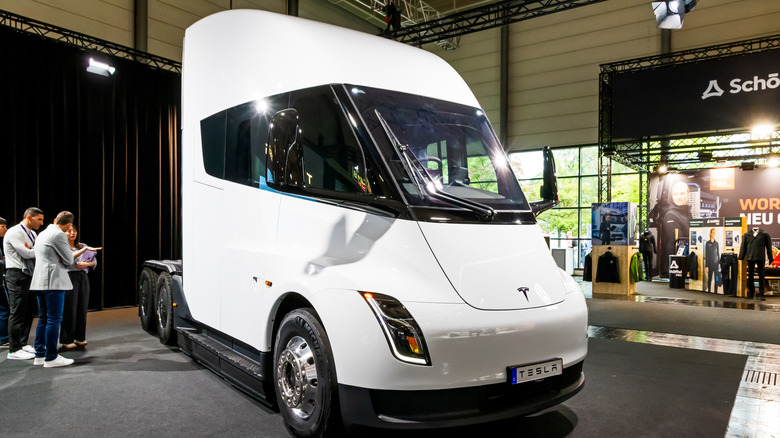
Winter driving is extremely dangerous. You need to make sure you don't get stuck in the snow, and even when the roads are seemingly clear, an errant patch of ice can make you spin out of control. While plenty of manufacturers sell EVs ideal for driving in winter and snowy conditions, Tesla wants to add its semi truck to that list.
Recently, the head of Tesla's semi program, Dan Priestley, posted a video on his X/Twitter account demonstrating Tesla's Vehicle Dynamics Control (VDC) functionality. In the video, a Tesla Semi drives over a huge patch of icy road while lugging a trailer. The trailer swerves dangerously to and fro, but the cab remains mostly stable. Oh, and Priestley clarifies that during the test, the trailer was weighed down with concrete blocks and steel bars, all to provide a low center of gravity.
According to Priestley, the VDC's secret sauce is its "high resolution sensing and precise multi-motor controls," which were developed in-house. This system constantly monitors factors such as wheel speed and angle, and individually applies different torque and brake settings to each wheel as needed. Priestley claims that the VDC delivers improved stability during winter driving conditions.
Don't get your hopes up yet
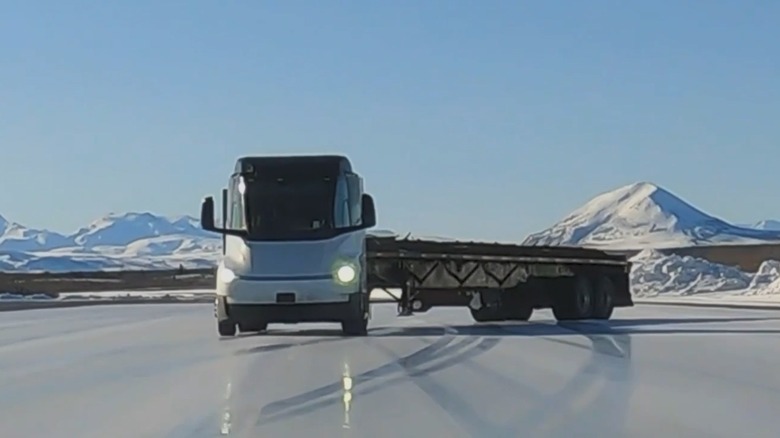
On the surface, the VDC sounds promising. While the truck trailer is still subject to drifting or potentially jackknifing (when the trailer swings around toward the cab like a closing pocket knife), the cab remains steady. This feature seemingly improves the driver's chances of regaining control and avoiding a potentially fatal accident. We'd be excited if not for Tesla's middling track record.
So far, the Tesla Semi has underperformed and underdelivered. For starters, Tesla promised an impressive range of 500 miles for the Semi, but real-world data shows that the vehicle caps out at 377 miles. Plus, early models had to be recalled due to faulty parking brake modules, and some of the first Semis delivered to PepsiCo became stranded due to software glitches.
If Tesla only had issues with its Semi, we could forgive the aforementioned problems, but every new release is plagued with complications of one variety or another. Take Tesla's flagship EV, the Cybertruck. The company promised the car can drive up to 366 miles on a full charge, but drivers claim it can't even achieve a range of 300 miles. Moreover, outlets such as Consumer Reports say the Cybertruck isn't that reliable and is subject to problems such as panel gaps and software update woes. And that's when drivers use new Teslas; Consumer Reports ranked Tesla as the least reliable used car brand. We will gladly eat our words if Tesla delivers on the VDC, but as things stand, we will not be surprised if the function either fails to stabilize trucks or makes them jackknife more than usual on icy roads.