

How Does Sennheiser's 'Dual Tuning' Feature Work?

A lot is said about the difference between in-ear monitors and earbuds and which one has better quality. When it comes to in-ear monitors (IEMs), you want to invest in a product you can rely on. Not only should the monitors fit well and sound good, but they should also be easy to control. One brand that checks all those boxes is Sennheiser, particularly with audio tech like the IE 200. This is an audiophile-grade IEM device that delivers exceptional sound quality and a fairly wide soundstage. They're also equipped with a feature called "dual tuning" that lands them among the gadgets that should be on every audiophile's wishlist.
Dual tuning is exclusive to the Sennheiser IE 200 and refers to the IEM's ear tip positioning. These in-ears can be mounted in one of two orientations for an increase or decrease in the bass. When the tip is mounted farther from the bud body, you're using the "bass light" configuration; when it's mounted closer to the body, it's called "more bass." If you're a fan of genres like rock, rap, hip-hop, and EDM, you'll probably want to pick the bass-boosted position.
Choosing the other position doesn't negate bass entirely, but it definitely places more emphasis on treble-range frequencies. That said, there's an interesting hack you can use with the IE 200, which involves covering the mounting nozzle with a piece of tape. Doing so helps to preserve bass consistency, regardless of which mounting position you choose.
Dual tuning is exclusive to the Sennheiser IE 200 in-ear monitors
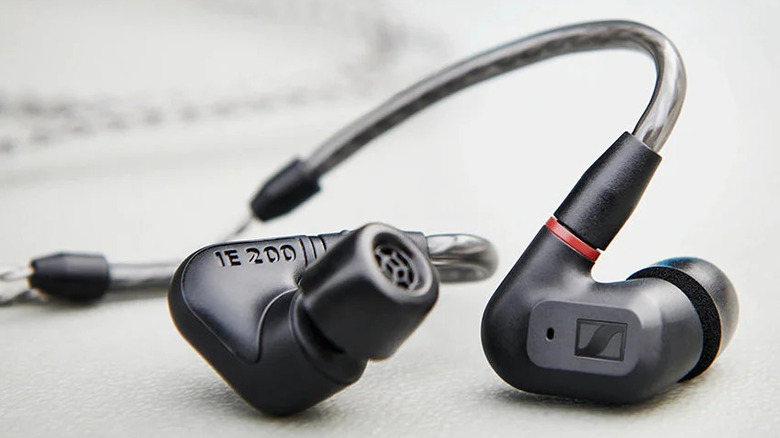
Sennheiser provides multiple sets of silicone and memory foam eartips with the IE 200. Take some time to find the ones that work best for your ears, and then see which of the two tuning positions sounds best. It might take some trial and error, but you're better off honing in on the best sound for your listening preferences sooner rather than later. It's also worth mentioning that the dual tuning feature is exclusive to the IE 200; neither the IE 600 nor the flagship IE 900 supports the function.
For those who didn't know, Sennheiser actually sold off the bulk of its consumer-grade audio business to Sonova in March 2022. This means that, other than a few flagship products, any product Sennheiser makes — at least as far as headphones and earbuds are concerned — is manufactured by Sonova. Interestingly, a recent post in r/headphones suggests that Sonova may be looking to drop Sennheiser by 2030/2031. Only time will tell.
It's hard to determine how much influence one company had over the other, but here's hoping that Sennheiser is able to hang onto its dual-tuning tech for future releases. It's certainly a feature worth enhancing and expanding upon, and we'd be thrilled to see what Sennheiser comes up with next.