

4 Brands Making RGB LED TVs In 2026
We may receive a commission on purchases made from links.
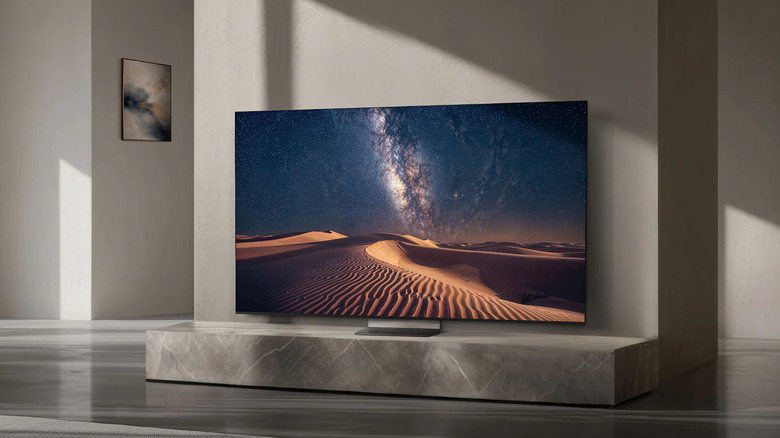
TV technology is always evolving, and often at multiple paces. New picture and panel features may arrive incrementally from some brands, while other manufacturers approach the cutting edge at a more rapid-fire speed. As for the present day, it's looking like one of those years where enhancements and ingenuity reign supreme, because there's a new TV trend in town that industry experts and users alike are going nuts over: RGB LED TVs.
Traditional LED TVs are lit by a white or blue LED backlight that passes through color filters to generate each pixel's color. The difference with RGB LED is that the white and blue diodes are replaced with an array of red, green, and blue LEDs. The endgame? Delivering some of the brightest and most colorful picture quality the TV-watching world has ever seen from an LED-LCD.
This new generation of RGB LED TVs has only been on the market since 2025, and the tech has already been adopted by a handful of reputable TV manufacturers. We're going to discuss each brand while also touching on the pros and cons of each manufacturer's RGB LED lineup. So without further delay, let's kick things off with one of the most popular TV titans: Samsung.
Samsung
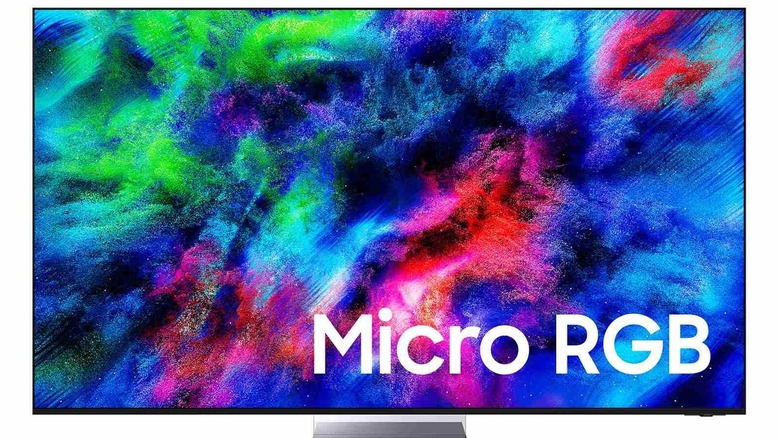
We're not surprised that Samsung is an active pioneer in the RGB LED space. The much-loved TV brand is often at the forefront of visual innovation and already makes some of the brightest, most colorful TVs on the market. But that didn't stop the Big S from producing one of its brightest TVs yet: the Samsung R95H. Unfortunately, "RGB LED" isn't a shared name amongst manufacturers, and Samsung decided to call it "Micro RGB" instead. Just know that it's an RGB LED TV at heart.
Samsung is also supposed to release a step-down version of the R95H, the R90H. We're not sure when exactly it'll hit shelves, but curiously, the model that's one rung below the R90H — the R85H — is already available. As for the flagship R95H, lab testing has revealed that Samsung's latest and greatest LED tech is pretty impressive; the R95H gets ridiculously bright and delivers exceptional color volume. The TV also has a local dimming system that allows for strong black levels and minimal haloing around bright objects during dark scenes.
The R95H is available in 65, 75, and 85-inch sizes, and can be purchased at Best Buy or directly through Samsung. Are there any detractors, you may be wondering? Yes, indeed. The R95H has an extremely slow response time. Even though it has a native 165 Hz refresh rate, fast motion tends to look blurry, which does not bode well for gamers and sports fans.
TCL
When shopping for a budget-friendly TV, one of the first brands we're quick to recommend is TCL. The Chinese manufacturer produces some of the most popular TVs on the market, while prioritizing reasonable prices. We were actually surprised to learn that the company was going to focus on improving quantum dots, while its LED competition was focused on RGB LED. These enhanced dots (which TCL is calling "super quantum dots") definitely deliver vibrant colors, as evidenced by industry pros and users alike, particularly for the flagship TCL X11L.
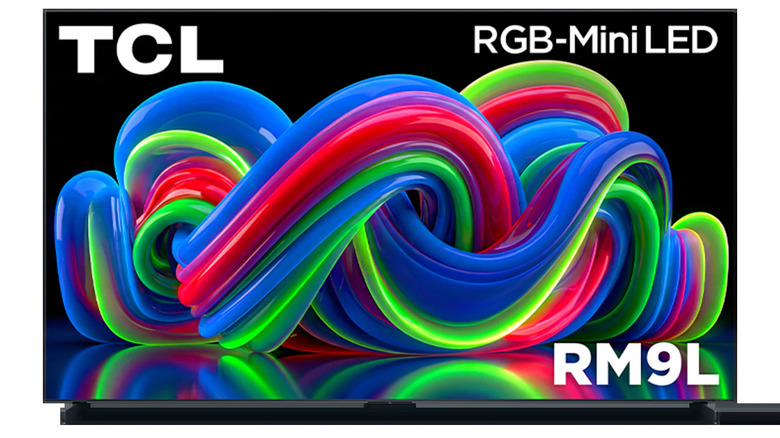
That said, TCL didn't completely miss the boat on RGB LED tech; it just didn't go all-in on it the way that other manufacturers did. TCL's take on RGB is called the TCL RM9L, a massive LED that's available in 85, 98, and 115-inch sizes. Right now, it seems like Best Buy is the most reputable place to grab one of these monster sets. It also hasn't been reviewed by many TV experts, and TCL made some bold claims about its RGB tech, mainly that it's able to hit 9,000 nits and delivers full coverage of the BT.2020 color space.
As one may have guessed, pricing for the TCL RM9L isn't exactly affordable. The 85-inch goes for $6,000, the 98-inch is $10,000, and the 115-inch screen costs a whopping $25,000. It is worth mentioning that Wired was able to take a look at this set, and the reviewer was floored by its "outstanding picture quality," but felt that the TV's skin tones weren't all that impressive.
Hisense
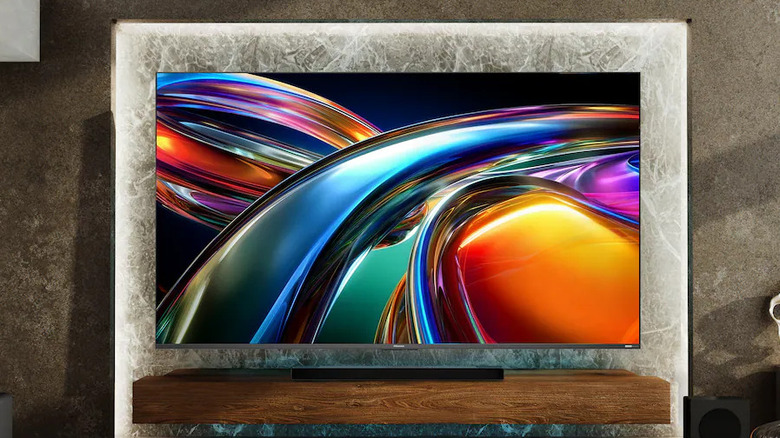
We would argue that Hisense is the most gung-ho over RGB LED, even going as far as to showcase a majority of the new TV lineup at CES 2026. RGB models include the Hisense UR9SG (available in 65, 75, 85, and 100-inch sizes), the company's flagship LED, and the UR8SG, which sits one rung below. There's also the gargantuan 116UXS, which also adds cyan LEDs for increased coverage of the BT.2020 color space.
Fancy specs look nice on paper, but how does a Hisense RGB LED fare in the real world? Quite well, as a matter of fact. Experts were able to run the UR9SG through lab testing, and the results were astonishing: vibrant, rich colors, excellent overall brightness, and remarkable black levels with next to no haloing. Pricing for the UR9SG isn't half bad either; at the time of writing, the 65-inch was on sale at Best Buy for only $1,700. You'll spend that much (or more) on many traditional LED TVs.
We here at BGR had the honor of reviewing the Hisense UR8SG, and we really enjoyed the experience. The runner-up RGB LED gets very bright and delivers ultra-rich colors and strong black levels, but it doesn't use the same Obsidian panel as the UR9 flagship and has lower peak brightness. But if you're trying to save a few hundred bucks, those sacrifices may be worth it.
Sony
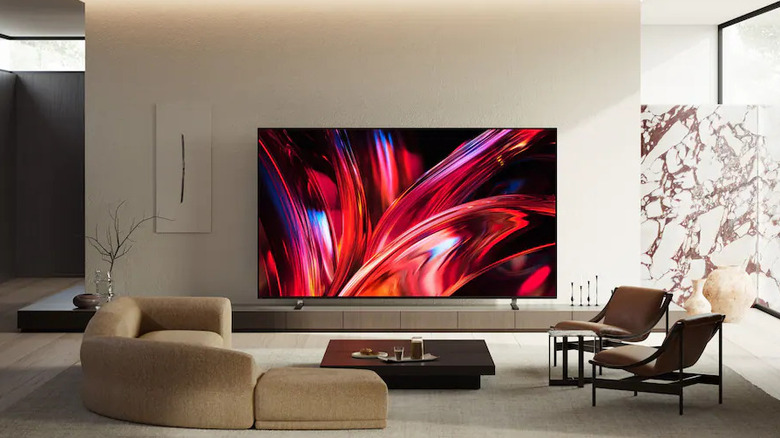
Taking a page out of Samsung's "make up your own name" book, Sony went with "True RGB" instead of just calling it RGB LED. For 2026, Sony introduced the Bravia 9 II, which is available in 65, 75, 85, and 115-inch sizes. The company also makes the Bravia 7 II (50, 55, 65, 75, 85, and 98-inch sizes), a runner-up to Sony's True RGB Bravia 9 flagship. How does Sony's latest and greatest stack up against the RGB competition? Very nicely, and it's markedly better than the Bravia 7 II, which is also no straggler.
The Bravia 9 II delivers amazing brightness levels and color volume, and it does a fantastic job at ridding your screen of reflections thanks to its anti-reflective matte coating. It also has improved local dimming over the Bravia 7 II, so you can expect inky black levels on par with some of the best OLED TVs. We're a little upset at Sony, though; the fact that the manufacturer is still only including two HDMI 2.1 ports on its flagship LED is almost insulting, especially to power users who want to hook up more than one next-gen game console.
The Bravia 9 II isn't without its picture flaws either. Colors and picture details start fading when viewed from the sides, and the TV doesn't have the best motion handling. If you can forgive these drawbacks, the Bravia 9 II may be worth it for you and yours, but if you're planning on connecting more than just a PS5, make sure you've got an HDMI selector that uses 2.1 inputs and outputs.