

How Many Joules Do You Need For Your TV's Surge Protector?
We may receive a commission on purchases made from links.
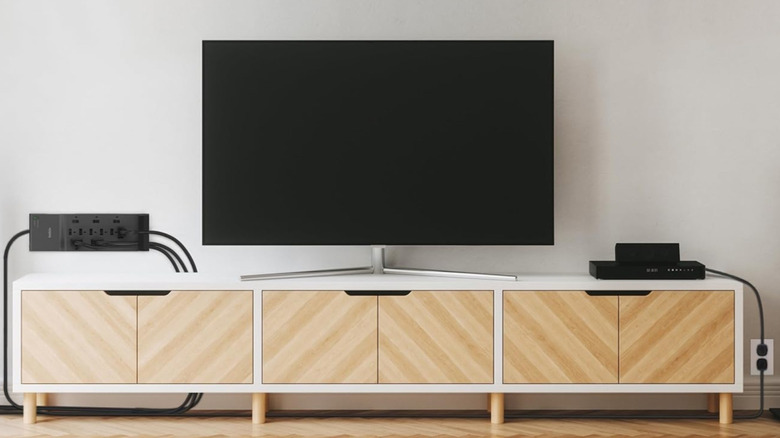
Protecting your treasured home theater equipment won't require a sword and shield, but at a bare minimum, you'll want to have your TV connected to a surge protector. Sold in numerous shapes and sizes, you'll find surge protectors just about everywhere electronics are sold, and they're often the last line of defense between your tech and a power surge. But not all surge protectors are created equal, as is the case with most consumer tech devices.
Generally speaking, if you're planning on adding a surge protector to your home theater setup, you'll want to invest in one that's rated to handle between 1,000 and 2,000 joules. For those unaware, a joule is a measurement of how much energy a surge protector can absorb and eradicate. While you'll find both higher and lower joule ratings across various products, one good mantra to stick by is "you can never have too many." The greater the number, the more capable the protector is of taking on bigger, badder surges.
Your TV likely won't be the only thing you plug into a new surge protector, though. Many living rooms and theater dens involve multiple AV components (like streaming devices and game consoles) that are worth safeguarding, too. This is why it's always a good idea to buy more joules protection than you need; you never know when or if you'll want it down the line.
There's more than just joule ratings to consider when buying a surge protector
There's something else you should be on the lookout for when you're investing in a surge protector: a connected equipment warranty (CEW). Many surge protector brands include a CEW on one or several products in their lineups, and these warranties can really come in handy. As long as your TV or other tech was properly connected to the surge device, the manufacturer should cover a device replacement up to a certain dollar value. Belkin will even collaborate with your homeowner's insurance company if you end up filing a claim.
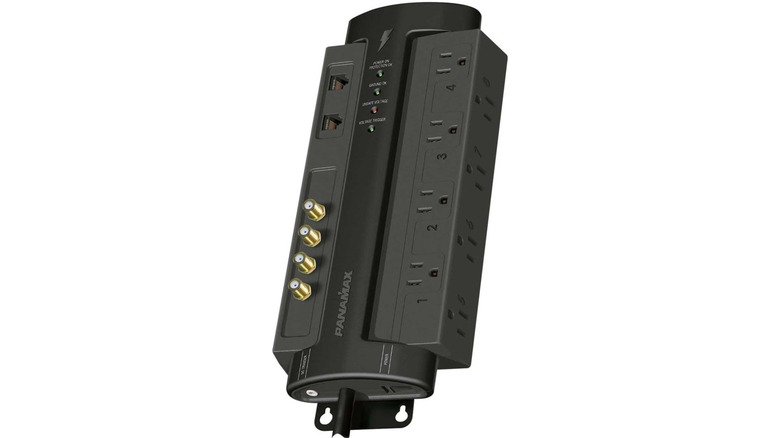
Audiophiles and videophiles should also be searching for surge protectors with features like voltage regulation and signal filtration. The latter lets you run coaxial and network cables into and out of the surge protector before it gets plugged into your cable box, gaming PC, etc. Brands like Panamax are renowned for this, and taking advantage of those connections may help to eliminate visual artifacts, hums, hisses, and other drawbacks related to "contaminated power."
Oh, and let's not forget this important fact: a power strip isn't the same thing as a surge protector. Just because the product has over a dozen AC outlets and looks like a surge protector doesn't automatically make it one; it's up to you to ensure you're investing in actual joules protection, not a glorified outlet extender.