

Hall Effect Sensors Aren't Just For Gaming - Here's How They Work
We may receive a commission on purchases made from links.
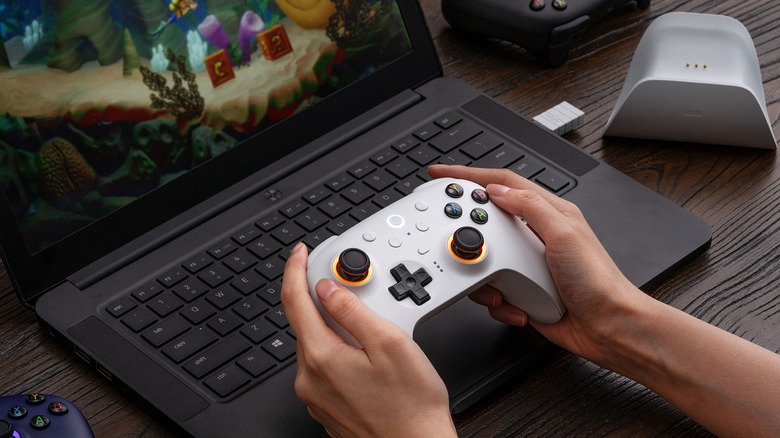
Lately, video game hardware manufacturers have been upgrading controllers with technology such as TMR and Hall effect sensors. You won't find these components in controllers that ship with consoles, though; you need to purchase third-party controllers for your Xbox and PlayStation. However, the items are worth the price you pay because Hall effect sensors provide superior controls and are less prone to stick drift.
The secret sauce behind Hall effect sensors are their reliance on electromagnetism, specifically a principle of magnetic fields that their namesake, Edwin Hall, discovered way back in 1879. Hall noticed that when magnetic fields are applied to electrical currents at right angles, a miniscule (but still measurable) voltage perpendicular to both the field and current would appear on conductive material. This is what is known as the Hall effect.
Unlike standard video game joysticks, which use potentiometers and resistive pads to vary voltages, Hall effect components rely on magnets, a flat conductive material, and a sensor. When a joystick moves, electrons within the conductive material are pushed, which generates voltage (Hall voltage). The stronger the field (how much the joystick is pushed), the stronger the Hall voltage, and the direction of the field (which way the joystick is pushed) determines where the electrons are herded. The information the sensor gathers is then translated into movement within a video game. Since Hall effect sensors rely on magnetic fields instead of physical contact, they exhibit less wear and tear — the primary causes of stick drift.
What other devices use Hall effect sensors

While video game controllers have hogged the majority of the Hall effect's spotlight, that may in part be due to the sheer popularity (and profitability) of the video game industry. Countless other devices benefit from the accurate and contactless design of Hall effect sensors.
If you name a device that uses sensors to monitor internal components and/or translate movement into external outputs, odds are it uses (or can use) Hall effect sensors. For instance, these sensors are often critical in anti-lock braking systems, as they can accurately monitor and gauge wheel rotation speeds without touching any part of the wheel. Hall effect sensors are also common in wind turbines and are employed to monitor rotor speed and blade rotation. If something goes wrong with the mechanics or a if turbine's output drops, Hall effect sensors let you know.
While Hall effect sensors (and their benefits) are mostly associated with the physical movements of components, they only work because these devices are designed to alter the electrical currents the sensors detect. If a device naturally produces electrical currents, such as solar inverters that convert the directional current that solar panels produce to alternating currents, Hall effect sensors can monitor them. Without Hall effect sensors, you might never know your solar panels are losing their power to downright invisible contaminants.
Commercial Hall effect sensors aren't a recent invention
Even though Edwin Hall discovered the underlying principles of the Hall effect in the late 1870s, it took some industries almost a century to harness the technology — and others even longer. As with many things in life, we had to wait for technology to catch up with our dreams. Or at least wait for the necessary technology to become affordable.
The first "commercial" Hall effect sensors weren't available to the general public but were reserved for laboratory settings. These early iterations helped scientists develop arsenide semiconductor compounds in the 1950s, which eventually paved the way for Hall switches (analog switches similar to light switches that rely on the same magnetic fields that Hall effect sensors use). Honeywell offered some of the first true commercially available Hall effect sensor devices in the form of Hall effect keyboards, which the company sold during the 1970s and 1980s. While these keyboards weren't prohibitively expensive, traditional keyboards proved more cost effective, although interest in Hall effect keyboards has resurfaced as of late.
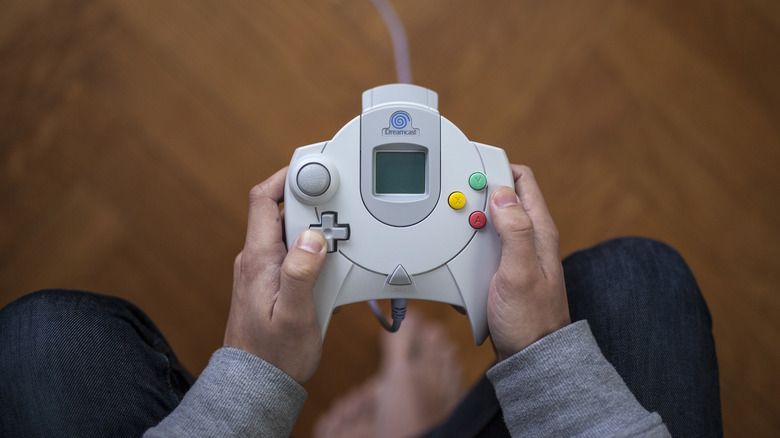
Funnily enough, gamers have been using Hall effect joysticks for longer than most of us realize. Atari's 1983 "I, Robot" arcade cabinets were one of the first game platforms to use Hall effect sensors, and Sega was also quick to adopt the technology, both for its arcade machines and the Dreamcast. While this retro console is notoriously unreliable thanks to its faulty controller port fuse, the controllers themselves were actually quite durable, and many still work today thanks to their reliance on Hall effect sensors. We can likely thank the public outcry against stick drift for the game industry's current focus on Hall effect joysticks.