

Why Did Apple Stop Making White MacBooks? The MacBook Air Might Be The Culprit
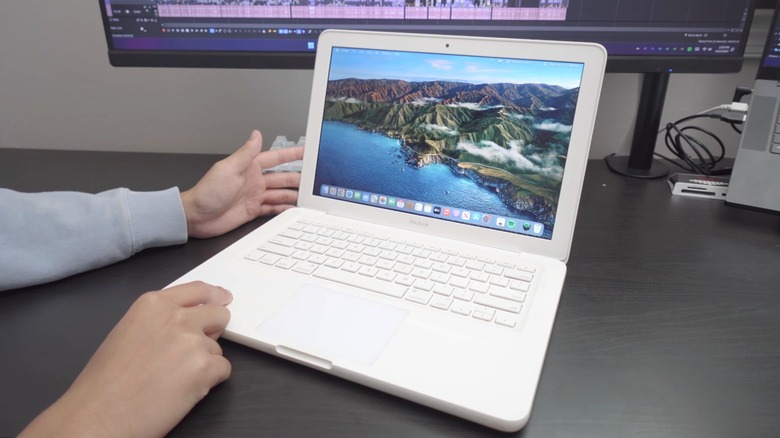
Apple has always been very secretive and has usually avoided revealing too many details about its products. The company doesn't explain every decision it makes about a new device, including design choices, though the tech giant will advertise certain design changes when it needs to. For example, Apple made a big deal about the iPhone 15's titanium chassis in 2023, but Apple didn't explain why it stopped using titanium for the iPhone 17 series two years later. Apple's history contains similar unexplained decisions concerning fan-favorite products. For example, Apple discontinued the white MacBook in 2011, about a decade after making the first white (plastic) laptops. The white MacBook's "death" coincided with the July 2011 launch of significantly slimmer aluminum MacBook Air models that started at the same $999 price point as the plastic notebook. Thus, the thinner, more durable MacBook Air became Apple's entry-level laptop that year.
To understand Apple's decision, we have to look at the company's broader laptop history. Some of Apple's first white notebooks were sold under the iBook brand, introduced in May 2001. Apple launched the white MacBook in May 2006, the model that some longtime MacBook users may still remember fondly. The laptop replaced the white iBook and joined the 15-inch and 17-inch MacBook Pro models, becoming the cheapest notebook in Apple's 2006 lineup, at $1,099.
Apple introduced the first 13-inch aluminum unibody (silver) MacBook in October 2008, following the announcement of the first-generation aluminum MacBook Air in January, when Apple marketed the Air as "the world's thinnest notebook." The silver 13-inch MacBook was renamed MacBook Pro in June 2009. In October 2009, Apple gave the white MacBook a brand-new polycarbonate unibody design. That version cost $999, a price point Apple introduced in 2008 despite the design and hardware upgrades.
The advantages of aluminum over plastic
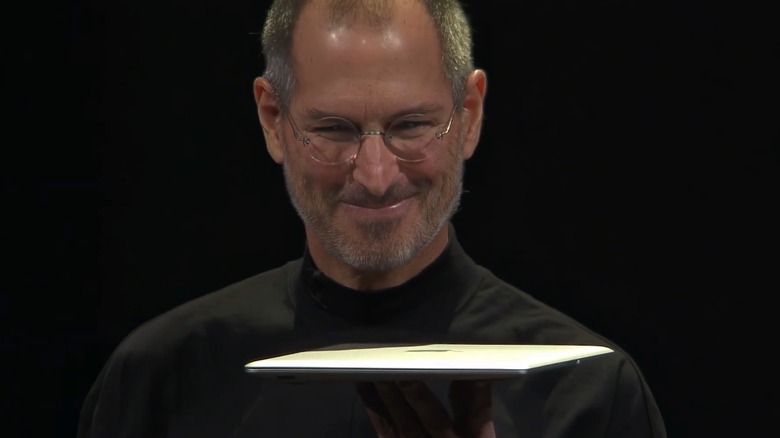
Apple may not have explained why it chose to stop making plastic MacBooks, but it's easy to speculate why Apple didn't. Aluminum offers a few advantages over polycarbonate. First, aluminum is stronger than plastic. The use of aluminum allowed Apple to create the thinner $1,799 MacBook Air, which the late Steve Jobs famously pulled out of a thin manila envelope during the laptop's launch event in January 2008. Aluminum also offers users a more premium feel. But Apple needed time to improve the Air design and performance and lower the price.
In 2010, Apple announced a unibody MacBook Air that was even thinner and more affordable than the original model. The 11-inch model started at $999, while the 13-inch model cost $1,299. Apple kept the 2010 price structure a year later, despite upgrading the specs. This made the $999 11-inch MacBook Air the cheapest MacBook in Apple's lineup once the $999 white MacBook was discontinued. "MacBook Air is available in 11-inch and 13-inch models that easily slip into a briefcase, purse, or bag," Apple said in a press release.
Also, aluminum is a better heat conductor than plastic and can help the laptop cool down more efficiently. The MacBook Air models had a single fan before 2020. In 2020, Apple introduced the fanless MacBook Air design, which featured Apple's first-generation M-series chip. Apple's entry-level laptop, the $599 MacBook Neo introduced in early 2026, has an aluminum chassis and a fanless design. Finally, aluminum may also help with Apple's environmental goals. Apple said in the same 2011 press release that "each unibody enclosure is made of highly recyclable aluminum."
Will Apple make white MacBook models in the future?
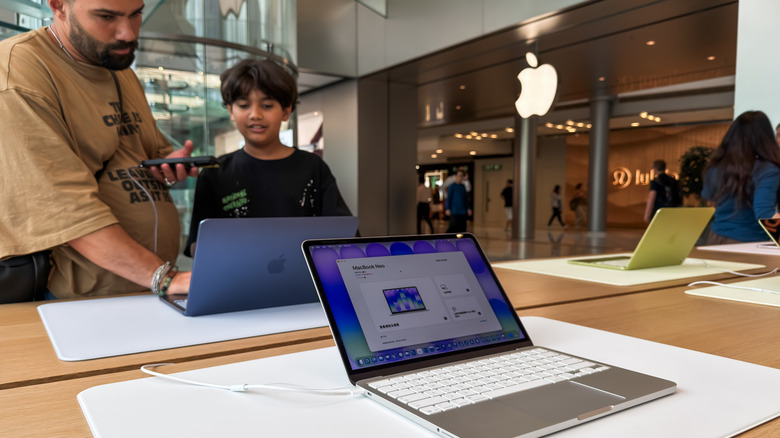
As of July 2026, buyers can purchase three distinct MacBook models, including the MacBook Air, MacBook Neo, and MacBook Pro, but the simple "MacBook" line remains discontinued. Fans of the popular late-2000s white MacBook would surely jump at the chance to see Apple bring it back. But there's no credible report to indicate that Apple will return to plastic laptops in the future. The introduction of the MacBook Neo suggests that Apple values durability in laptop design. One may speculate that a plastic MacBook Neo would help Apple cut manufacturing costs, but, as seen above, aluminum has a few advantages over polycarbonate.
Using aluminum across the MacBook family also gives Apple's entire line a distinct, premium identity. That may be another reason for the same material for all MacBook chassis designs. By comparison, when Apple discontinued the white model, it didn't offer the same uniformity. Before July 2011, buyers could still choose between a white plastic MacBook and the aluminum MacBook Air and MacBook Pro models.
That said, Apple's more recent MacBook Air, MacBook Pro, and MacBook Neo designs hint that Apple can partially satisfy the white MacBook dream. Apple has used various colors for these laptop lines. For example, the MacBook Neo comes in silver, blush, citrus, and indigo. There's no white metal MacBook model as of this writing, and there's no telling if Apple will ever use white paint on a future aluminum MacBook model. But a white MacBook Neo made of metal seems more likely than one made of plastic.