

4 Disadvantages Of Renting Digital Movies
We may receive a commission on purchases made from links.
I'm old enough to have known the experience of counting down to Friday night. Sitting at home and waiting for your parents to get off work, so that they can take the family to the local Blockbuster and rent a couple of movies. And if you were really lucky, you might even be able to snag a video game too. I mention this because I understand the appeal of renting movies.
In the 1980s, a VHS release could cost upwards of $50, with early DVDs coming in at around $25, or around $50 today when factored for inflation. Renting a movie for a couple of bucks over the weekend simply made more sense, especially when you didn't even know you'd enjoy the film you're renting. In the modern era you might think these points still apply. The truth is a little more complicated.
There are a lot of disadvantages to renting digital movies in 2026, many of which didn't affect people renting films back in the day. From quality issues to pricing factors, the appeal of renting a film digitally comes with a number of pitfalls that might make the viewing experience a worse one over physical media.
Ownership issues
You go into the movie rental experience with the understanding that you aren't going to be owning the film. The issue comes down to what you're paying for. Looking at a recent release like the latest entry into the "Scary Movie" franchise, we see a strange discrepancy that I find hard to wrap my head around.
To rent the film for a limited time, you'll need to pay $19.99. That seems high, especially when you consider that new movie rentals in the 1990s and 2000s were $5, often less. But if you want to buy "Scary Movie" digitally, you'll be paying $24.99, a $6 difference between renting and owning a copy. Oh, and you don't actually own the film, only a limited digital license.
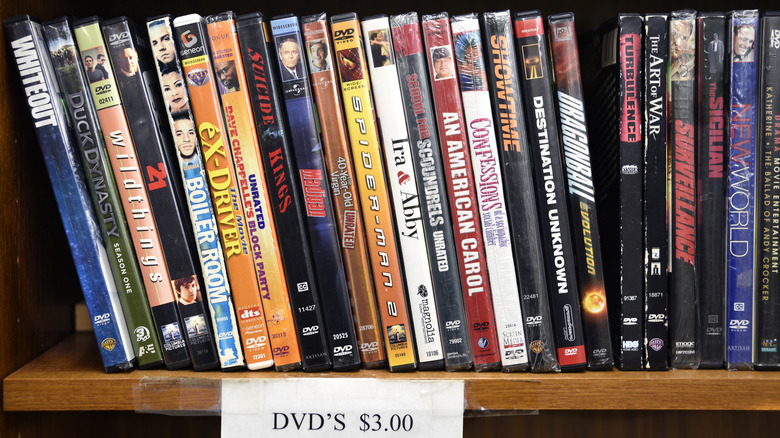
And with the DVD release coming in at $25.99, you're left wondering why a file in the cloud is nearly identical in cost to a printed, shipped, and sharable disc. Now imagine hoping to watch the digital film you rented, only for the platform to revoke your access to it. This isn't a possibility, it's already happened. Sony recently removed 550 digital titles from accounts, showing how important it is to physically own the films that you watch.
Pricing inconsistencies

Pricing has become a real problem in the digital rental and ownership space. Where once you would know how much a film would cost to rent at someplace like Hollywood Video, a digital rental today feels a lot like the Wild West. A big film like "Project Hail Mary" is currently available to rent on Amazon for a reasonable $5.99.
But sometimes you can't even rent or buy a digital film, and if you can, Amazon can take it away at any time. This feels especially strange when you consider that a digital film is simply a file sitting on a server. And there are times where a film is only sold digitally, but isn't available to rent digitally. The policy makes no sense as the digital file already exists on the servers.
A comedy like "Beerfest" is only available to purchase digitally for $12.99, or $6.99 for Prime members. But a star-studded film like "The Great Wall" is renting for $3.99. And if you wanted to purchase it digitally, you could do so for $14.99. But if you wanted "The Great Wall" on Blu-ray, Amazon is happy to sell it and ship it to you for only $7.99, at the time of writing.
Quality issues
Visual fidelity is a complicated topic to discuss, especially with regards to digital files and downloads. And that doesn't even account for the screen you are using to watch the digital content you have rented or purchased. You might even be surprised to find out that your fancy UHD television might not even technically be 4K, meaning you can't take full advantage of the content you are renting at a premium.
I have a decade-old Sony Bravia TV in my office. It's great, but can only support a maximum of 1080p video. This means that UHD content would simply be a waste, even with a dedicated player and discs. If you don't have a true UHD television, you're simply throwing money away by renting UHD content. You'd be much better served buying an often cheaper DVD or Blu-ray and watching that instead.
And then there are bit-rate issues across platforms, meaning visual fidelity can fluctuate, unlike a physical disc. You might be best served subscribing to a platform like Amazon Prime or Netflix, as they offer a lot of 1080p content that looks great on a television, laptop, or even your phone.
Platform availability
I'm a proponent of owning physical media. From games and movies, to CDs and books, ownership means you are in complete control of your media. This is at a time when some lawsuits have claimed you don't actually own the digital content you purchase. No one can take your content away from you, and you never have to worry about losing access to it if you lose internet access.
I have bins of movies I can watch at any time, the only thing I need is a cheap player to play them. But when it comes to digital rentals, you're often limited by where a film is available and how you can watch it. Maybe the movie that you want to watch isn't for rent, simply bouncing around platforms that require a monthly subscription, sometimes even requiring an added rental fee.
Then there's potential playback issues with rental platforms, with Amazon and Apple having pages dedicated to what to do if the title you rented won't play. Just imagine trying to watch content without issues if your internet goes out, or on vacation in an area with a spotty connection, and your movie constantly buffers or doesn't play at all.