

5 Groundbreaking Personal Computers That Defined The '70s
Today's best desktop PCs can be put to use in a number of ways, from daily office work, to gaming, and from media consumption to its creation. This is also true of all of the best laptops on the market. These machines are packed with so much power, connectivity and portability that it can be easy to overlook the fact that this wasn't always the case. A lot of PCs have come and gone over the years, paving the way for what we have now.
The 1970s saw a lot of defining moments. A president resigned amid a scandal, the Vietnam War came to an end, and many different kinds of technology moved out of research labs and into our homes. There are lots of electronics from the 1960s and 1970s that shaped an entire generation, but one that really gained footing in the 1970s was the personal computer. Enough advancement took place for computers to shrink to desktop sizes, and with the help of the emerging video game market, more and more consumers were becoming interested.
While it took a good chunk of the decade for the personal computer to fully grab the American people's attention, several models helped define the decade both technologically and culturally. Some of them only existed within research and development departments, while many others became household names. Each of them made a mark on the decade, whether through advancing the marketplace or through the relationship their users came to develop with them.
Altair 8800
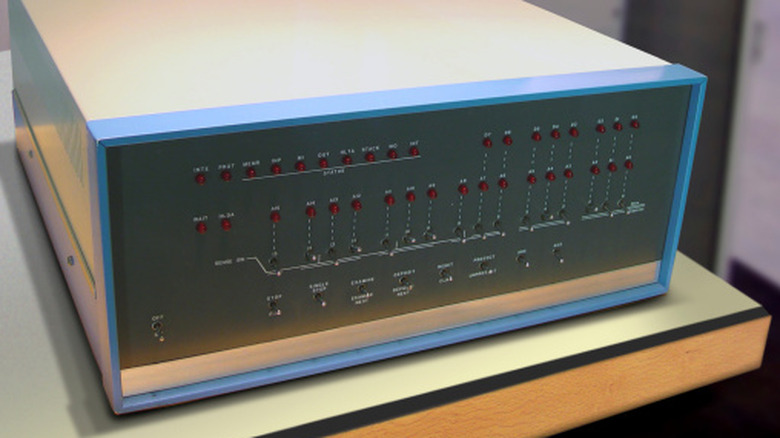
While the Altair 8800 had no keyboard, no monitor, and no modern day interface, it played a major role in the public beginning to embrace the personal computer. The idea of a computer in every home took time for the marketplace to embrace, and the Altair 8800's design is somewhat reminiscent of why. It utilized blinking lights to communicate with the user, who could tell it what to do through switches on the machine's front panel.
It wasn't a particularly user-friendly machine, nor was the Altair 8800 popular in terms of sales. But it's often recognized as the computer that served as the starting point of the personal computer age. In 1975, the 8800 appeared on the cover of Popular Electronics magazine, and for the first time the computer was presented to hobbyists and electronics enthusiasts no longer as a machine reserved for giant corporations and research institutions.
The Altair 8800 served mostly as a stepping stone to computers that would hit the market eventually. The switch-and-light interface would soon give way to more user-friendly designs. But at the time of its release, commercial computers were generally priced in the $30,000 range. The Altair 8800 cost just $439, announcing to the hobbyist market that owning a personal computer was within their reach.
Xerox Alto
Another personal computer that can make a claim for being the machine that kicked off the PC revolution of the late 1970s is the Xerox Alto. It was developed in 1973, two years before the Altair 8800 hit the market, and introduced some features that would become commonplace among PCs. The Xerox Alto utilized a graphical user interface, which we continue to use today in the form of desktop icons, docks, and software application windows.
This interface was a massive overhaul in the computing world, and it would inspire software designers for decades. In the 1970s, it influenced many companies, including some that would go on to take over the entire market in both Apple and Microsoft. Developed at the Xerox Palo Alto Research Center, the Alto completely changed the relationship between the computer and users. It combined a mouse with the new visual interface, allowing users to simply click in order to interact.
Unable to manufacture the machine at a consumer price, Xerox never took the Alto to market. It cost around $12,000 to build, and could have cost as much as $40,000 as a retail product. But the research and development behind the Alto is why it's often recognized as the first PC. It directly led to decisions Steve Jobs would make in regard to computers made by Apple, which wasn't far behind Xerox in making its mark on the 1970s.
Apple II
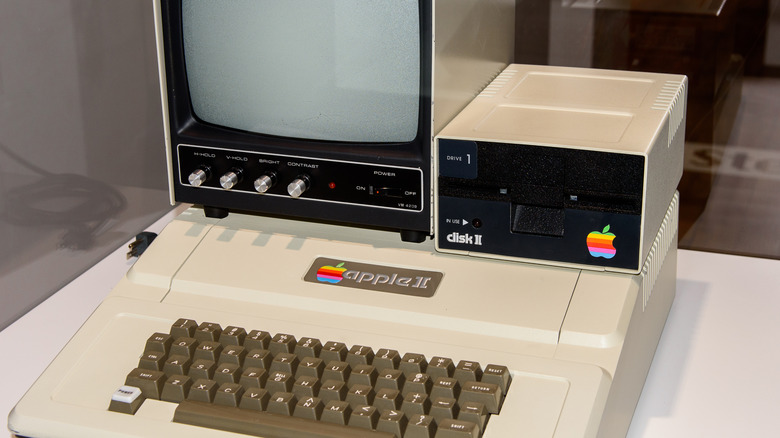
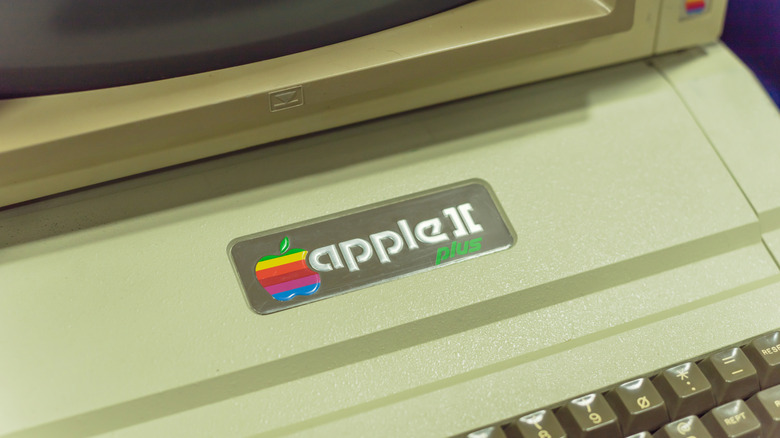
While today Apple makes a MacBook for every budget, in the 1970s its computer lineup wasn't quite so robust. In 1977, it was still mostly hobbyists and electronics enthusiasts who were drawn to personal computing, but in the same way Apple revolutionized mobile computing with the iPhone, it did so for personal computing with the Apple II. As would become a staple of the Apple brand, the computer featured a sleek look and was designed to be user friendly.
What stood out visually about the Apple II was its use of color. It had built-in color graphics, which was still rare at the time. Apple paired the Apple II with a color monitor. This helped catch the eye of everyday people who were becoming more and more aware that computers were making their way into individual homes. The Apple II also sold with a keyboard and built-in audio, making it a convenient and approachable all-in-one purchasing option.
Software was another major influence the Apple II had on the PC revolution of the 1970s. In 1979, a company called Software Arts introduced VisiCalc, the first spreadsheet application ever made, and released it specifically for the Apple II. This made the machine enticing as a professional tool as well. Apple updated the Apple II over the next few years, and by 1984, had sold more than two million units.
Commodore PET 2001
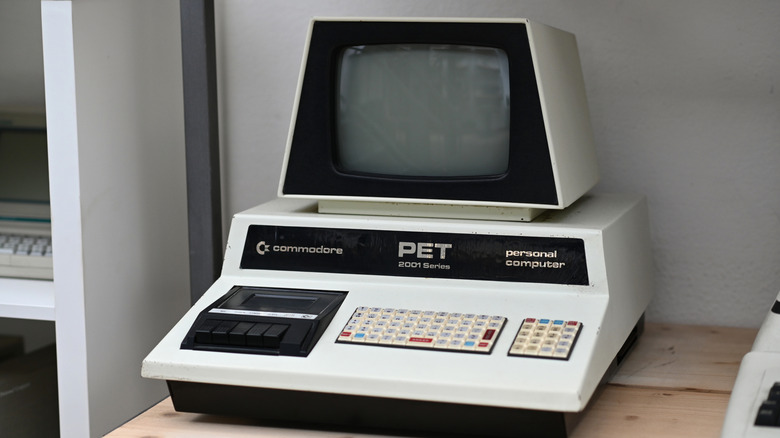
The Apple II was among three computers that make up what has become known as "The 1977 Trinity." The TRS-80 was the third machine among them, but the first in the Trinity was the Commodore PET 2001. The name was an acronym for Personal Electronic Transactor. It had an all-in-one construction that included a monitor, keyboard and internal storage, and it utilized a 1 Mhz MOS 6502 processor. It was the first computer Commodore ever made.
Nowadays, Commodore is one of many extinct PC brands, but the PET 2001 made it one of the most recognized computer brands of the 1970s. Similarly to the Apple II, it made itself appealing to prospective buyers through the convenience of an all-in-one purchase. The PET 2001 had a built-in cassette that could be used for data storage. Software was another selling point, with the inclusion of BASIC allowing users to write their own programs.
Commodore sold the PET 2001 for $495 upon its release in 1977, and while it was extremely popular at the time, it's most recognized for helping to open the doors to the homes of individual computer users. While it sold well, the PET 2001 drew criticism for its small keyboard and monitor, and with both built directly into the machine's design, users had to take what they got without swappable alternatives.
Atari 400/800
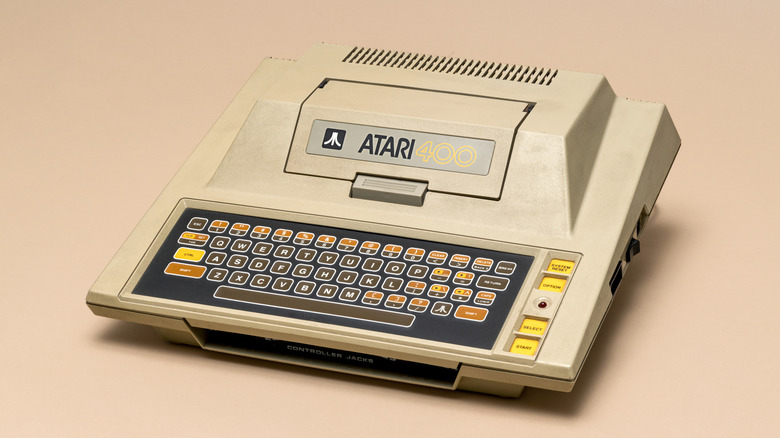
Due in large part to the commercial success of computers like the Apple II and Commodore PET 2001, other major electronics brands became interested in entering the PC market. One such company was Atari, which had spent most of the 1970s establishing its name not only making video game consoles, but pioneering the video game market. In late 1978 the company released the Atari 800, as well as its smaller sibling, the Atari 400.
Both were built around the MOS 6502 — the same processor the Commodore PET 2001 used — but Atari set out to position itself as a gaming option within the PC market. Personal computes were yet to provide hardware that could handle more than daily office computation, but Atari built custom chips that removed certain functions from the CPU load, leaving more power to play video games on the machine.
While Atari continued its work in the video console space, the 400 and 800 sparked a line of Atari 8-bit computers that are now somewhat renowned among retro gaming and computer enthusiasts. These included the Atari 1200XL, which was a commercial flop upon its release in the spring of 1983, and the Atari 1000, which focused on high-end components and never made it to market. The Atari 400 and Atari 800 helped carry the PC explosion into the 1980s, though the company struggled to keep up with the PC market's then-emerging giants.