

Why Did Apple Stop Making The Pippin Video Game Console?
While Apple has waded into gaming with Apple Arcade — which for many is a hidden Apple One perk they should start using — and the Apple Vision Pro, even some diehards may not know that the company once made a home console. Developed by Apple Computers and manufactured by Bandai (now part of Bandai Namco) and Katz Media, the Apple Pippin was released in 1996. It was intended as a MacOS-based gaming console mixed with a way to browse the internet from a TV but ultimately became one of Apple's greatest failures.
The primary reason for the Pippin's demise is Steve Jobs' 1997 return to Apple. After several years of allowing other manufacturers to develop and release products operating on MacOS, Jobs put an end to the so-called Mac clone era. Apple abandoned the Pippin after just one year, and while Bandai tried to keep the console going, it faded into obscurity pretty quickly after selling around 40,000 units. Even if it hadn't been a Mac clone, though, abandoning the Apple Pippin wouldn't have been a tough decision for Jobs considering how poorly the system was already doing.
High prices and stiff competition doomed the Apple Pippin
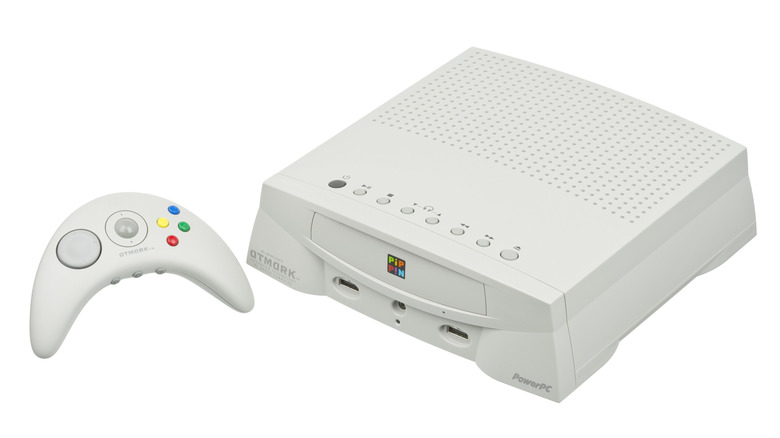
The main reason for the Apple Pippin's failure was its cost. The hardware was hilariously overpriced at $599, which is nearly $1,275 when adjusted for 30 years of inflation. That's over three times the cost of the Nintendo 64, which launched at $199 ($423.52 with inflation) that same year (1996), and double what the Sega Saturn cost at the time. Even in 2026, you can still get a home console for $600 or less: The Xbox Series S starts at $499, and even after Sony's price hike earlier this year, PlayStation 5 Digital Edition is $599.99.
The Pippin's price is even more mind-boggling when you remember that the mentioned consoles were actually powerful for their eras and had games to play. Meanwhile, the Pippin was unimpressive even by 1996 standards, with a 66-megahertz processor and a 14.4-kilobits-per-second modem. By the end of its life, the system had a minuscule library at just 21 games total.
On top of all that, Apple and Bandai's console had major branding issues. The hardware was marketed as the Bandai Pippin @World, a name that's both wordy and pretty silly. It was also pushed as a product for accessing the internet from a TV rather than a gaming platform. In the end, the Pippin was doomed to fail by its price, inability to compete with the heavy-hitters of the era, and generally poor development and marketing decisions.
Is Apple repeating the Pippin's failure with Apple Vision Pro?
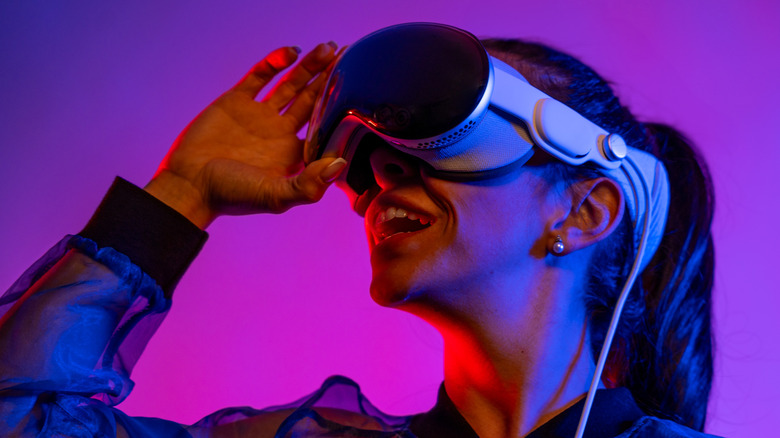
Apple hasn't attempted another home gaming console, but it currently has the Apple Vision Pro, a mixed reality headset that can sense gestures, eye movement, and speech to deliver immersive digital experiences. However, as with the Pippin, Apple has never treated it as a gaming device. Despite the fact that it can run iPad games and is compatible with the PlayStation VR2 controller, Apple has marketed the Vision Pro as an immersive theater that also lets users do pretty much anything they can on a smartphone. It doesn't even refer to the hardware as a virtual reality headset, once again shying away from terminology associated with gaming.
As with the Pippin decades earlier, the Vision Pro's failure can largely be attributed to price. It starts at $3,699, which is exorbitantly expensive even compared to the Steam Machine, a console many see as overpriced at over $1,000. At that price, the install base is small, so there's no reason for Apple or developers to invest in Vision Pro-gaming-exclusive content — another problem that led to the Pippin's demise. The key difference is that the Apple Vision Pro's price actually reflects its power, but that doesn't mean much when few people can experience it.
Despite these major flops, Apple has had one successful gaming endeavor: Apple Arcade. The mobile gaming subscription service has hundreds of ad- and microtransaction-free games, a rarity these days, and adds new titles pretty frequently. Apple Arcade is the bright spot in the company's history where gaming is concerned, but the Vision Pro repeating so many of the Pippin's mistakes doesn't bode well for Apple gaming hardware.