

4 DIY Computer Boards More Powerful Than The Raspberry Pi 5
We may receive a commission on purchases made from links.
Finding a more powerful single-board computer (SBC) that can beat the Raspberry Pi 5 isn't so difficult these days. Despite the ongoing AI-induced price crisis, which threatens to stall the SBC market just as it was gearing up for its next big jump, there's still plenty available if you're willing to pony up.
However, as we all know (this is a factor across the board), what you will find is a slight price oddity. Some of these, despite being more powerful, might actually come in a bit under the price tag of the Raspberry Pi 5 at the moment. If you spot something like that, it might be best not to wait for a deal to come around, as prices are still expected to keep rising into 2027 and potentially beyond.
There are plenty of other alternatives that aren't as powerful. But today, let's take a look at some DIY SBCs that will trounce a Raspberry Pi 5 in terms of performance.
Radxa Rock 5C
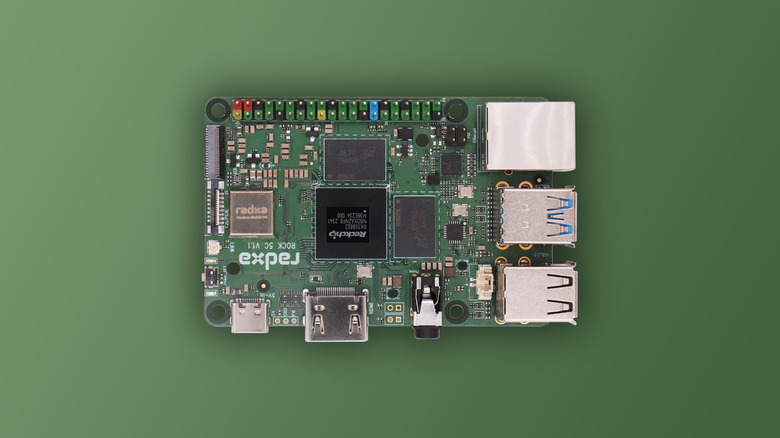
Radxa's main family of Raspberry Pi competitors, the Rock 5C, is the latest iteration to take on and beat the Pi in terms of performance. The 5C clearly beats the Pi 5 in synthetic benchmarks like Geekbench, where it provides around a 100-point difference in single-core performance, depending on the operating system. For multi-core, the Rock 5C's chip roughly bests the Pi 5 by a few hundred points, again, depending on the OS.
Much like a Raspberry Pi, the Radxa Rock 5C has a bunch of accessories that Radxa sells separately. These include cameras, power-over-ethernet adapters, and even additional storage via eMMC modules. Getting Pi-native HATs, accessories that expand the SBC out, to work on the Radxa kit is a little hit or miss in some spots, hence selling them directly.
Radxa's Rock 5 lineup is fairly varied, depending on your needs. The Rock 5B+ is full of ports that aren't available on the smaller 5C, and there's even the ITX+ version if you want it in a traditional PC case.
Orange Pi 5 Max
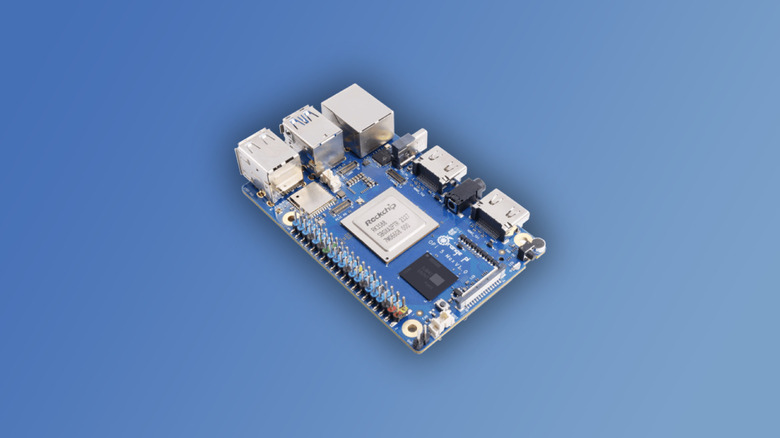
Here's another Pi 5-sized SBC with its own storied history. Launching in 2014, Orange Pi has been another company providing various small PCs in different form factors, and it's become a mainstay in the alternative-to-Pi scene. The Orange Pi 5 Max is its latest addition, and while its single-core performance is nearly identical to the clocked-faster Raspberry Pi 5, it beats its main competitor by more than 85% in multi-core scenarios, meaning it'll be far better for running multiple programs at the same time.
It can be fitted with up to 16 GB of RAM and sports a 2.5 Gb Ethernet port, so using it as a media server will provide legitimately faster speeds if routed properly. There's also Wi-Fi 6E for quick wireless internet, and a neural processing unit (NPU) for running LLMs. All in all, while it might not be the most impressive compared to everything else detailed here, it's still outfitted better than a Pi 5. Orange Pi boasts its three camera ports, as well as GPIO pins for connectivity.
LattePanda Mu
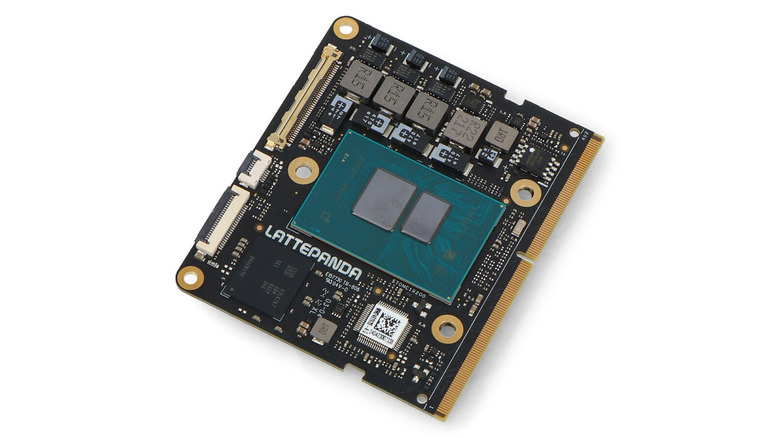
Closer in scope to the Raspberry Pi Compute Module 5 than the regular Pi 5, this RAM-shaped SBC uses a carrier board to access inputs and outputs. In Geekbench testing, the LattePanda Mu proves its prowess over the Pi 5, in large part due to the Intel N100, which is a significantly more powerful x86 processor. The Mu beats the Pi 5 Model B by 68% in single-core performance and 125% in multi-core.
Also similar to the Compute Module 5, it's a massive improvement in optionality over the Pi 5. While you lose things like the GPIO pins on some of the carrier boards, being able to swap the Mu over to scale it to your project is always a boon. With the N100 aboard the Mu being x86, you won't be jumping through any hoops for software support, like you could wind up doing with the ARM-based Pi 5. It'll also run Windows 11, but it is probably best to look at the versions with 16 GB of RAM if that's your goal (or opt for the more expensive and powerful N305 version).
Manufacturer DFRobot is even selling graphics card carrier boards, which will let you harness either an Nvidia RTX 3060 or an Intel Arc A380. Combining the Mu with the Intel board would make for an excellent low-profile media server using Plex or Jellyfin. With a discrete card backing up video playback, it can transcode far quicker if the software needs to convert on the fly for playback.
Radxa Dragon Q6A
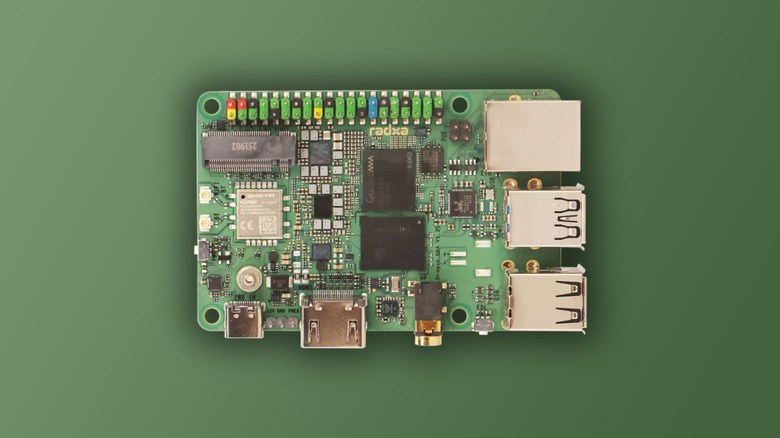
About the same size as the Raspberry Pi 5 but far faster, the Radxa Dragon Q6A board is backed by a Qualcomm QCS6490 system-on-a-chip (SoC), pulling in scores that beat the Pi 5 by 57% in single-core and 108% in multi-core performance. Qualcomm's chip is intended for industrial applications and will provide enough overhead to run some surprising software.
The 8 GB model with Linux installed is more than capable of running some video editing software, like Kdenlive, and playing and editing 1080p footage relatively easily. YouTube channel trailcurrentopensource demonstrates running a large language model (LLM) thanks to the embedded NPU, as well as 3D modeling software, Blender. This is a significantly more powerful device that'll slot easily into self-hosted projects.
Unfortunately, this is a board that's fallen victim to RAM price inflation. In the ExplainingComputers video covering the Dragon Q6A in January 2026, the 8 GB model was priced at $79.50. It is now $219.99 on Amazon as of this writing. At that price, even the impressive performance of the Q6A might not be worthwhile for your project.
Methodology
The article was put together by leveraging the author's experience reviewing and working with PCs and laptops in professional capacities, along with third-party information from the web. This included gathering information from independent reviews, customer questions and reviews, and other coverage involving single-board computers.
A broad spectrum of devices was considered, and we opted to go with performance as a metric over anything else. We also disregarded pricing conversations outside of highlighting it where interesting; otherwise, recommendations would be very slim. Some more powerful single-board PCs were considered, like the Framework Desktop Mainboard, but ultimately, the scope was limited to that in the Pi 5 range. Devices chosen had to meet the bar of besting the Pi 5 in benchmark scores, which were sourced from databases like Geekbench and independent tests.