

The Disadvantages Of A Screenless Fitness Tracker May Far Outweigh The Perks - Here's Why
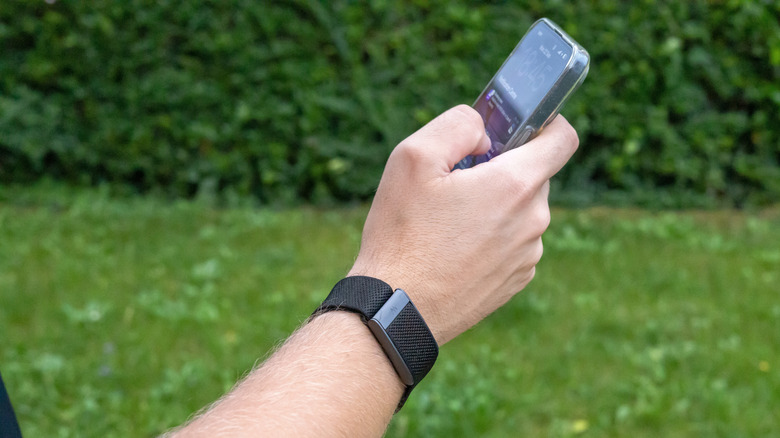
Screenless fitness trackers promise full health tracking without the distraction of a display, and the idea has caught on. Whoop's screenless fitness bands are gaining traction, and the product category has expanded quickly, with Google, Garmin, Polar, and Amazfit all now offering screenless options of their own. I wear an Oura Ring 5 every day, but before that, I spent a year with the Whoop MG strapped to my wrist.
Oura calls the Ring 5 the world's smallest smart ring — and 40% smaller than its predecessor, even — with a battery that lasts between six and nine days. Since it looks just like a normal ring, people may not even realize it's a health tracker. Whoop takes a similar approach, but on the wrist. Its latest bands promise more than 14 days of battery per charge, which no mainstream smartwatch gets close to, save for some Garmin watches. When I reviewed the Whoop MG, I found the 27-gram band light enough to forget about, even under a shirtsleeve. Google's Fitbit Air joined the category this year as a $99 screenless tracker, and if you're eyeing it, it's worth reading up on how the Fitbit Air stacks up against Whoop's screenless bands.
After using these devices for more than a year, though, I've learned the screenless tracker territory comes with trade-offs. Many aren't dealbreakers for me, so I still wear my Oura Ring 5. But that doesn't mean I don't experience some of the disadvantages. Broadly speaking, these cons fall into two camps: information the device can't relay to you, such as live activity stats, and how much of the experience actually ends up on your phone, which is the only place you can view your fitness data.
Activity detection on screenless fitness trackers can be iffy
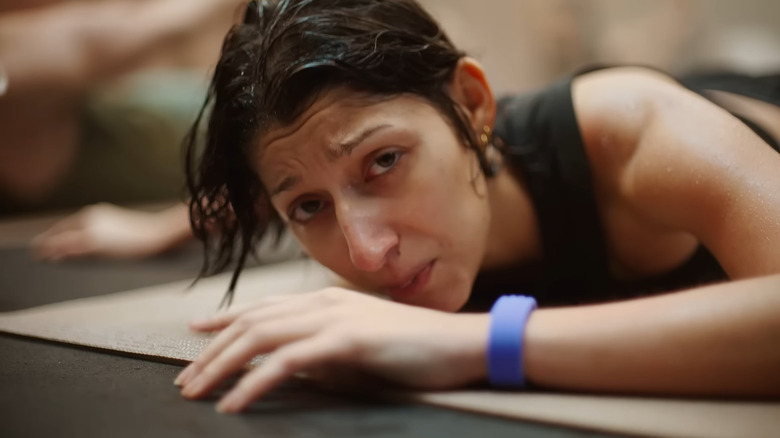
Screenless trackers rely on automatic activity detection; with no screen and no buttons, there's no way to manually start an activity. TechRadar's Whoop MG review found the band excels at logging regular workouts once its software has learned your habits, and the Oura ring's Automatic Activity Detection feature works similarly. Both the Oura Ring 5 and Whoop MG have handled my runs and walks well, but they've measured my lifting sessions and swims less accurately.
The problem isn't unique to those two devices. Tom's Guide ran into the same issue with Amazfit's screenless Helio Strap, finding its workout detection unreliable for some activity types, such as cycling. Oura's latest software, which was launched alongside the Ring 5, does let you start a workout in the app to view real-time stats. However, that still means unlocking your phone and tapping through menus to see your data. A smartwatch handles that same job with one button press — which brings us to another disadvantage.
Let's say you wanted to enjoy a workout sans smartphone. Like all screenless smart rings and watches, the Whoop MG can't ping you with notifications, so you'd risk missing important alerts without having your phone on hand. If staying reachable matters to you, that should factor into your choice between buying a fitness band or a smartwatch. For me, one (somewhat silly) solution to the problem was wearing my Apple Watch on my left wrist and the Whoop on my right. If you're hoping to trim down your everyday carry, though, it's a little disadvantageous to sport a health wearable that nudges you into buying a second one, especially when you need your phone anyway to check your readings.
The useful health data only lives on your phone, not the wearable
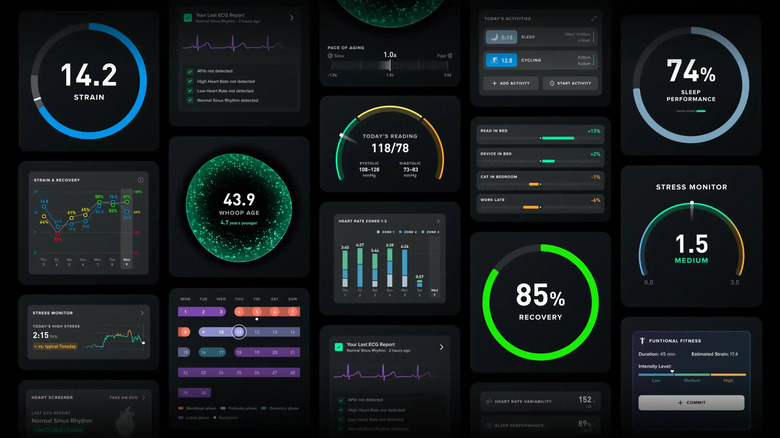
For all screenless wearables, companion apps are the only way you can interpret readings. For instance, if heavy lifting produced rapid heart rate changes, with screenless wearables you'd only be able to know by checking your phone. In this fashion, a device hinged on keeping you off your phone manages to steer you back to it — and thus to distracting notifications.
Outdoor sports rely on smartphones even more. No Whoop models have built-in GPS, so they can't track your route, pace, or elevation. You could use another screenless GPS-enabled device for this purpose, but you'd get no map or pace splits. That isn't just a Whoop quirk, though. No current screenless health trackers include built-in GPS. This is particularly disadvantageous for swimming, since live pacing disappears entirely when your phone is in a locker. For trail running, open-water swimming, or interval sessions where live pacing is essential, screenless trackers are far from ideal. Compare that to Apple Watches whose built-in GPS handles distance, pace, and route mapping in workouts, all without relying on an iPhone.
Many screenless health wearables are still excellent at their core jobs, though. Oura's sleep data is the best I've seen. I wear my Oura ring daily because it blends in to my outfits like other wearables can't. Cost is also a plus, although there are a few things worth knowing before buying an Oura Ring beyond the sticker price. The Oura Ring 5 retails for $399 and requires a monthly membership for full feature access. Meanwhile, Whoop bundles its hardware into its subscriptions, with the Whoop MG tied to the $359-per-year Life plan. That's smartwatch money for a device with fewer capabilities, so it's worth asking whether there's a point to owning a screenless wearable if you've bought a smartwatch.