

5 ASUS Laptops More Powerful Than MacBook Pro
We may receive a commission on purchases made from links.
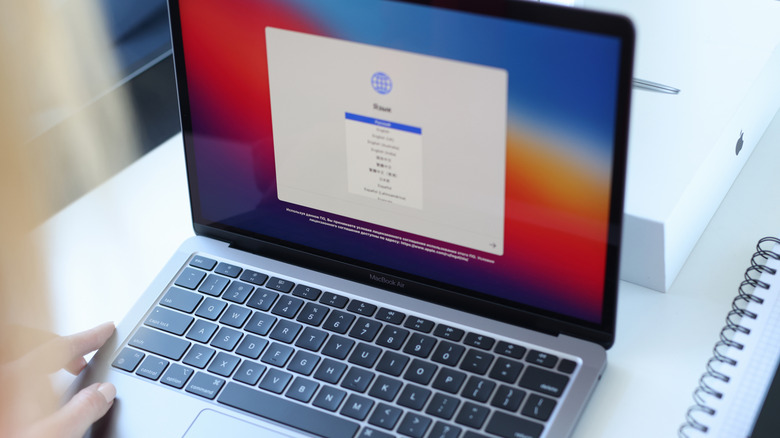
For creative workflows like music and video production, the MacBook Pro M5 Pro is the benchmark most buyers turn to. But what about raw graphics power, gaming, and other GPU-demanding tasks like local AI models, designing 3D models and more? ASUS answers this demand with discrete RTX 50-series graphics on Windows. We're talking Nvidia RTX 5070, 5080, and 5090 laptop GPUs vs. M5 Pro integrated graphics.
It's not completely one-sided: Apple's M5 Pro chip is best for efficiency, battery life, and quiet operation, while ASUS offers far more raw power and the flexibility of Windows. An ASUS laptop could even double up as a dedicated games console with Xbox Mode. The Apple M5 Pro chip features an 18-core CPU with six super cores and 12 performance cores alongside a 20-core GPU capable of hardware-accelerated ray tracing. It also packs in a 16-core Neural Engine, complete with Neural accelerators and a total 153GB/s memory bandwidth.
Performance varies depending on the most powerful ASUS laptop, but focusing on the RTX 5070 laptop GPU shows off a 5th-generation Tensor chip and 4th-generation ray tracing cores delivering 798 AI TOPS. It can also use DLSS 4.5 Multi Frame Generation to get at least twice the frame-rate performance the silicon alone can produce, alongside image upscaling. There are plenty of laptops more powerful than the MacBook Pro M5, and these are just some of the machines ASUS offers at various price ranges.
The Flagship: ROG Strix SCAR 18
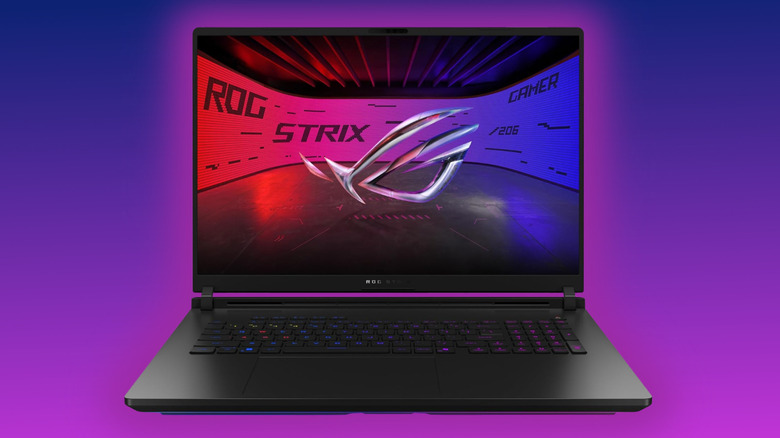
For many, the ASUS ROG Strix SCAR 18 is a dream gaming setup. Configuration-wise, it can pack up to an Intel Core Ultra 9 290HX Plus CPU, up to an RTX 5090 Laptop GPU at 175W max TGP, an 18-inch 4K Nebula HDR Mini LED display (240Hz and 2,000+ local dimming zones, advanced vapor chamber and tri-fan cooling, and toolless upgrading for SSDs, RAM, and cooling fans.
Compared to the M5 Pro, the 290HX Plus has 14/14 more CPU cores/threads, with 4 more cores running .89 to 1.79 GHz higher in Core Cluster 1 and 10 extra Core 2 Clusters running 0.90 to 1.65 GHz higher. Intel's high-end chip also has an extra 12 MB of L2 cache and a 36 MB L3 cache that the M5 Pro doesn't have at all. It's overclockable too, something the closed Apple ecosystem would never allow.
It goes without saying that the RTX 5090 Laptop GPU performs significantly better than the M5 Pro's integrated GPU. Up to 47% better in 3DMark Steel Nomad Lite, 2.7x higher maximum theoretical performance at 45.3 vs. 16.6 TFLOPS, 46% higher memory bandwidth at 896 vs. 614 GB/s, and has over 2x more shading units at 10496 vs 5120. The M5 Pro is far more power-efficient, but it can't compete with the ROG Strix SCAR 18, ASUS's most powerful laptop, at $4,999.99.
Slim RTX 50 Series Laptop: ROG Zephyrus G16
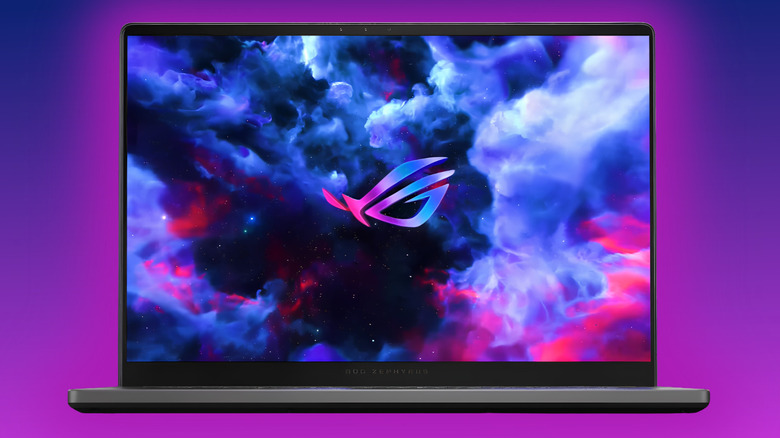
The ASUS ROG Zephyrus G16 at $3,449.99 is the choice for buyers who want the MacBook aesthetic without committing to the Apple closed ecosystem. This particular model has an Intel Core Ultra 9 386H as its CPU, which again sits above Apple M5 Pro silicon performance-wise.
While it has 2 / 2 less CPU Cores / Threads, Core Cluster 1 has two fewer cores but performs 0.29 to 1.19 GHz better, while Cluster 2 has two fewer cores, performing 0.65 to 0.7 GHz faster, and Cluster 3 is an extra over the M5 Pro chip, featuring 4 Darkmont LP cores running at 1.6 to 3.5 GHz. L2 cache is 6 MB lower, but it has an extra L3 cache at 18 MB. Like the M5 Pro, 386H doesn't support overclocking, which is a wise move in such a slim chassis.
The M5 Pro 10-core GPU is also miles below the RTX 5080 Laptop GPU. It's packing 16GB of GDDR7 memory while hitting an extra 790 MHz boost GPU frequency. The benchmark scores say it all, scoring an extra 12,315 points in 3DMark Steel Nomad Lite, an extra 102,365 on GeekBench v6 GB6 Compute, and an extra 5,258 in GB6 ML Single Precision as well as an extra 7,068 in GB6 ML Half Precision. The only issue with the G16 is that it doesn't have dual Thunderbolt ports like the MacBook Pro.
The Creators Macbook Killer: ProArt P16
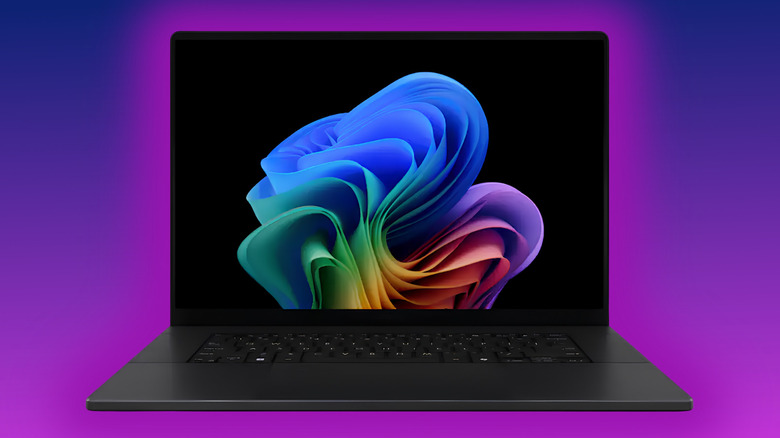
For creators who need dedicated graphics power, the ASUS ProArt P16 is a MacBook Pro M5 killer at $3,999.99. Its AMD Ryzen AI 9 HX 370 CPU and RTX 5070 Laptop GPU combo destroys the Apple-shaped Elephant in the room, complete with a 16-inch 4K touch screen and small local AI capabilities.
Looking at CPU performance, HX 370 has 6 fewer CPU Cores with 6 extra threads, which balances out in Core Cluster performance. Core Cluster 1 has 2 fewer cores but performs 0.49 to 1.09 GHz better, as does Core Cluster 2, with 4 fewer cores and 0.15 to 1.10 GHz faster. Its L2 cache has 10 MB less space, but benefits from an L3 cache at 24 MB with no overclocking.
Nvidia's RTX 5070 Laptop GPU would be my personal entry point into portable 50 series performance, and it still destroys the M5 Pro GPU. It runs 900 MHz above the M5's boost GPU frequency and packs 2,048 shader units, so ProArt 16 should handle image and video rendering alongside 3D modeling with ease. It also makes for a solid gaming PC in a Razer Blade-style slim chassis with 2TB of storage to keep the backlog installed. The icing on the cake here is the 64GB of LPDDR5X RAM, which is more than enough for creatives and gamers.
Compact Macbook Pro 14 Rival: ROG Zephyrus G14
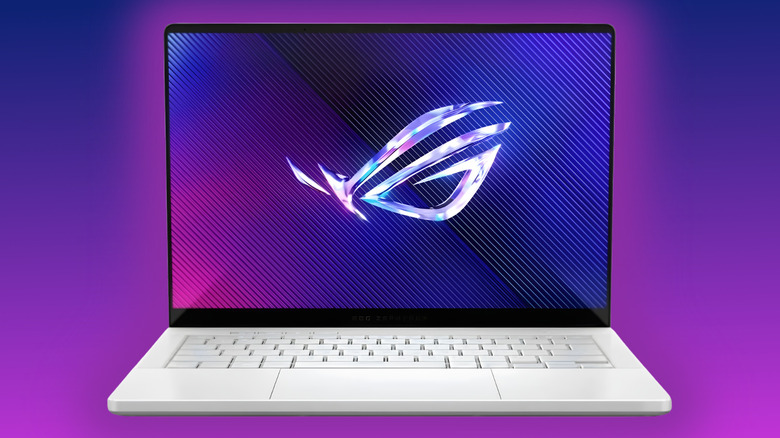
ASUS ROG Zephyrus G14 is a brilliant alternative to the MacBook 14 M5 Pro at $3,469.99. The MacBook 14 runs the M5 silicon with a 15-core CPU/16-core GPU, and the G14 practically walks to the finish line by comparison, with a stunning 120Hz OLED 2.8K display.
Its AMD Ryzen AI 9 HX 370 trades punches with this M5 Pro model, which still delivers great overall performance. It has three fewer CPU Cores but nine extra Threads. Its first Core Cluster has one fewer core but performs 0.49 to 1.09 GHz better, while Core Cluster 2 has two fewer cores but performs 0.15 to 1.10 GHz better. It also has 10 MB less L2 cache but benefits from a 24 MB L3 cache. Long story short, it's a fantastic CPU.
MacBook 14's M5 Pro also has four fewer GPU cores, at 16 when compared to the other higher-spec M5 Pro at 20 GPU Cores. As expected, the RTX 5080 Laptop GPU dominates in benchmark comparisons. It scores 13,780 in 3DMark Steel Nomad Lite, 15,119 in GB6 Compute Score, 7,177 in GB6 ML Single Precision, and 9,775 in GB6 ML Half Precision. Its Boost GPU Frequency is 790 MHz higher, and it has 5,632 shader units too. Considering this GPU is DLSS 4.5-capable, the G14 is a great laptop and powerful enough for every kind of user.
The Value Pick: TUF Gaming A16
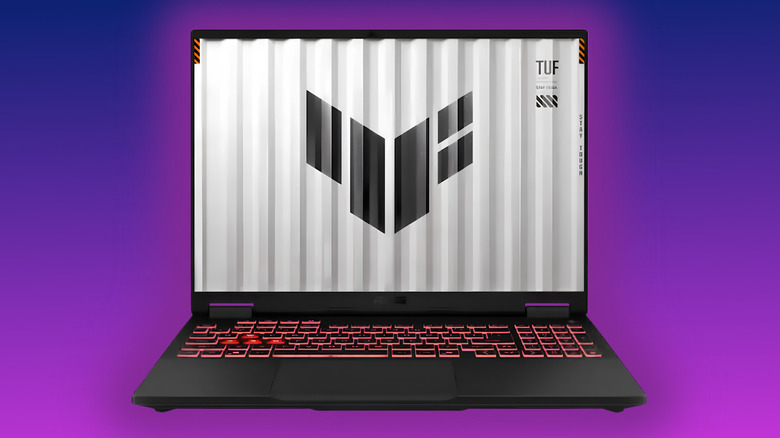
The big surprise in the ASUS lineup is the TUF Gaming A16, which outperforms a MacBook Pro M5 Pro 15 CPU/16 GPU model while saving $75 at $2,224.99. The screen isn't as good, but it still does a great job for a 16-inch 165Hz FHD+ display. The lesson with the A16 is not to spend money on more computer than you need. 16GB DDR5 RAM, for example, is more than enough, and the MacBook Pro's 24GB doesn't make much real-world difference for gaming.
The A16's AMD Ryzen 9 8940HX has one more Core and more than double the thread count at 17. It has one core cluster with 16x Zen 4 at 2.40 to 5.30 GHz, delivering 0.69 to 1.49 GHz better performance than the M5 Pro. It's behind by 6 MB in its L2 cache, but its L3 cache is 64 MB and supports overclocking. All in all, it's a great processor choice for the price point.
The RTX 5070 is also a good combination for a powerful ASUS laptop, coming in at half the price of the current flagship. The 5070 scores 59,002 more than the M5 Pro GPU in Geekbench 6 and is a fantastic alternative to a MacBook Pro.
Methodology

We wanted to show how much more raw compute and graphics power ASUS laptops have than MacBooks, and why a dedicated graphics processing unit in a Windows ecosystem is better for gamers and creatives. Specifically, we're comparing Nvidia GeForce RTX 50 series Laptop GPUs to the Apple M5 Pro GPU's capabilities by using specifications from Amazon and Best Buy listings and component specification comparison services such as CPU-Monkey and Nano Review.
We didn't compare battery life and noise levels, as MacBook Pros will always come out on top here due to their fanless design and optimized performance. As with all laptops, pricing and specifications may change after this article, so check current listings before committing to buy. Any shop links included go to the listing for the ASUS or Apple laptop in question at the time of writing.
While Apple MacBook Pros and their M5 series of silicon are extremely optimized within a closed ecosystem, ASUS laptops offer extra raw power and the flexibility to upgrade and run a wider range of software. When you look at the MacBook Pro through gamer goggles, it's obvious that a Windows-based laptop with a high-performing processor and current-gen dedicated GPU is the best option for game compatibility alone.