

Should You Put Your Speakers On Stands?
We may receive a commission on purchases made from links.
Getting the most out of your sound system is all about the small adjustments. Increasing speaker size and distance is one way to change how your AV receiver performs. Choosing higher-quality speaker wires and HDMI cables can also make small, audible improvements. But one of the most meaningful additions you can make to a home theater or hi-fi setup is a set of speaker stands. Should you own a pair of floor-standing speakers, you obviously won't need stands for the front of your surround sound configuration, though you may still want to hang onto them for your rears.
Yes, bookshelf speakers are literally called that because they're usually just the right size to sit on a traditional shelf. The issue is that this isn't an ideal home for any speaker; vibrations caused by the drivers can actually distort the sound your speakers produce. Moreover, for closed-back furniture like a tall bookshelf, you could end up dealing with an overly reflective acoustic mess. Not only will speaker stands help mitigate vibrations and reflections, but they'll also help your shelving be less cluttered and more cohesive.
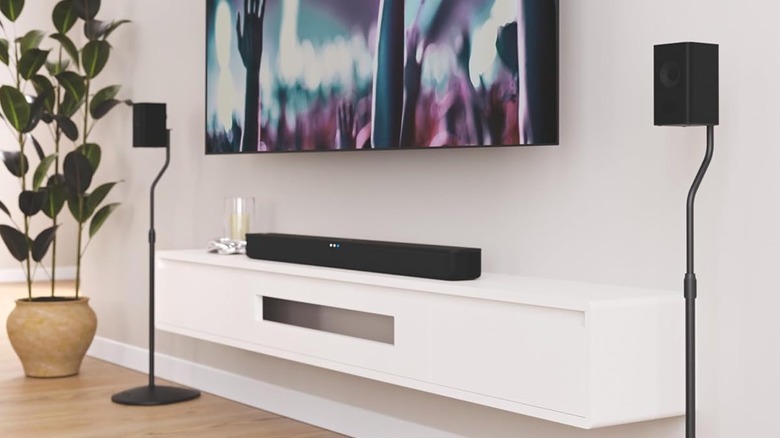
Whether you're investing in stands for the front or the rear of your system, ideally, you'll want your ears to be at the same height as your speakers' tweeters. The latter is responsible for high frequencies, and the better you and your speakers are positioned, the more defined your audio will be — especially when it comes to dialogue and vocals.
Speaker stands can help improve the sound quality of your entire AV system
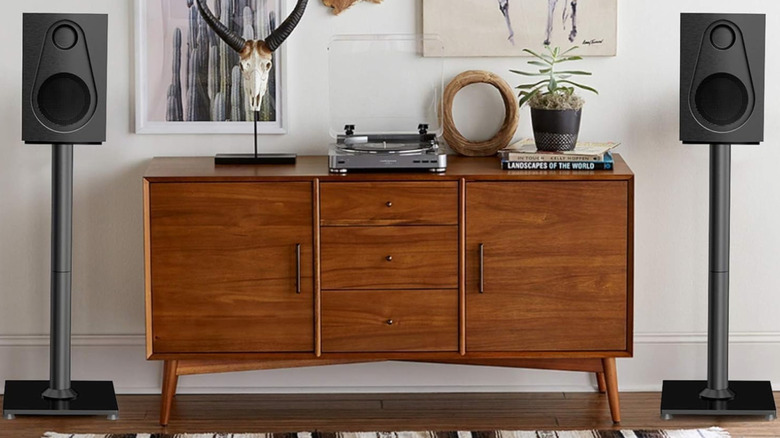
Let's imagine you're investing in a simple hi-fi setup. You'll be buying a stereo amplifier, two bookshelf speakers, a vinyl player, and some speaker wire. Adding a set of stands would be the icing on the cake, because they'll allow you to create an audible "sweet spot." By placing both speakers the same distance from your seating area, you should be able to visualize a complete soundstage, with each instrument or vocalist claiming a specific position in the mix.
Want some help figuring out how tall your speaker stands should be? Our pals at Crutchfield have a genius formula: Measure the height of your ears when you're plopped down in your favorite seat. Next, subtract half the height of your stand-ready speakers; the result will be the stand size you should be shopping for. Conveniently, many stands are height-adjustable, which could also come in handy if you buy bigger or smaller speakers down the line.
An organizational bonus: many speaker stands are hollowed out, allowing you to run speaker wires and other AV cables through the posts. A pair of speaker stands may not be warranted for every hi-fi or home theater system, but they're not an accessory to be taken for granted.