

5 Of The Biggest Computing Breakthroughs Of The '70s
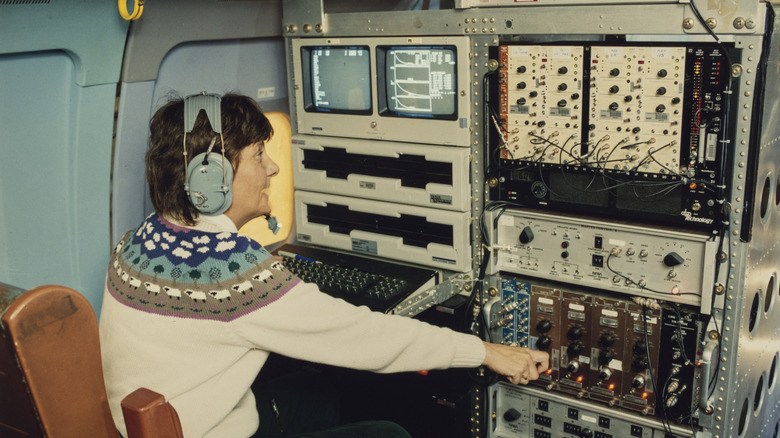
There are clichés that come to mind when thinking of the 1970s. Cultural fads like disco fit that mold, as do fashion trends like bell-bottom pants. But the 1970s were also a decade of serious ingenuity and technological development. On the consumer side, there was no shortage of electronics from the 1960s and '70s that shaped an entire generation. On the commercial side, by the time the 1980s rolled around, computers were branching out from the corporate world, well on their way to becoming as much of a tool for the individual as they had been for larger entities during the decades prior. In fact, many of the technological advancements that took place in the 1970s happened within the computing world.
At the onset of the 1970s, however, computers — and the act of computing in general — were mostly in the hands of large corporations, government departments, and colleges. And while computers had previously been an exciting, up-and-coming technology, the 1970s saw them mature as an everyday tool and present a burgeoning marketplace with real-world use-case scenarios as a product. A number of computing breakthroughs led to this. From everyday office work to home video games, and from filmmaking techniques to internet-like connectivity, here we're exploring some of the advancements that helped computers spread their roots throughout the 1970s.
TCP/IP
In 1969, messages were successfully sent across a packet-switching network for the first time, thus marking the beginning of the Department of Defense's ARPANET (Advanced Research Projects Agency Network), the predecessor to the internet. Other networks popped up throughout the early 1970s, all of which were incompatible with one another. Each network transmitted data in a different way, and while computers connected within each network were able to transmit data between one another, the networks themselves were island-like, existing and operating apart from each other.
A shared language was needed for separate networks to pass data between them. In 1974, two computer scientists devised what would become known as Transmission Control Protocol (TCP) and Internet Protocol (IP). The protocols worked together, with the IP breaking messages into small chunks called packets and forwarding them to specific destinations across any network that stood between sender and recipient. The TCP did the heavy lifting once data was received, reassembling the packets upon arrival at their destination.
After the introduction of TCP/IP, ARPANET grew into a massive interconnected network and paved the way for our modern-day internet. Today, the term "IP address" is commonplace, and it's the very thing that was set up in 1974 to establish unique senders and receivers across networks. While initially bundled under the TCP umbrella, the technology was split into TCP/IP layering in 1978 in order to provide more flexibility, allowing other protocols to use IP's addressing and routing.
Laser printing
Computers cleared several advancement thresholds throughout the 1970s, but the printers available to pair with them weren't particularly reliable or efficient. There was the daisy wheel printer, which functioned much like a typewriter and produced a lot of noise. Also on the market were dot matrix printers. These worked in a similar way, and while faster and more reliable than daisy wheel printers, dot matrix printers were still unable to reproduce the kinds of graphics and images computer users were working with on their screens.
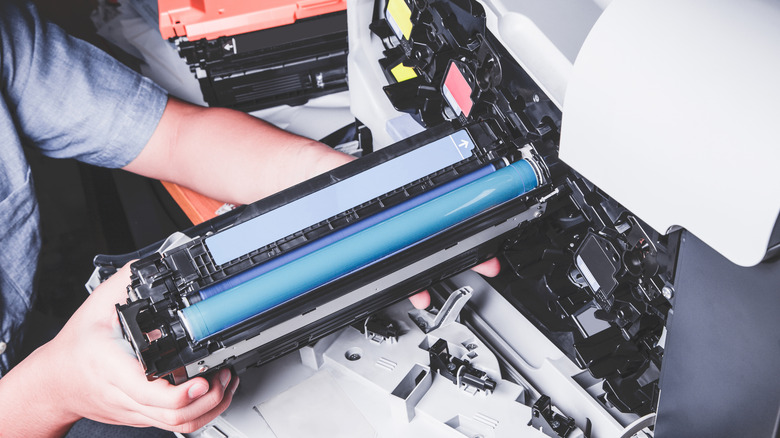
But lasers were an emerging technology all on their own, and in the late 1960s a physicist working at Xerox named Gary Starkweather realized a laser could be utilized for the printing process. He built the world's first laser printer over the course of the next year. Devices like daisy wheel and dot matrix printers were what's known as impact printers, working by essentially stamping an ink ribbon onto a piece of paper with a letter-shaped piece of metal. Laser printers worked by running a laser beam across a light-sensitive drum, leaving an accurate image wherever the beam strikes.
It took some time for Starkweather's original laser printer to hit the market, but Xerox released the 9700 laser printer in 1977. It was a near-instant commercial success and went on to make billions of dollars for Xerox. Competitors like IBM and Canon jumped into the market soon thereafter. Because of their accuracy and ability to reproduce complex images, laser printers became the go-to printing option for many businesses in the 1970s. Nowadays, laser printers are almost always among the most reliable printers on the market.
CGI in movies

The magic of moviemaking has always existed, but until the 1970s, special effects artists were limited to the use of physical, real-world tools. Things like puppets and miniatures were put to use alongside other constructs, such as sets that were designed to allow for unique camera positioning and lighting tricks. Much of the magic that moviegoers got to see was done with in-camera techniques like forced perspective or post-production tricks like match cuts.
Hollywood had experimented with computers before, but in 1973, "Westworld" — one of the '70s sci-fi movies everyone needs to watch — became the guinea pig for more complex computer-generated imagery (CGI). The filmmakers wanted to create a shot that provided a POV perspective of a robot character. It was the first film to pair live action with digital animation, and in 1976, the film's sequel, "Futureworld," incorporated even more groundbreaking CGI. "Futureworld" featured a computer-generated 3D hand and face that was made independently by graduate students Frederic Parke and Ed Catmull, the latter of whom went on to co-found Pixar.
Filmmakers continued to implement CGI throughout the 1970s, though it remained somewhat rare and experimental. While movies like "Star Wars" were renowned for their effects, only very briefly did any CGI make an appearance. But computers had broken into the movie business, and while there was no real technological breakthrough that got them there, the psychological hump had been cleared. CGI became an acceptable and more affordable tool to implement by the time the 1980s rolled around, and it was entirely commonplace by the 1990s.
Portable storage
Until computers started being deployed by businesses, storing data was mostly a physical ordeal, with cabinets, closets, and even entire floors required to store paper documents and folders. But with the computer came the beginning of file digitization. Businesses often relied on mainframe computer systems to store and process data, but they weren't particularly portable, and there really wasn't any kind of go-between when it came to getting data from one computer mainframe to another.
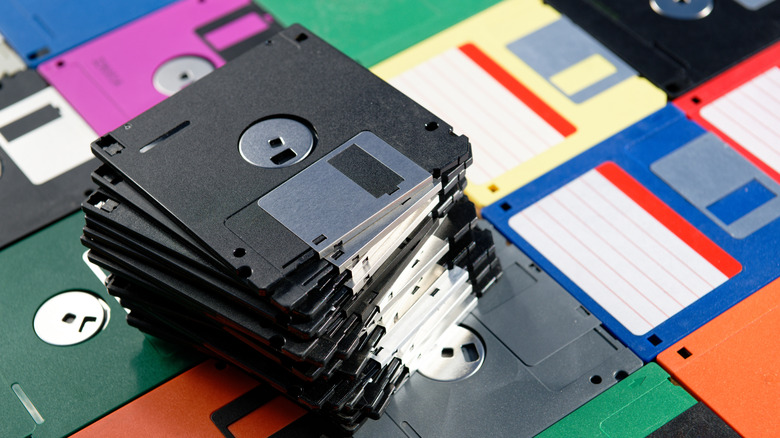
But in the late 1960s, a team at IBM was tasked with finding a better way to load software onto mainframes. It came up with what would become known as the floppy disk, which hit the market in 1971. It was read-only and could only store 80 kilobytes of data, but the floppy disk was still a substantial breakthrough in the 1970s, as it allowed users to move data from one place to another in a convenient fashion for the first time. Known as Minnow, this version of the floppy disk was an eight-inch disk housed in plastic.
Today, gadgets like SSDs and external hard drives have taken on a similar role, though floppy disks had a relatively long reign as a portable storage device. Development would continue throughout the 1970s, and in 1976 IBM introduced a smaller, 5.25-inch floppy disk to the market. The floppy disk was the delivery mechanism of choice for software installations throughout the 1980s and well into the 1990s, when technology like CD-ROM drives started to make them obsolete.
Cartridge-based video games
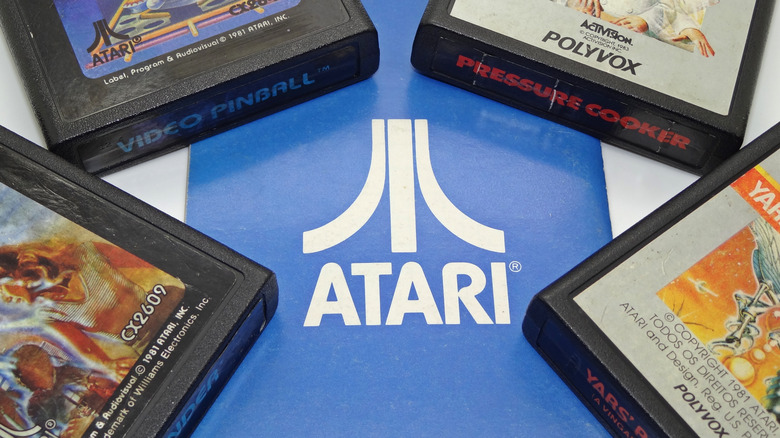
Some old school gaming consoles are making a comeback, but in the early 1970s, there really was no such thing as a gaming console, at least as we know them today. Gaming was mostly done at arcades, and the machines looked more like pieces of furniture than something you'd connect to a television set. Video games did start making their way into the home in the 1970s, but the earliest consoles came with the games built directly into the hardware.
But in 1976, a console called the Fairchild Channel F was released. It was a short-lived product and was quickly outdone by consoles like the Atari 2600, but it was the first console ever to allow users to purchase games separately from the console itself. It did this with the same kind of thinking that led to the floppy disk: The Channel F utilized ROM video game cartridges instead of preinstalling games directly to the console, effectively making the plastic-shelled cartridges a form of portable storage for video games.
This was as much a marketing breakthrough as it was a technological one, as it turned video games into individual products rather than something that had to be purchased as part of a larger package. Cartridge-based video games helped bring video games into homes and, really, outright defined the way an entire generation physically interacted with their gaming world. Cartridges allowed users to rent video games, borrow and trade with friends, and even sell games once they were finished with them or decided they didn't live up to expectations.