

Apple's First Computer In The '70s Made One Clever Design Choice
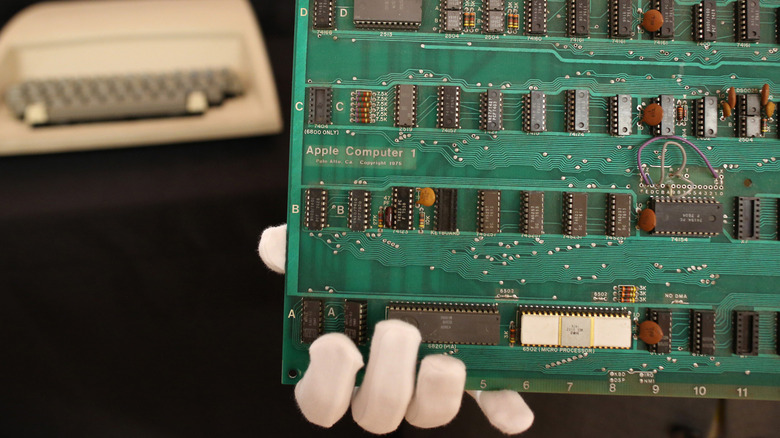
When Apple launched its first personal computer, the Apple I, PC hardware just wasn't something people had. The Apple I came as a circuit board with no power, keyboard, or monitor. However, because most people in the U.S. in 1976 had a TV, the built-in video display hardware would allow users to connect any TV with RF connections to it. This ingenious, clever design choice allowed almost anyone to use the next big thing: computers.
By designing the Apple I to function with a regular TV, it eliminated one of the major costs of purchasing a dedicated terminal or all-in-one device at the time, lowering the barrier to entry. The Apple I's slapdash design comes from Steve Wozniak, co-founder of Apple, who oversaw the development of the machine that put the company on the map, the Apple II. Wozniak, in contrast to Apple's current leaders, was all about giving the user full control of the machine. This manifested more with the Apple II, due to the Apple I's short life.
With his plug-and-play design ethos, Wozniak opened up the world of computing to a staggering amount of people. This strategy would persist with the Apple II and be an embedded feature for most computers available on the consumer market going forward. The ZX Spectrum, Commodore 64 — which has had a lot of changes recently – and even the Amiga and Atari ST were able to connect to a TV, even well into the 1990s, when monitors had become more available.
Monitors were expensive
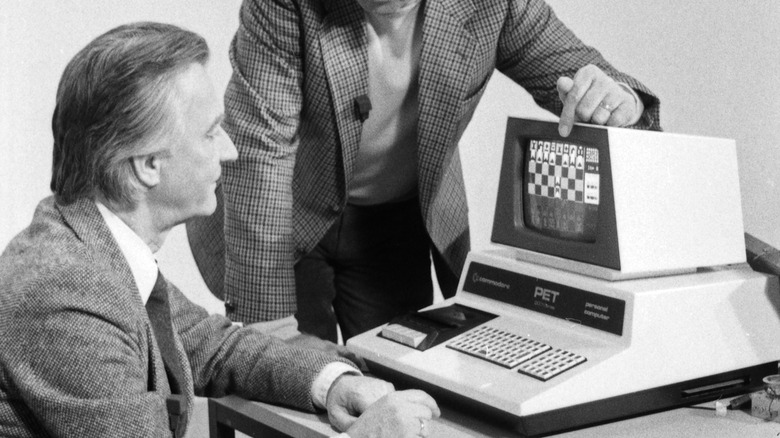
The Apple I was an incredibly short-lived product. 200 units were made, while an estimated 66 have survived to this day, and one was donated to the Smithsonian National Museum of American History. These machines now go for hundreds of thousands of dollars. Compared to the price that an original Macintosh goes for, the ancient machine is now an expensive piece of history. The Apple I was one of the first home computers to allow components to be hooked up to a TV. At the time, computers came in chunky, all-in-one designs that eliminated much of the complexity of getting them running.
However, it also eliminated much of the flexibility PCs have today and drove up costs. The lower-cost RF modulator completely wiped out the requirements for a dedicated composite monitor, which could rack up nearly $600. In 1977, the Commodore PET went for $795 ($4,380 in 2026), and Tandy sold its TRS-80 for $599 (around $3,300 in 2026). Getting these connected to a TV would require the user to actively modify the hardware, with future revisions introducing the RF connector for easier connections. Even with its limited availability, Apple had the upper hand on what foundations it was laying down.
Computers on the TV? A unique idea
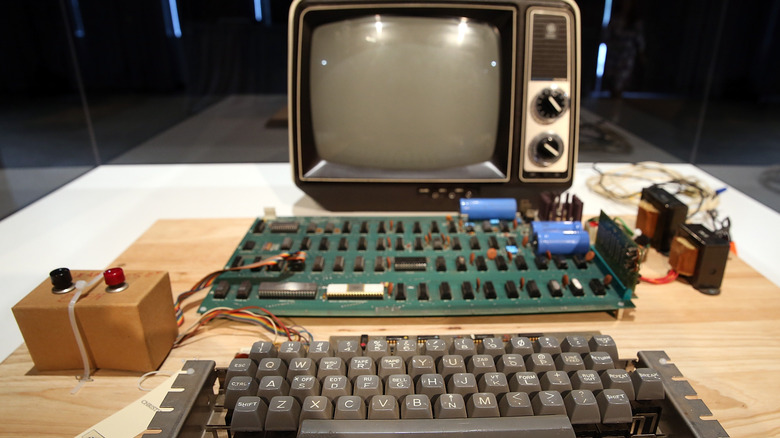
The Apple II cemented the company as a player in the space. Wozniak's philosophy drove the machine for the most part, with accessories and additional hardware that could be installed as the user needed it. His deep understanding of electronics and circuitry allowed him to bring color to the Apple II after the idea was given to him by Pong creator Al Alcorn. As the Apple II launched in 1977, just a year after the Apple I, it was quickly swept aside in favor of the more powerful device. Even though Apple sold a monitor for the Apple II, it was easily plugged into the TV with an RF modulator.
Apple struggled to get the FCC to approve its own, so it opted to allow the market to provide it instead, avoiding any legal trouble. Today, turning your PC into a TV gaming console is as simple as using an HDMI cable. In fact, Valve's recently released Steam Machine and the rumored upcoming "hybrid" Xbox Project Helix, which could change gaming, have brought (or are bringing) PCs to TVs, as both Microsoft and Valve try to figure out how to make it work all over again.