

New Solar Farm Designs Aren't Just For Crops, They're Helping Workers Too
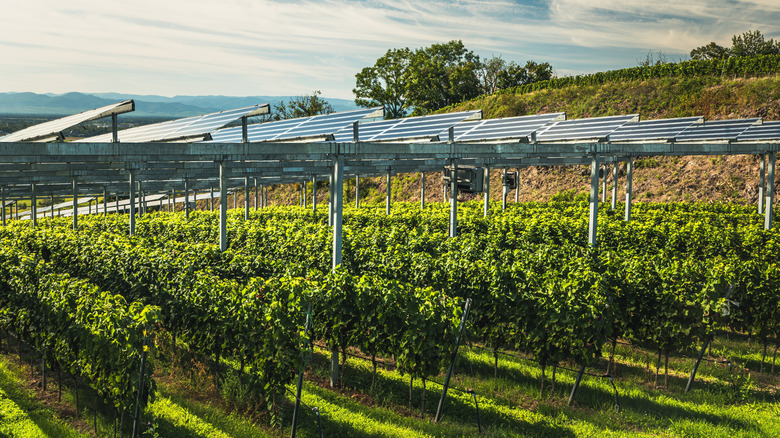
Farm work is hard work. Much of it has to happen during the day because of visibility and safety concerns, and because some crops are best picked after the morning dew dries. That means hunching, squatting, pulling, reaching — again and again — for long hours in direct sunlight. It's why crop workers are more likely to die from heat stroke than the average U.S. worker. But there is relief on the horizon. A new study found that farms built underneath solar panels, a practice called agrivoltaic farming, can greatly reduce the heat workers face while picking crops.
A Princeton University-led team of scientists built a model to better understand how solar panels affect food, energy, and health. They found a dramatic drop in average perceived temperature, which is a combination of humidity, wind, activity, and sunlight. Researchers based their model on a hypothetical tomato farm using weather data from central New Jersey on a hot summer day. In an open field, the workers' perceived temperature was about 102 degrees Fahrenheit. At an agrivoltaic field, picking crops underneath a panel, the workers felt about 7 degrees cooler.
The main reason is obvious. The panels block direct sunlight. What's interesting is that the study found the ground to be cooler as well. Crops release water through transpiration. Soil releases water through evaporation. Both processes use heat to turn water into vapor, which helps cool the ground and surrounding air. Together, the shade and moisture create a cooler microclimate underneath solar panels that workers will find soothing. Given these results, it's no surprise solar farms are having an unexpected effect on the environment.
The unexpected benefits of solar panels
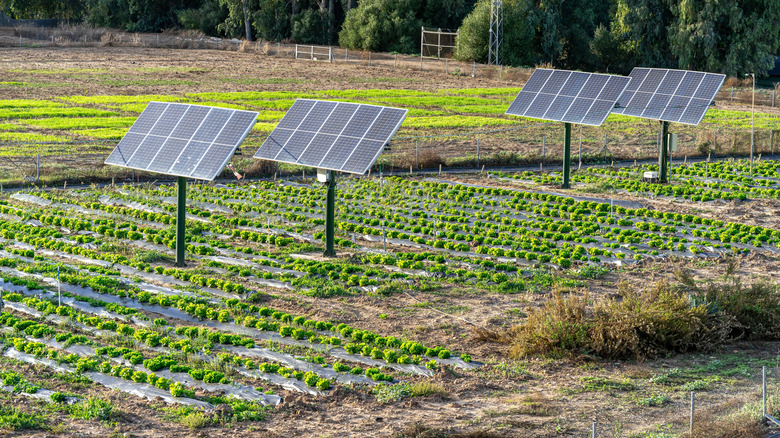
Not only are workers finding more comfort with solar panels, but the farms can potentially yield more produce. While under the shade of a panel, the study found tomato leaves were three degrees Fahrenheit cooler, on average, during the day and up to 13.6 degrees cooler during peak heat. And the leaves lost about 22% less water. German researchers studying the impact of shade on crops found those covered by cloths, nets, or solar panels can produce more food.
With a 20% reduction in sunlight, yields for fruiting vegetables, like tomatoes, were 8% higher under partial shade than full sunlight. Fruits and berries were 14% higher. Solar farms are also having a positive effect on wildlife, especially pollinators. But the Princeton study discovered one benefit that's not as obvious. The crops are cooling the solar panels. In the model, conventional panels peak at 153 degrees F under direct sunlight. Researchers found that during the same peak sun hours, panels over an irrigated crop reached just 135 degrees. That's an 18-degree shift.
Solar panels don't work well in high temperatures, so it's no surprise that the study found agrivoltaic panels are more efficient by about 3% versus standard solar farms. There is one minor concern. Panels set too closely together can restrict airflow, causing moisture to build underneath. That can increase humidity, making it harder for workers' sweat to evaporate and keep them cool. Researchers say ventilation from low-energy fans powered by the solar array can fix the issue.