

Here's What The Numbers Actually Mean In An Nvidia Graphics Card's Name
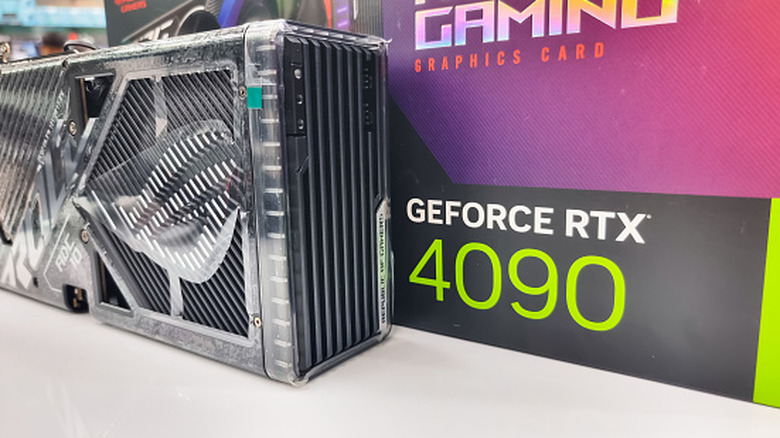
GPU naming schemes can be needlessly complicated, and it may seem like the biggest graphics card manufacturers just throw random numbers and letters together. But this isn't true — each letter and number in a card represents important information about the product, and understanding how Nvidia names its GPUs is integral to getting the best graphics card for your setup.
The numbers on Nvidia GPUs consist of two parts. The first two digits (or the first digit on older Nvidia cards) represent the generation, while the last two show the performance tier. Put simply, an RTX 5060 and an RTX 4060 belong to different generations but have similar performance, while an RTX 4060 and an RTX 4080 belong to the same generation but perform differently. Knowing the generation is important if you want to make use of modern features like Nvidia's DLSS, as older cards were made when these technologies either weren't available or were not as developed as they are today. A more recent generation means that the GPU is more optimized for technologies like ray tracing and DLSS, and it also means that the card is more efficient in handling processes.
The generations for modern Nvidia GPUs include the GTX 10- and GTX 16-series, as well as the RTX 20-, RTX 30-, RTX 40-, and RTX 50-series, the latter being its current generation. The GTX prefix means a card is older and fine for general gaming, while RTX means the cards support ray tracing and DLSS. These series are often also referred to using four digits by consumers, so note that the RTX 50 and RTX 5000 series are one and the same. Prior to these GPUs, Nvidia used a three-digit numbering convention. This included the GTX 200, GTX 400, GTX 500, GTX 600, GTX 700, and GTX 900 series.
Performance tiers

The generation of an Nvidia graphics card doesn't tell you how heavy a workload the GPU can handle. For this, you refer to the last two numbers, which indicate the performance tier. The lowest tier in Nvidia's current lineups is xx50, which encompasses budget-friendly, entry-level GPUs. These are fine for casual gaming, but struggle with anything graphics-heavy and aren't intended for high frame rates in demanding games.
Next are the xx60 cards, which are mainstream, mid-range cards that most avid gamers use. These offer good performance at 1080p resolutions and decent frame rates, but cannot run high-end games at the highest graphics settings. The xx70 cards are high-end GPUs that support high-quality gaming at 1440p, while cards ending in 80 offer even more graphics processing power, something that's needed for 4K gaming. Lastly, xx90 cards are Nvidia's highest-end GPUs for any given generation, and are usually overkill for most people both in terms of price and performance.
Figuring out which Nvidia graphics card you need is easy when you understand these numbering conventions. In terms of generations, higher is almost always better. However, if you don't need fancy features like ray-tracing or AI upscaling, opting for a more powerful card from an older generation can be cheaper. For performance tiers, decide what resolution you want to game on, whether you're comfortable gaming at medium settings or want the highest-level visuals, and whether you want high frame rates. It's also worth noting that Nvidia graphics cards often have suffixes that also affect performance. For example, a card ending with Ti means it has a slight improvement over the non-Ti variant.