

The Invention Of The 3D Printer Traces Back To The 1980s
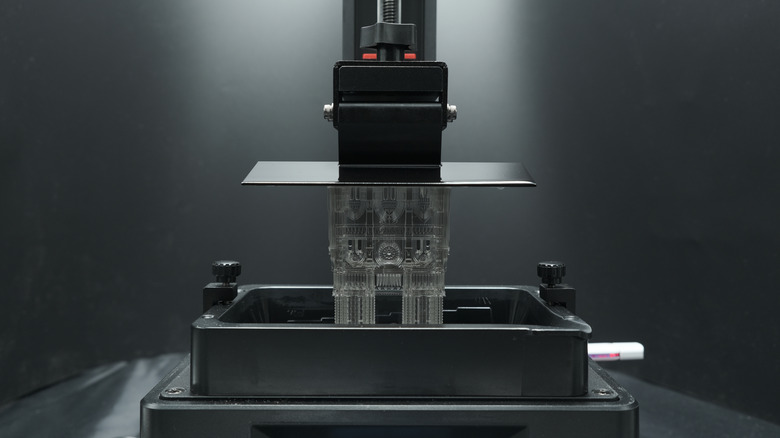
Many examples of modern technology are older than you think. For example, capacitive touch screens were pioneered in the 1960s to improve air traffic radars. And decades before you could buy a 3D printer for your home, engineers were pioneering ways to prototype objects quickly.
Depending on who you ask, the first 3D printer dates back to either 1981 or 1986. Dr. Hideo Kodama invented the 1981 "3D printer," which laid down a resin layer by layer and polymerized it with UV light. Meanwhile, the 1986 model, while running on the same premise (now known as stereolithography), was patented by Charles Hull. As such, many people recognize Hull as the grandfather of 3D printing.
Obviously, developments didn't end there. In 1988, Carl Deckard, then a student at the University of Texas, created a form of 3D printing known as selective laser sintering, a process where a laser solidifies powdered material into a solid object. And in 1989, Scott Crump developed the most recognizable form of 3D printing: fused filament fabrication (i.e., melting spools of plastic and depositing the results on a platform to build an object layer by layer).
Inspiration comes in many forms
Every artist and inventor has their muse. Some inventions were inspired by science fiction — after engineers wanted to turn science fiction into science fact. Other inventions, such as the 3D printer, come from places closer to home.
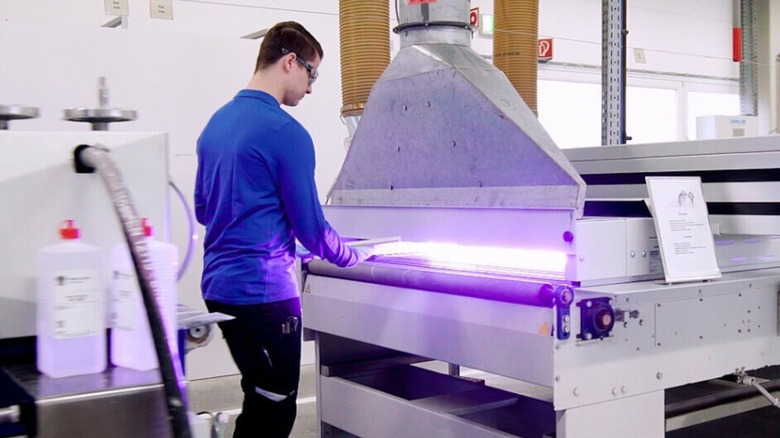
When Chuck Hall recounted to the National Inventors Hall of Fame how he invented his version of stereolithography, he said he got the idea from his workplace, which used UV light to add a thin plastic veneer to furniture. He wondered if the same technology could be used to "stack thousands of thin plastic layers on top of each other" and create a shape with the UV light. It took some convincing, but Hull's boss eventually signed off on the idea and let him work on the project... so long as Hull did it in his spare time.
Initially, Hull thought his 3D printer would only build temporary parts — rapidly prototype items that would be replaced with more durable injection-molded versions. His work eventually resulted in a system that beamed UV light into a tub of photopolymer, and thus stereolithography as we know it was born. But Hull's work didn't end there. He also invented the photopolymer material used in resin printers known as SLA, the .stl file format most 3D printers use, and the world's first commercial 3D printer, the SLA-1.
A lasting legacy
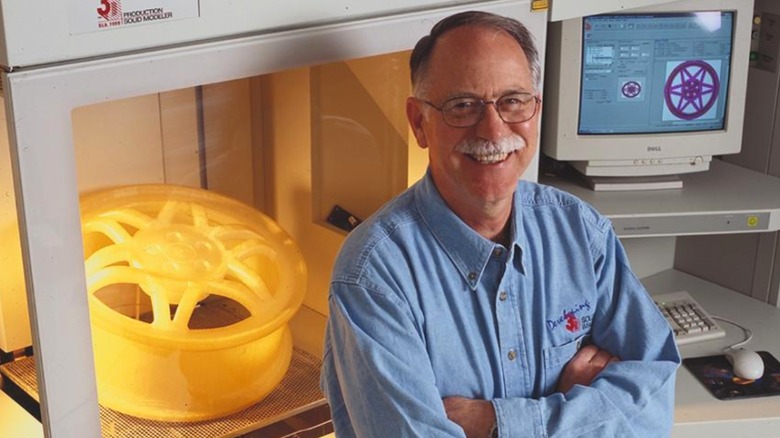
3D printing has evolved by leaps and bounds since the '80s. Today, you can 3D print houses and use a 3D pen to extrude molten plastic in freeform instead of sticking to an electronic blueprint. And while many people still use stereolithography for their prints, the original SLA-1 is long gone. But like the dinosaurs, it is preserved for posterity.
While fused filament fabrication is currently the most popular form of 3D printing, SLA printing was the original go-to method of rapid prototyping, especially for professionals. This was mostly because of how it worked: a UV laser bounced off a mirror to cure photopolymer in a tub, and an elevator in the tub lowered the part so the laser could start on the next layer. This method required large tanks, which restricted these printers to industrial settings. However, the process was flipped on its head thanks to inverted stereolithography. This newer iteration uses a series of mirrors to beam the UV laser onto a thin layer of SLA on a platform, which then lifts the piece out of the resin tank so the laser can cure another layer underneath. This method quickly became the stereolithography industry standard thanks to its smaller resin tanks and cheaper price tag.
As 3D printing advanced, including the advent of inverse stereolithography, the SLA-1 was phased out. However, you can find these relics of early 3D printing on display in museums such as the National Inventors Hall of Fame Museum in Alexandria, VA. While the Henry Ford Museum (in Dearborn, MI) presumably owns an SLA-1, this particular model is stored somewhere within the annals of the museum's collection and isn't available for public display.