

Is It Safe To Live Near Wind Turbines?
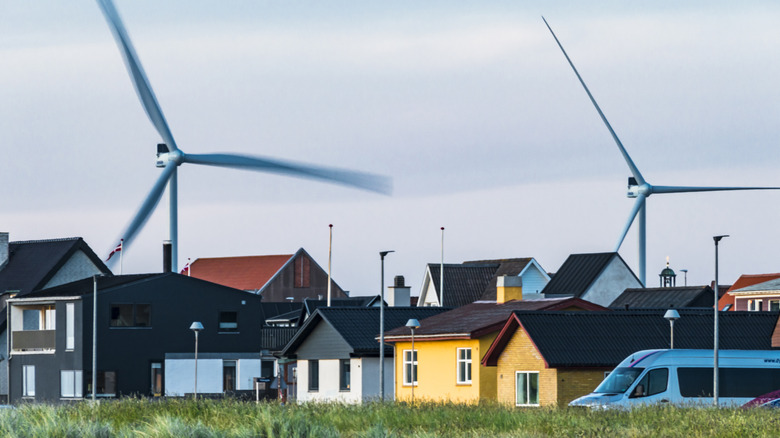
Not in my backyard! It's the rally cry of anti-wind turbine activists who want to stop the clean energy source from popping up near their backyard. They attend local planning commission meetings and preach on Facebook about the dangers of wind turbines. The thing is, most studies show there's very little risk. That doesn't mean turbines aren't dangerous. A turbine blade fell and killed an 81-year-old man in Akita, Japan in 2025, so the risk is definitely real.
Standing underneath a commercial wind turbine can be intimidating. On average, a hub is 350 feet off the ground. The blades rotate in circles 450 feet across. They're enormous. But are they dangerous? Researchers behind a 2025 study that examined a blade failure in Kansas say it's unlikely in their case in which a lightning blast hit the blade, launching debris more than 2,600 feet. The smaller debris didn't possess enough kinetic energy to hurt people, and the larger chunks fell underneath the turbine, not hurting anyone. Researchers said an adequate setback distance is important to keep wind turbines safely away from people.
There were similar suggestions for safety improvements after a 2024 tornado in Iowa buckled six turbines, although no one was hurt. Researchers suggested future designs should account for tornadoes. Another study tested the risk of ice being thrown from turbines onto highways. The study's authors recommended a risk assessment based on proximity to people. Currently, there is no national setback rule for wind turbines, but many local jurisdictions require 1.1 times the turbine height, which would be about 630 feet for the average turbine. Authorities in Japan say the man killed in Akita was "tens of meters" from the wind turbine when the blade struck him.
Are wind turbines bad for your health?

Health concerns drive some of the biggest outcries against wind turbines, including claims about wind turbine syndrome. The condition, allegedly caused by infrasound, hasn't held up under scientific scrutiny. Most research suggests there's no discernable health impact. A major 2026 study found no detectable decline in physical or mental health in the average person who lives near wind turbines. The study looked at 120,000 households over more than a decade. Another study in the Netherlands evaluated the primary-care records of between 350,000 and 560,000 people over a decade, finding no consistent association between wind turbines and health problems.
One of the disadvantages of wind turbines is they do emit noise. About a thousand feet away it sounds like the hum of a fridge. Noise can disrupt your life, especially sleep. Though, a 2025 study in Canada found wind turbine noise did not increase the chance of serious sleep disturbances. That study is interesting because researchers tested people living various distances from turbines. Results were similar except for one issue. People with the louder turbine noise were more likely to blame the turbines for sleep issues.
Annoyance is another story. The constant hum can be like living a few blocks from a major road. In rare cases, the spinning blades cast flickering shadows through your windows. But in both cases, people may get used to it. A 2025 study in Japan found that over a decade, annoyance from turbine noise and shadow flicker declined. Researchers said it suggests residents may adapt. It's good news for people living in the five states with the most wind farms who rely on one of the most efficient energy sources on the planet.