

Are Bookshelf Speakers Better Than Soundbars?

We may receive a commission on purchases made from links.
Are you thinking about investing in an audio system? We applaud your aspiration, but now it's time to take a look at the dizzying number of sound-emitting devices you'll have to choose from. Two of the most common options for the average home are bookshelf speakers and soundbars. The former is typically combined with an AV receiver or amplifier, while the latter is more of an all-in-one solution, complete with inputs, outputs, and power. Bookshelf speakers have been around a lot longer than soundbars, so you may be wondering if scooping up a well-rated set is a better choice than buying a single soundbar that plugs into your TV.
Unfortunately, there really isn't a straightforward answer, because a lot will depend on what you like listening to and what types of components you plan on routing through your new system. If you usually watch movies and TV shows or play video games, a soundbar might make the most sense. Most bars are designed to sit below or above your TV and will often contain a number of ports for connecting AV components like Blu-ray players and game consoles. Many soundbars also include a dedicated center speaker for enhanced dialogue and vocals.
A single pair of bookshelf speakers may actually sound quite impressive — particularly for music-focused listening and hi-fi sources — but most of these speakers are passive, which means you'll need to connect them to an amplifier with speaker wire. Fortunately, this also means you'll have more control over your speakers' final placement, whereas a soundbar is limited to the width and height of its chassis.
Speaker components and configuration make a difference, too
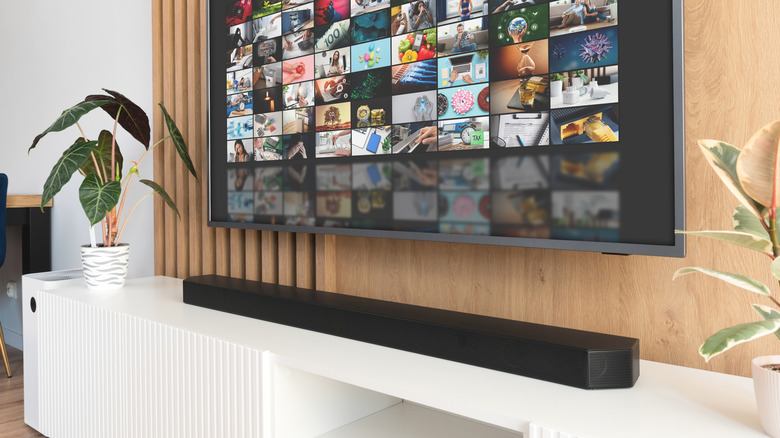
Further complicating the bookshelf speakers versus soundbar debate is the design and engineering that goes into each product. Drivers, woofers, and tweeters are the individual audio producers you'll find inside a bookshelf speaker or soundbar, and they're not created equal. A higher price for a pair of speakers or bar may mean that the product uses higher-quality components, but it could also just mean that the manufacturer decided on a higher price while using cheaper materials. And don't forget: your bookshelf speakers will still need an AV receiver or amplifier to power them.
You should also think about the expandability of your audio. If you're planning on adding additional channels — say for a 5.1 or greater surround sound setup — it's much easier to build out your system with bookshelf-style (or smaller) speakers than it is with a soundbar. There are a handful of bars that give you the option of adding rear channels or a subwoofer down the line (the Samsung HW-Q900H is a good example), but most soundbars are limited to the channels they support out of the box.
There's also the aesthetic to consider: Bookshelf speakers are often much bulkier than soundbars, so you may not be able to place them on a TV stand without blocking the TV screen; thus, you might need to invest in speaker stands or mounting hardware for your walls and ceilings. Generally speaking, soundbars are often more streamlined in appearance, and most systems are designed to fit right underneath your TV.
Having the best of both worlds is more complicated than you think

"Why not try for the best of both worlds?" you may be asking yourself. We hate to be the bearers of bad news, but combining passive speakers and a soundbar usually isn't an option, at least not for a traditional home theater system. Part of the reason why is that an AV receiver and soundbar typically plug into the same port on your TV: the HDMI ARC/eARC. The issue is that ARC/eARC is only designed to output audio to a single source; that means you can either connect an AV receiver with speakers or a soundbar.
It was a bit easier to skirt around this in the past, because older soundbars would sometimes include traditional speaker terminals. Theoretically, that meant you could connect both a soundbar and a set of bookshelf speakers to the same AV receiver, but we're willing to bet that manufacturers weren't so thrilled with this open-armed approach; after all, Brand A doesn't want you buying both Brand A and Brand B. This also explains why modern soundbars opt for the walled-garden approach; companies want you to buy their own extra speakers, not a pair from Klipsch or Polk.
But what if you just wanted to connect your soundbar using digital optical to your TV, while still connecting an AV receiver via HDMI ARC/eARC? Yes, that's literally an option, but even if you're somehow able to get everything working at once, chances are good you'll end up dealing with some kind of synchronization snafu. We love the idea of combining multiple audio products, but for the best results, you're better off keeping traditional speakers and soundbars separated.