

Is There Any Point In Buying An AI Subscription?

We may receive a commission on purchases made from links.
Subscriptions are becoming a first world problem, and often not worth it. Music and video subscriptions dominate users bank accounts, and now AI large language models (LLMs) do, too. Free versions of big chatbots can get the job done, but if readers find their sensitive and personal data flowing through data centers disturbing, there's another solution.
AI power users need more tokens or unlimited usage for agent features, reasoning models, image/video generation, but the average user will probably never hit free major LLM limits. Serious users often subscribe to multiple AIs at once, and it adds up. ChatGPT Plus, Google AI Pro, and Claude Pro are around $20/month. Over a five-year span, that's $1,200 out of pocket to use AI, and it's even more for higher plans, like ChatGPT Pro ($6,000), Google AI Ultra ($5,999.40), and Claude Max ($6,000).
LLMs can run on a PC, as closed- or open-source models, and they're free. Combine one with an AI-capable PC with dual ethernet ports to run alongside a user's home network, and the possibilities are practically endless. Open-source solutions for the cost of a capable PC put privacy and control in tinkerers' hands, not an AI or Cloud data center that's ruining its local environment and harming locals.
Open-source LLMs
Before discussing the hardware, picking the right open-source LLM to download is key. Open-source models are freely usable, modifiable, redistributable with no token or subscription costs and full privacy peace of mind with tasks being carried out locally and completely offline.
There's a lot to choose from, with the most popular choices being DeepSeek-V3/R1, Google Gemma 4, Z.ai GLM 5, Kimi K2.5, and MiniMax M2.5. Most run on consumer hardware, but the performance of these LLMs is down to how powerful a user's GPU and RAM are. Free is great, but the ceiling with local AI is determined by local hardware specifications. Subscription-based browser and app models using data center processing power.
DeepSeek is a good start, with both general use and reasoning models combining for solid performance and being able to problem solve. The easiest way to get it up and running is by downloading LM Studio, and then following the guidance on getting a language model running. For the average user keeping privacy in mind for their household, local open-source AI is at a point where its good enough for everyday questions, help, coding, and more. Most people think AI is a solution, but it's an efficiency tool, and my Radeon RX 9070 XT and 48 GB DDR5 RAM handles common tasks well enough for the family. But now there's mini-PCs that are built around AI use.
Mini AI PCs mark an end to subscriptions
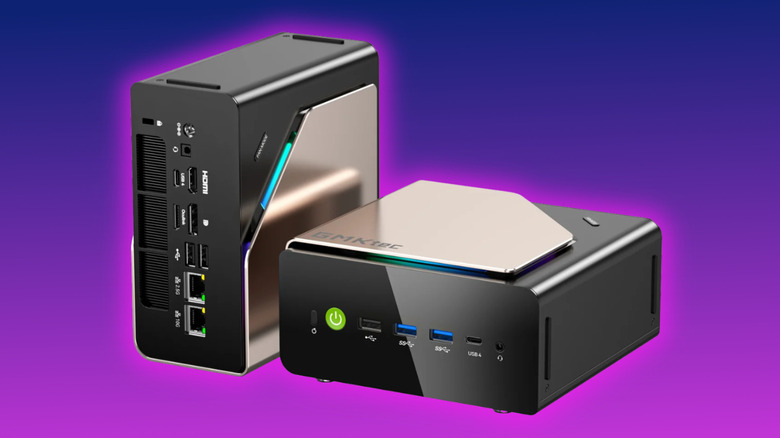
I've been messing around with the capabilities of the GMKtec EVO-T2S, and it does everything needed to run a local language model. Featuring an Intel Core Ultra X7 358H and 64 GB of soldered RAM running at 8533 MT/s, it uses a combination of the included neural processing unit, Phison AI SSD, and Intel Arc B390 graphics to run open-source LLMs on-device. GMKtec EVO-T2S is $3,299.99 right now, which is a big investment, but this isn't just to save money running AI.
Thanks to its 2.5GbE and 10GbE LAN port, GMKtec EVO-T2S can be integrated into a home network as a comprehensive firewall and smart home hub too thanks to virtual machines. The best part is that this isn't going to cost a cent to set up. OPNsense is a great open-source firewall operating system that's officially supported by Windows Hyper-V, just install it inside a virtual machine.
This process can be used with another open-source project called Home Assistant, which allows users to run their smart home functionality via their home network for ultimate privacy. Tinkerers can even install another M.2 SSD for more on-board storage alongside USB-C SSDs to run local storage on a home network.
By getting a purpose-built AI mini-PC like the GMKtec EVO-T2S, users can save thousands in just a few years while making a home network secure and more functional. Looking at the bigger picture, AI subscriptions aren't cost effective or worth it for most households.