

5 Times Star Trek Predicted Scientific Breakthroughs
Science fiction is a timeless genre. Every year sees new must-watch sci-fi shows and movies, but few are as iconic as "Star Trek." The series started as Gene Roddenberry's idealistic view of a future where humanity is part of a galaxy-spanning United Federation of Planets that all but eliminated disease, poverty, and capitalism. But most people remember "Star Trek" for its stories, characters, and technology. Inventions such as the warp core are key components in almost every plot, but they're also completely impossible (for now at least). But that doesn't mean every piece of technology on display exists solely in the realm of fantasy.
It's no secret that science fiction has inspired its fair share of real-life devices, many of which were brought to life because inventors want to turn "Star Trek" props into real tech. Tablets (Personal Access Display Devices) and pocket-sized wireless communication devices (the OG communicators) are some obvious answers, but these aren't the only pieces of technology or scientific breakthroughs the show effectively predicted. In fact, one could argue "Star Trek" predicted several advances, and here are some of the more noteworthy examples in no particular order.
Machine learning
The question of what defines sentience frequently crops up in "Star Trek." Lieutenant Commander Data (Brent Spiner) is the face of this due to his nature as an android, with Voyager's EMH (Robert Picardo) also personifying this issue to a lesser extent. However, Data was made to be sentient. A tool that was never designed for sentience can't develop critical thinking skills all on its own, can it?
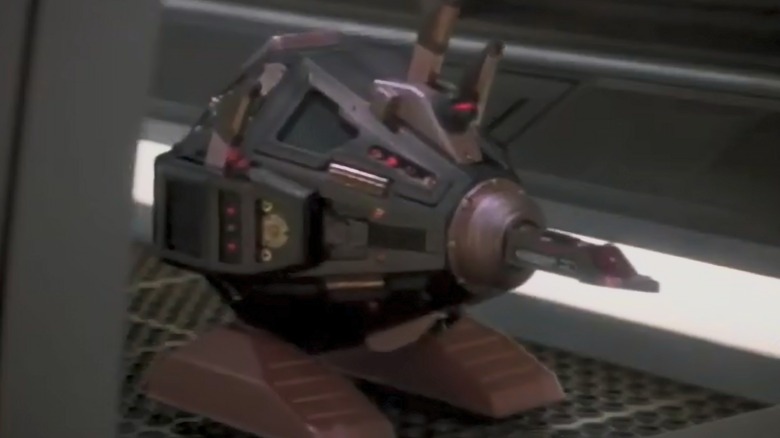
The "Star Trek: The Next Generation" episode "Quality of Life" introduces audiences to the exocomps: autonomous pods equipped with miniature replicators that can create virtually any tool needed for maintenance and repair. More importantly, the exocomps display an ability to adapt to their environments and utilize critical thinking skills. While the episode paints this ability as a sign of sentience (and indeed exocomps showed clear signs when they returned in "Star Trek: Lower Decks"), it has more in common with machine learning functionality.
Machine learning is a critical component of AI models that lets devices examine data, derive patterns from them, and produce inferences. In other words, machine learning is pattern recognition for robots. In the real world, machine learning can use your shopping habits to recommend products (e.g., you buy model kits on Amazon, and the store and its ads will suggest new kits for future purchases). Meanwhile, in "Quality of Life," an exocomp can infer that a simulated overload is just that: a simulation. So instead of repairing a fault that does not exist as intended, it eventually learns to fix the (intentionally) faulty signal. While this function was meant to allude to Data's sentience and self-determination, we can't help but notice similarities between exocomps and how machine learning functions.
Directed energy weapons

In "Star Trek," the Federation is a peaceful organization whose primary weapon is diplomacy. However, the Federation is far from the only power in its series' galaxy, and many are more interested in conquest rather than coexistence. As such, even the Federation needs actual weapons, which are the most iconic sci-fi guns to ever grace a screen and aren't that far off from reality ... from a certain point of view.
While most sci-fi ranged weapons rely on laser technology, "Star Trek" goes one step further with "phasers." These devices are classified as directed energy weapons that emit a beam of particles and, unlike most fictional laser weapons, phasers have variable settings. Depending on the situation (and the people in the writers' room), a phaser can stun or completely vaporize a target, but it also has utility, such as scraping condensed carbon off carbon filters. While we don't have directed energy sidearms yet, our current level of laser tech is more in line with Federation thinking than you realize.
Real-world militaries have been using laser-based weapons since the world's first Laser Weapons System was installed on the USS Ponce in 2014. These installations have become downright essential for modern warfare, as they are perfect for disabling drones. Like phasers, modern directed energy weapons can produce a variety of effects, from temporarily disrupting drone electronics systems (stun setting) to turning drone components into slag (max power setting). Admittedly, these results are the product of varying exposure time and distance to the drone rather than energy intensity, but the ability to change how directed energy weapons affect their target is too close to phaser philosophy to ignore.
Non-invasive medical scanners
If phasers are the de-facto weapons of "Star Trek," then "tricorders" are synonymous with data recording. These handheld devices can scan the entire electromagnetic spectrum and pick up even the slightest anomalies. While scientists have yet to replicate these devices (pun intended), they take a page out of the scanning devices of Federation starship sickbays.
The medical facilities of "Star Trek" are full of wondrous tools, including hyposprays (needleless injection syringes) and specialized medical tricorders. However, biofunction monitors are some of their most impressive. Just place a patient in a bed, and sensors can monitor vital signs and scan for almost every ailment imaginable. Some beds even include frames that provide more in-depth scans and mobile surgery suites. While modern hospitals don't have any such all-in-one medical contraptions, "Star Trek" accurately predicted the rise of non-invasive body scans.
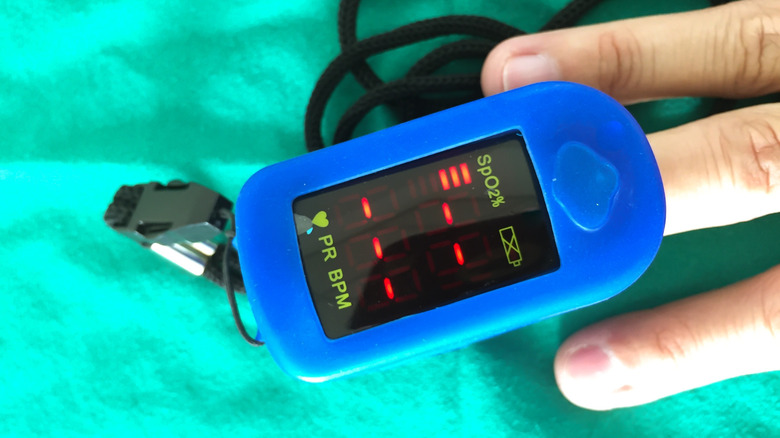
Today, non-invasive scans are commonplace in hospitals. You've got MRIs and CT scans, which create 3D cross sections of bodies — the latter has also been used to scan mummies. And even though they aren't as contactless as sickbay beds, real-world non-invasive medical technology has advanced so much that doctors can monitor a patient's vitals with only a finger clip. Heck, you can take that same tech with you on the go with smart rings that monitor your blood oxygenation and heart rate. Perhaps truly remote monitoring isn't as far off as we might think.
Wireless/Bluetooth earbuds
As previously stated, "Star Trek" predicted much of wireless communication. Heck, given how the original series' communicators worked, you could argue they predicted flip phones. However, every ship needs a communication officer, and every communication officer needs tools to do their job.
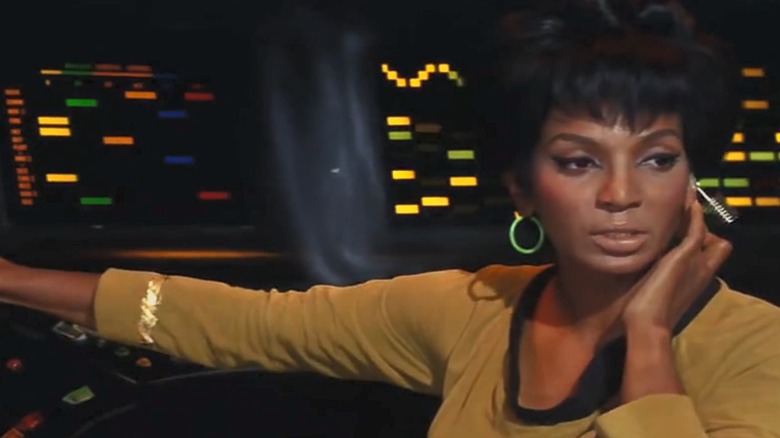
Nyota Uhura (played by Nichelle Nichols) was the original Enterprises' chief communications officer and one of the most influential characters in TV history. She was often seen manning her station, monitoring signals for potential communications and patching them through to the main viewscreen. Unlike the rest of the bridge crew, Uhura wore a special earpiece in her left ear, which she used to hear signals and messages before anyone else on the bridge. And it wasn't plugged into anything.
As you have likely guessed, the first season of "Star Trek" prophesied wireless and Bluetooth earbuds, as Uhura's earpiece serves the same function. Some models from throughout the series even have built-in microphones. What sets these earpieces apart from other communication devices in "Star Trek" to put them more in line with wireless and Bluetooth technology? They only work inside Federation starships, just like how wireless/Bluetooth signals are strong but have a limited range. Of course, earpieces were phased out after Federation scientists figured out how to miniaturize communication technology and stick them in combadges, so maybe the same will happen to Bluetooth/wireless earbuds. Solidifying the connection through the mercurial nature of technological advancement would be fitting.
Black holes
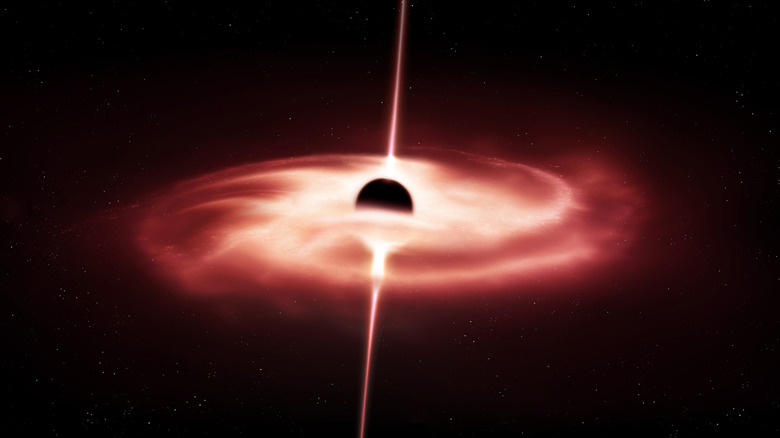
It is a known fact that "Star Trek" plays fast and loose with physics. How else could the crews of the various Enterprises (and Voyager and Cerritos) travel between solar systems within a matter of hours? But every now and then, an episode implements elements of a theoretical concept and gets the facts right. Well, sort of.
The episode "Tomorrow is Yesterday" from the original "Star Trek" is noteworthy for two reasons. First, the story, which aired in 1967, accurately predicted when humans would first land on the moon (1969). And the crew of the Enterprise gets to witness it — kind of — because they travel back in time. How? By using max warp power to escape a black star, a celestial body with intense gravitational power and is invisible to most detection methods.
What "Star Trek" called a black star would eventually come to be known as a black hole, as the first official one, Cygnus X-1, wasn't discovered until 1971. However, scientists have theorized that black holes exist for centuries — Michael John and Pierre-Simon Laplace came up with the concept in the mid-to-late 18th century. The black star of the episode was likely based on numerous theories, and the whole "difficult to detect" thing probably stemmed from the lack of evidence at the time. However, after black holes were discovered, "black stars" exited "Star Trek" lexicon. That, and since we now know how to detect black holes, we are learning that they're much more common than we previously thought.