

Is The Google Pixel 11 Pro Fold Worth Buying Over The Samsung Galaxy Z Fold 8?
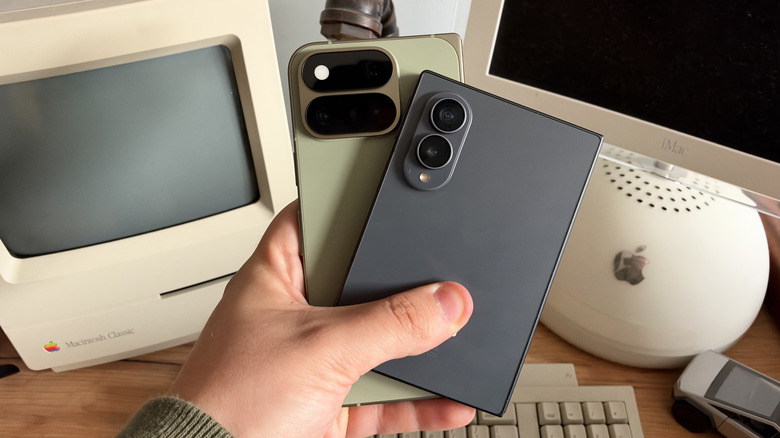
Google and Samsung have landed on the same price for their newest book-style foldables. The Pixel 11 Pro Fold starts at $1,899 for the model with 256 GB of storage, while the Galaxy Z Fold 8 starts at $1,899.99 for the same capacity. Both run Android 17, both open into an inner display of roughly 8 inches, and both are sold on the promise that Gemini will handle even more than it did last year. But that's where the similarities end.
Samsung used this generation to redesign the Z Fold into a short, wide slab that unfolds into a 4:3 screen built for watching things, the same style as the new iPhone Duo (and ironically, the first Pixel Fold). Google, on the other hand, kept the Pixel shaped like the book-style foldable phones you're familiar with that open into a near-square tablet — the same layout it has used for three generations now. Instead of focusing on a new design, Google turned its efforts to durability and a camera system the Fold 8 can't match.
While the two phones are quite different, you may be looking at both for your next folding phone. I've used both devices since they launched, and am here to break down the differences to help figure out which may be the right pick for you.
Pixel 11 Pro Fold vs. Galaxy Z Fold 8: What's the same?
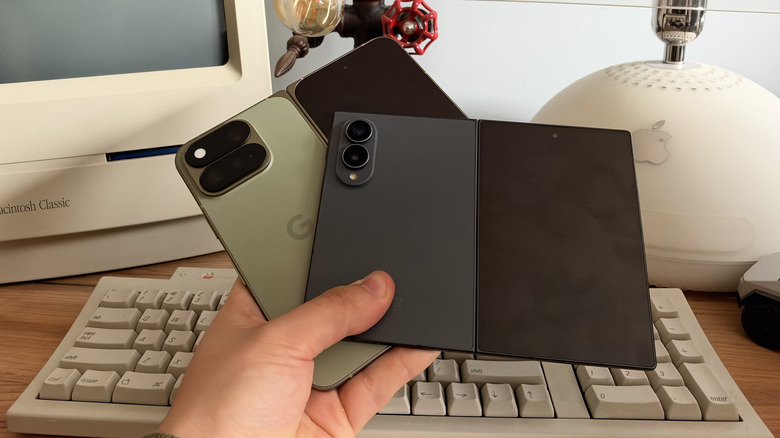
While the two foldable phones look quite different, there are a few similarities between them. Both phones start at 256 GB, both offer a 16 GB RAM configuration, and both launched with Android 17 and a focus on AI software features powered by Gemini. Connectivity matches as well, with Wi-Fi 7, Bluetooth 6, 5G, and eSIM support across both devices.
The displays are also quite similar, despite being entirely different shapes. Both phones offer an adaptive refresh rate between 1 Hz and 120 Hz on the cover screen and the inner panel, so scrolling and always-on content feel the same on either. Battery capacity is effectively the same, too. Samsung lists a 4,800 mAh cell for the Fold 8, while Google lists a 4,750 mAh cell for the newest Pixel foldable. That 50 mAh gap isn't something you'd notice during daily use.
Pixel 11 Pro Fold vs. Galaxy Z Fold 8: What's different?
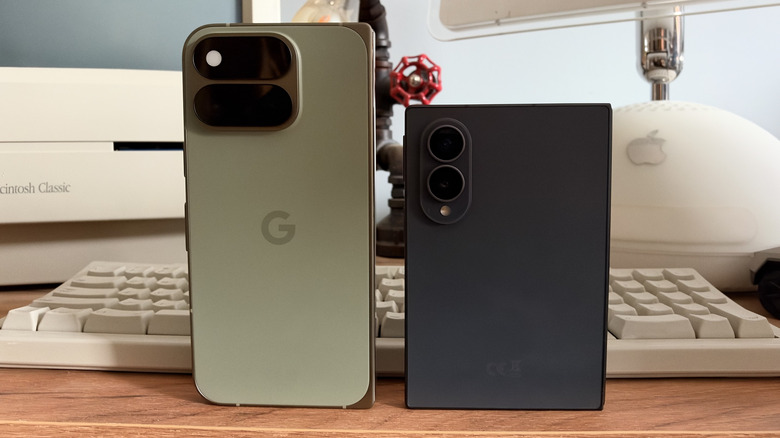
The Fold 8 is short and wide. When folded, it's 3.2 by 4.9 by 0.4 inches, and it weighs 7 ounces. It has a 5.5-inch cover screen in a squarish 16:10 ratio that opens into a 7.6-inch, 4:3 inner display. Meanwhile, the Pixel 11 Pro Fold looks like a regular phone when folded, measuring 6.1 by 3.0 by 0.4 inches, with a 6.5-inch 19.5:9 cover screen and an 8-inch inner panel. It weighs 8.4 ounces, over an ounce more than the Samsung, though you're unlikely to notice that.
As mentioned, the two foldable phones differ quite a lot when it comes to the cameras. The Fold 8 has two 50-megapixel rear cameras, with 2x optical zoom and no dedicated telephoto lens. The Pixel 11 Pro Fold has three cameras, adding a 10.8-megapixel 5x telephoto lens to its 48-megapixel wide and 10.5-megapixel ultrawide offerings. Despite the Pro name, Google's camera system is disappointingly the same from the regular Pixel 11 rather than the Pixel 11 Pro. However, Google does offer its 30x AI-powered Super Zoom. When it comes to image processing, Google and Samsung opt for different color and saturation styles. Having used both phones, I much prefer the look of the Pixel's photos, though this is entirely subjective. But, both carry a 10-megapixel selfie camera on the cover screen and a second 10-megapixel camera on the inner display, each at f/2.2.
The Pixel is rated IP68 water- and dust-resistant compared to the Fold 8's IP48 rating, which means the Pixel is more protected against dust. That's particularly important for foldable phones, as dust can damage the flexible display, hinge, and folding mechanism. Plus, the Pixel hits 3,600 nits of peak brightness compared to Samsung's 3,000.
Pixel 11 Pro Fold vs. Galaxy Z Fold 8: How does performance differ?
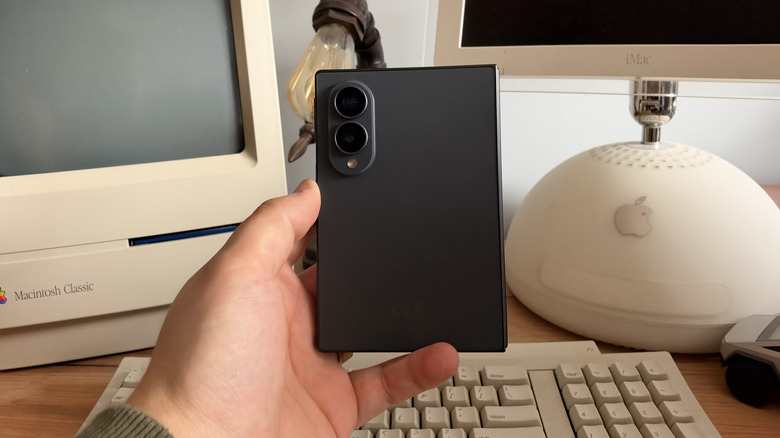
Both devices offer very different performance. Samsung uses the Snapdragon 8 Elite Gen 5 for Galaxy chipset and starts at 12 GB of RAM. Google's Tensor G6 chip comes with 16 GB of RAM in every configuration. When it comes to raw power, the Galaxy Fold 8 is miles ahead of the Pixel 11 Pro Fold. In fact, the Snapdragon 8 Elite Gen 5 is around 30-50% faster than Tensor G6 in raw CPU performance, according to benchmarks, roughly twice as fast overall in AnTuTu, and more than four times faster in GPU benchmarks.
The Galaxy Z Fold 8 charges faster over a cable at 45 W, reaching about 63% in 30 minutes, while the Pixel 11 Pro Fold charges at 30 W and will reach roughly 50% in 30 minutes. Google tries to compensate for the slower charging with its 25 W Qi2.2 magnetic wireless charging. Coming from an iPhone with MagSafe, I have a soft spot for Pixelsnap and the accessories designed to work with Pixel phones.
Which flagship foldable phone should you buy?
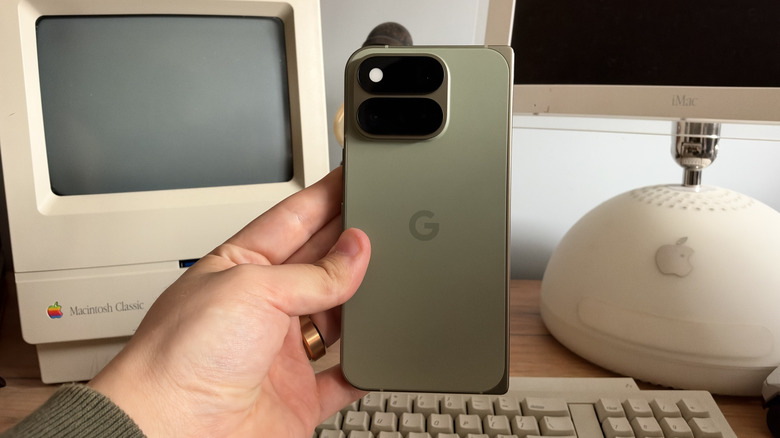
When it comes to which of the two folding phones you should buy, I think they separate themselves quite evenly. You should buy the Pixel 11 Pro Fold if you take a lot of photos. The 5x telephoto is one of the biggest advantages here, and it's why I'd pick the Pixel over the Galaxy — I just don't use the ultrawide lens very often. It's also the better pick if you read or work in documents frequently, because the larger internal screen is more ideal for text. It's also the better option if you want a cover screen you can use all day without thinking about it.
You should buy the Galaxy if you want to use the internal screen mostly for content. The 4:3 inner display is the better shape for film and games, and the Snapdragon chip is a stronger fit for gaming by a long way. The 45 W charging is a feature you'll be glad you have when you need to juice up the battery in a pinch, and being about 15% lighter makes it the easier phone to carry. While I prefer the portability of the smaller, square cover display, it's a radically different experience to using a regular phone, which may not be for everyone. The Galaxy Z Fold 8 Ultra adds the telephoto lens the Fold 8 lacks alongside a 200-megapixel main camera, an 8-inch display, and a 5,000 mAh battery. If the Pixel's camera is tempting you away from Samsung, that may be the phone to look at.
The Pixel 11 Pro Fold is $1,899 from the Google Store, Best Buy, or Amazon. The Galaxy Fold 8 is $1,899.99 direct from Samsung, rising as high as $2,499.99 for the 1 TB model.