

Samsung Galaxy Z Fold 8 Review: A Breath Of Fresh Air
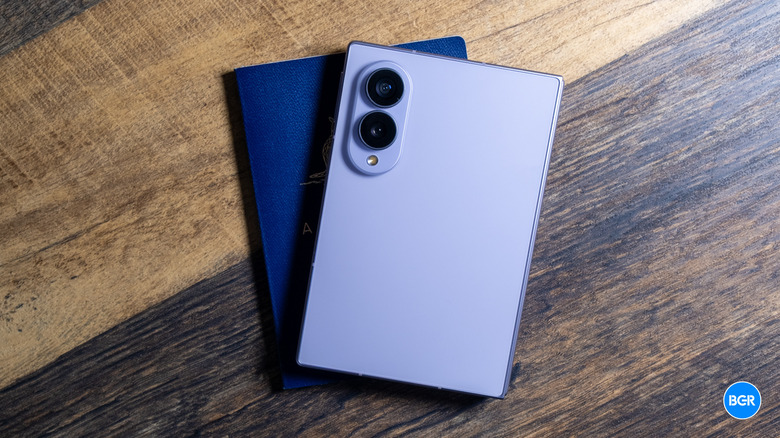
Samsung has spent years making the Galaxy Z Fold feel more like a traditional smartphone when it's folded up. Gone are the days of the super-thin candy bar. Thanks to the thin build and its current shape, you'd barely know that the Galaxy Z Fold 8 Ultra is a foldable phone — until you unfolded it. That, however, isn't the case at all with the new base model Samsung Galaxy Z Fold 8. The new device trades in the typical smartphone-like design for a shorter, wider passport-style build. It sits squarely between the big productivity-focused tablets and the compact flip foldables, and at $1,899.99 to start, it's still very much a premium product.
To be clear, this isn't the direct successor to last year's Z Fold 7. Confusingly enough, the Galaxy Z Fold 8 Ultra is the successor to the Galaxy Z Fold 7, despite its seemingly more premium name. The new Galaxy Z Fold 8 is a new tier altogether, sitting below the Z Fold 8 Ultra in price but with an entirely different design approach and a few missing features.
That, of course, begs the question: How does the new Galaxy Z Fold 8 compare to the Z Fold 8 Ultra, especially given its arguably more exciting — or at least more unique — design? Also, when you're spending that much in the first place, should you spring for the Ultra model regardless? We've been testing both phones to find the answer.
Design
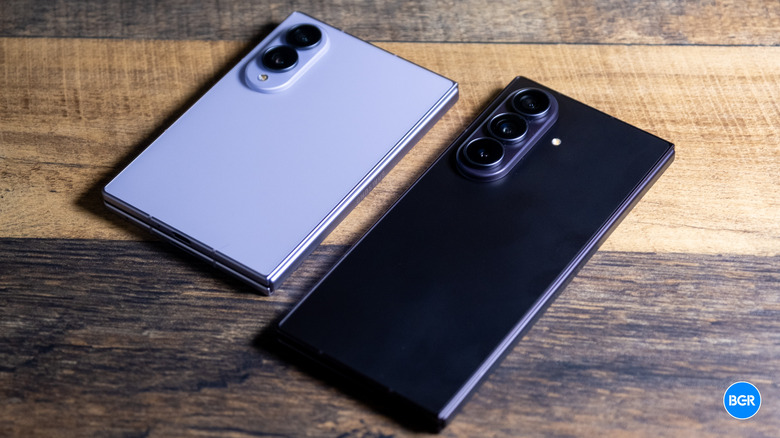
The passport comparison truly does work here. The Samsung Galaxy Z Fold 8 is shaped much more like one than any other foldable phone before it, and not everyone will be into it. Folded, the device measures 123.9mm tall, 81.9 wide, and 9.7mm thick, which makes it noticeably shorter and wider than the tall, narrow Z Folds of years past. Unfolded, it opens to an impressive 161.4mm wide, and sits in at only 4.5mm thick, so it still feels very thin.
Frankly, I really like the look and feel of it. I remember not loving the dimensions of the original Google Pixel Fold, but in retrospect, maybe I was wrong. Or perhaps it's just time for something different. I'm happy that there's a little more variety in foldable phones, and I hope to see that trend continue — I'm sure we will when Apple's next event rolls around.
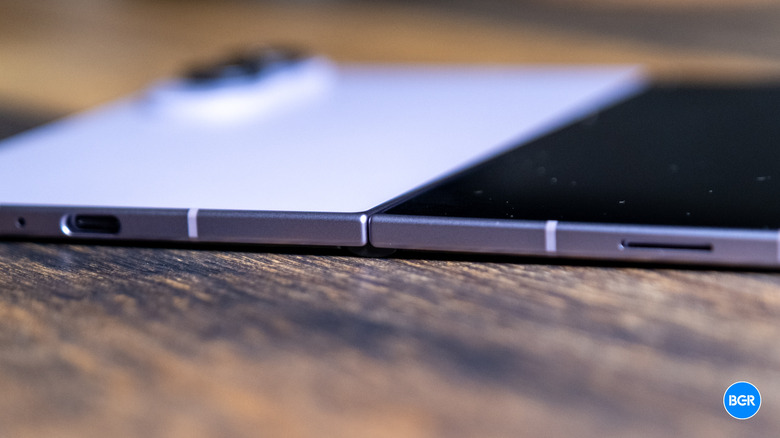
The device may not be the premium model in the lineup, but it still feels appropriately high-end given its price point. There's an Advanced Armor aluminum frame, Gorilla Glass Victus 2 on the back, and Gorilla Glass Ceramic 3 on the cover display. The inner display is a plastic-topped panel sitting on a titanium substrate, which gives it structural rigidity but leaves the surface soft. One thing you will notice about this device versus other foldables, however, is that the crease is very subtle compared to issues with foldable phone creases from the past few years. But the Galaxy Z Fold 8 makes it even less of an issue. Sure, you can see the crease if you hold it at the right angle, but you'll almost never feel it unless you're looking for it.
Durability is otherwise slightly mixed. The phone carries an IP48 rating, which means it'll survive 1.5 meters of fresh water for 30 minutes — but the "4" means it's only protected against limited dust ingress, not fully dust-proofed. That means that it could have some issues if, for example, you take it to the beach. It's entirely possible that smaller dirt particles will get trapped and do some damage as well, so you'll probably want a case to keep your device protected against those issues.
The rest of the design is relatively straightforward. There's a side-mounted capacitive power button with an integrated fingerprint sensor, which was fast and reliable in my experience. Color options for this phone include lavender, cream, graphite, and pistachio — the lavender is the hero shade this year, and I really like the look of it.
Display
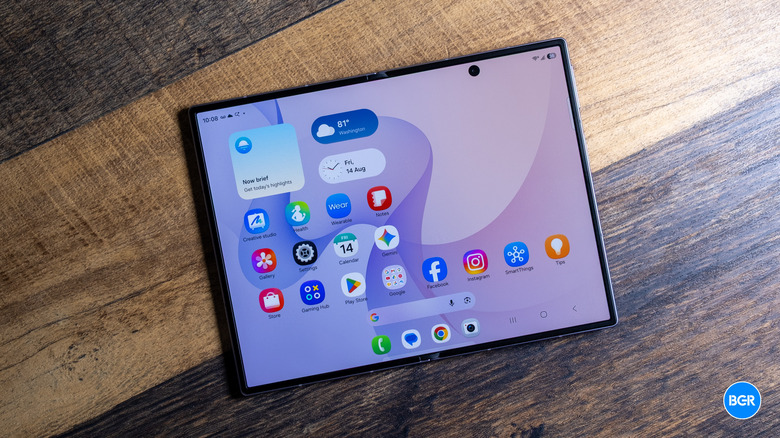
Both displays on the Galaxy Z Fold 8 look quite good. The inner display is a 7.6-inch Foldable Dynamic LTPO AMOLED 2X panel with a 4:3 aspect ratio and a resolution of 2448 x 1848 — which works out to 403 pixels per inch. The outer display is a 5.5-inch Dynamic AMOLED 2X at 1972 x 1248 with a 10:16 aspect ratio. Both refresh at up to 120Hz, both hit 3,000 nits of peak brightness, and the inner panel supports HDR10+ with an anti-reflective coating. Again, these are excellent screens. Outdoors, in direct sunlight, both stay perfectly legible, and the wide inner screen is perfect for watching videos, playing games, or using in split-screen mode.
Both screens are smaller than those of the Z Fold 7 and Z Fold 8 Ultra, though. That, of course, is kind of the point. You're trading some screen size for a different aspect ratio altogether. And while the shorter screen can mean that you're not seeing as much vertical content as you otherwise might, there are plenty of situations where having the wider display helps. If you want the bigger canvas, the Z Fold 8 Ultra keeps the 8-inch inner display and a traditional 21:9 outer screen — but you'll pay more for it.
There are some quirks to the displays. Samsung has ditched the under-display cameras in general, meaning that there's a hole-punch cutout, which you may or may not care about. To be clear, this doesn't bother me. Also, some apps simply aren't optimized for this kind of an aspect ratio (at least not yet). So while I didn't really notice many bugs, I did find that some apps just looked a little weird. But on the whole, both the front and the inner display on the Samsung Galaxy Z Fold 8 look excellent. That's no surprise coming from Samsung.
Performance
The Z Fold 8 runs on Qualcomm's Snapdragon 8 Elite Gen 5 for Galaxy, built on a 3nm process, paired with 12GB or 16GB of RAM and 256GB, 512GB, or 1TB of storage. It's a step up from the hardware built into the Galaxy Z Fold 7, and it's not a step down from the Galaxy Z Fold 8 Ultra, so you won't have to sacrifice performance if you're interested in the fresh design.
In day-to-day use, it certainly feels like a high-performing, modern device. It never dropped a beat while multitasking across split-screen apps, scrolling through dense pages, or jumping between the cover screen and the inner display. Gaming is no problem either, for the most part. It doesn't quite perform as well as a thicker device might with managed cooling, but most people won't notice this unless they game for extended periods of time. It never throttled to the point of frustration in my testing, but if you're planning marathon gaming sessions, know that it runs warmer than a similarly powerful slab phone would.
Battery and charging
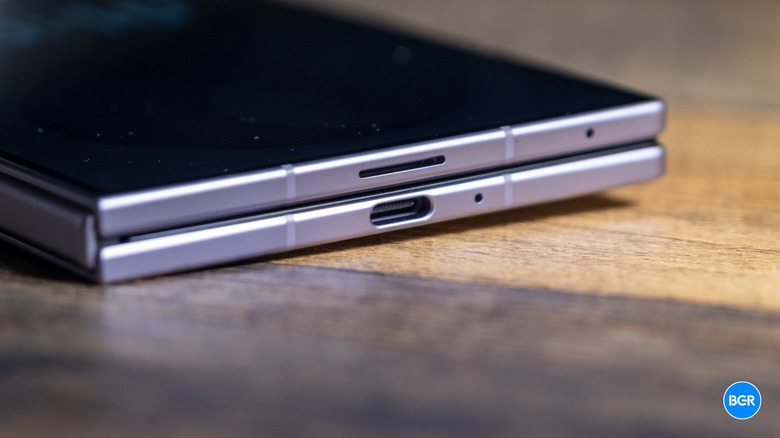
The Z Fold 8 offers a 4,800mAh silicon-carbon dual battery, up from 4,400mAh in the Z Fold 7, and its battery life is above average. I had no trouble getting the device through a full day of moderate to heavy usage — and while I probably wouldn't be able to get it through a second full day of moderate usage, that's certainly not a dealbreaker. I suspect most will have a similar experience.
Of course, actual battery life depends on how you split your time across the two screens. If you rely more on the cover screen, you're likely to stretch a charge for longer because the phone is driving a smaller screen more of the time. Even then, however, with moderate amounts of inner display usage, you should still be able to get through the day perfectly fine.
Charging is improved, too. Wired charging jumps from the Z Fold 7's 25W to 45W over USB PD 3.0, and with a compatible charger you'll hit roughly 65% in 30 minutes. Wireless charging runs at 20W, and there's 4.5W reverse wireless charging for topping up earbuds. The 45W figure isn't spectacular by industry standards — plenty of competitors advertise far higher — but it's fast enough that a quick top-up before heading out actually accomplishes something.
The one annoyance is the lack of built-in magnets for Qi2 wireless charging alignment. If you've invested in magnetic stands or car mounts, the Fold 8 won't snap into them the way an iPhone or a some compatible Android devices will, and you'll need a case with magnets to get that convenience back. That's pretty disappointing, and I hope Samsung adopts magnetic wireless charging in the near future, because it's behind the times compared to some of its biggest competitors.
Camera
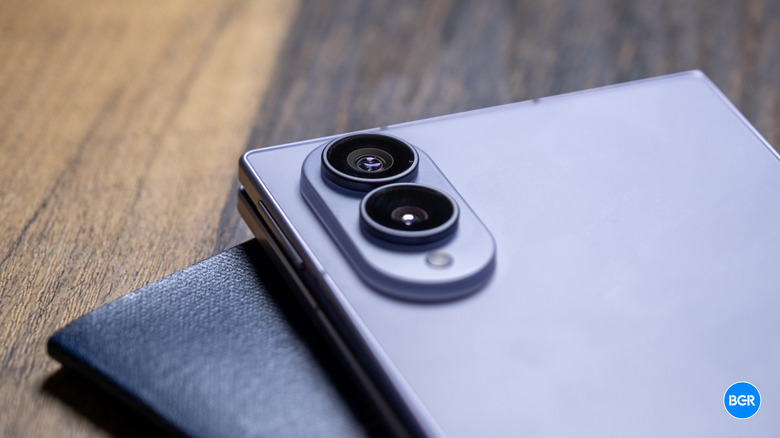
Apart from the design, the camera system is the biggest difference between the Z Fold 8 and the Z Fold 8 Ultra. On the back, you get two 50-megapixel cameras — a main camera with an f/1.8 aperture, OIS, and PDAF, plus a 50-megapixel ultra-wide. For front-facing cameras, you'll get two 10-megapixel hole-punch cameras — one on the inside screen, and one on the outside. Of course, like any foldable phone, you'll be able to use the higher-quality rear cameras for selfies, so it's not as big of a deal that the front-facing cameras are lower-quality.
The absence of a telephoto is noteworthy. There's no optical zoom of any kind here — magnification relies entirely on digital zoom up to 10x. That's a real downgrade from the Z Fold 7 and Z Fold 8 Ultra, which paired a 200MP main sensor with a 10MP 3x optical telephoto.
In fact, the lack of a telephoto camera is one of my biggest issues with the phone in general. I would have been perfectly fine with Samsung adopting the quad lens system of the S26 Ultra for the Z Fold 8 Ultra and putting a lower quality telephoto camera on the standard Z Fold 8, but having no telephoto camera at all on a phone that costs this much is pretty silly.
The cameras that are built into the phone perform decently well. The main camera produces accurate colors, and daylight shots are bright, detailed, and consistent with what you'd expect from a Samsung flagship. The 50MP ultra-wide is a step up in resolution from the Z Fold 7's 12MP unit, and it holds up nicely for landscapes and group shots. For social media, family photos, and travel snapshots, most people will be perfectly happy with what this device produces.
Again, though, zoomed shots are a little disappointing. Digital zoom at 2x or 3x is passable thanks to the resolution headroom in that 50MP sensor, but push toward that 10x limit and the processing can only do so much — edges soften, detail smears, and you're reminded that no amount of computation fully replaces a dedicated camera with optical zoom.
Low-light photography is similar. The main camera has a fairly capable sensor, but it's not as impressive as the 200-megapixel camera built into the Z Fold 8 Ultra, and that definitely shows up in lower-light scenes. Photos taken in low-light scenarios will show more noise and less dynamic range. In genuinely dark conditions, this camera trails the best slab flagships by a clear margin. Finally, the dual 10MP selfie cameras are unremarkable but perfectly adequate for video calls, which is arguably their main job on a device like this.
Software
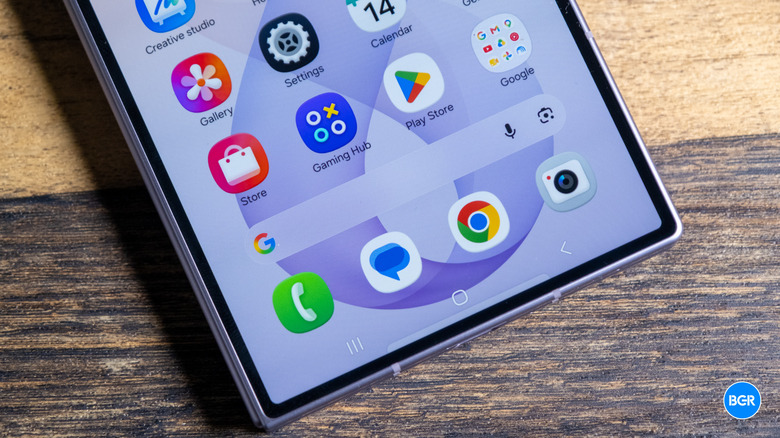
The Z Fold 8 ships with Android 17 and One UI 9, and Samsung guarantees up to seven major Android upgrades — which matters a great deal on a $1,900 phone. For the most part, One UI works fine on this device. It's never been my favorite implementation of Android, but it works well here, and it's easy to do things like manage multiple apps open at a time, drag-and-drop between apps, and switch seamlessly between inner and outer displays.
Flex mode is still here, too. Fold the phone halfway, and content shifts to the top half of the inner screen while controls move to the bottom — which is handy for video calls while propping the phone up or for media playback with a built-in stand. It's the kind of feature you forget about until you're on a call without a tripod, and then you're glad it exists.
The generative AI features are more of a mixed bag. Text generation, image editing, and smart suggestions are all built in, but whether or not you use them remains to be seen. As with most recent releases, these features aren't moving the needle for me.
Like other recent foldable Galaxy devices, there's no S Pen support, which is a little disappointing, and the device doesn't recognize any stylus input. The Z Fold 6 was the last generation to support it. For anyone who treated the Z Fold as a Galaxy Note successor, taking handwritten notes or sketching on the big screen, this is the end of the line.
Conclusions
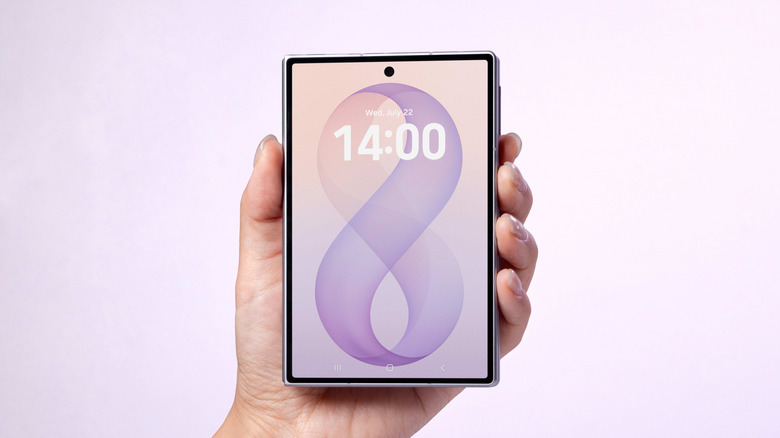
The Samsung Galaxy Z Fold 8 is one of the most refined book-style foldables Samsung has made, and the passport shape makes it unique among foldable devices in 2026. I really like the design — though it certainly isn't for everyone. For now, I'm glad there are options in both forms, and while I hope we start to see more passport-style foldables, I also hope we see more designs and experiments across the industry. Apart from the design, the hinge is durable, the structure holds up well, the displays look excellent, and the device performs excellently.
There are, of course, missing features. That was always going to be the case for a device that's being released alongside an "ultra" variant. I certainly wish the phone had a telephoto camera, and I wish buyers could choose which they wanted based solely on the form factor rather than the camera quality. For now, if you're interested in this design, you'll need to settle for a worse camera.
If you want a pocketable tablet for reading and multi-tasking, and you're willing to give up optical zoom and stylus support to get it, the Z Fold 8 delivers.
The competition
The most obvious alternative is Samsung's own Galaxy Z Fold 8 Ultra, which keeps the 8-inch inner display and the higher-end camera system with an optical telephoto. The Galaxy Z Flip 8 attacks from the other direction at $1,200, heavily undercutting the Fold 8 on price with a focus on pocketability rather than doubling as a tablet. And, interestingly, last year's Z Fold 7 remains a legitimate option — it has the larger 8-inch screen, DeX desktop modes, stylus input, and a 3x optical zoom lens, all of which the Z Fold 8 dropped.
There are other foldables worth considering, though. The new Motorola Razr Fold is an excellent device, with a triple camera system and equally impressive performance. And, of course, there are devices like the Honor Magic V6, which is ultra-thin, performs well, and comes with a better camera — but the software doesn't quite stack up.
Should I buy the Samsung Galaxy Z Fold 8?
Yes, if you like the new form factor and don't mind giving up a telephoto camera to get it.