

Are AirPods More Likely To Damage Your Hearing Than Wired Headphones
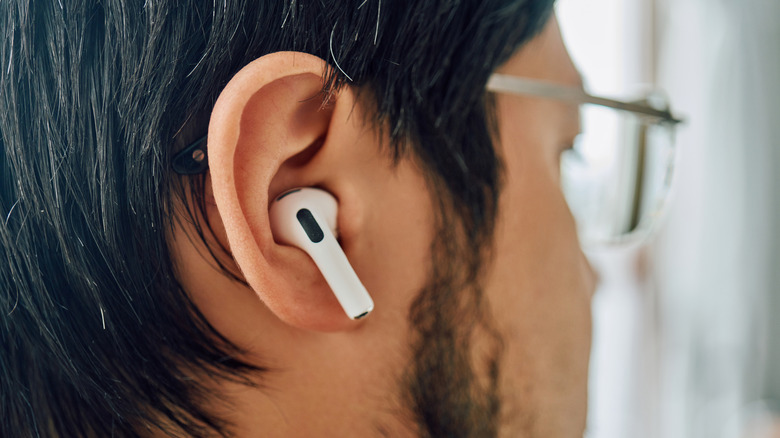
For many, AirPods may be more convenient than wired headphones, but it's also easier to damage your hearing with them. AirPods are not more harmful than wired headphones. For example, the concern around that Bluetooth radiation emitted by AirPods causes brain cancer is a Bluetooth myth you shouldn't believe. But our behaviors linked with using AirPods can increase the risk of them damaging our hearing compared to wired headphones. Particularly, any habit that forces you to turn the volume up to a decibel (dB) level that is unsafe for long durations can damage your hearing.
Decibels are a measure of how intense a sound is, and according to the World Health Organization (WHO), anything below 60 dB, which includes a normal conversation and breathing (10 dB), is safe to listen to for an unlimited amount of time. At 80 dB, which is approximately the sound of an alarm clock, you can safely listen to sounds for 40 hours a week. If you crank that up to 90dB, which is the level of a shouted conversation, that number drops down to four hours a week. Just keep in mind that the effects of listening to music too loudly are cumulative — the hours don't reset when you stop listening; it's about the effect it has on your ears over time.
AirPods habits may increase your risk of turning the volume up
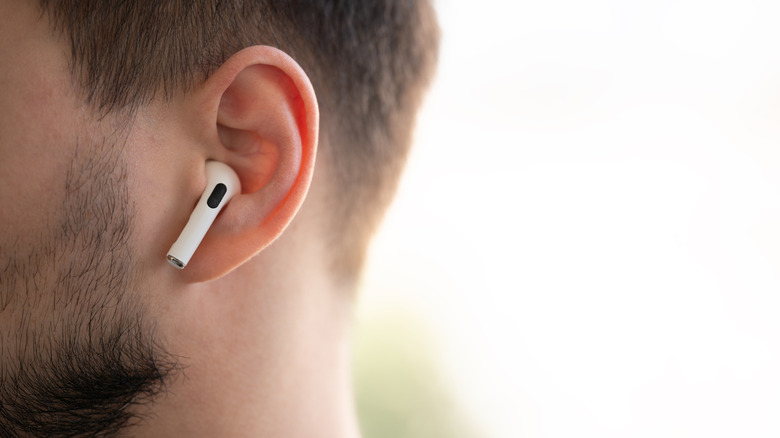
Over-ear headphones have large cup sizes and speakers, making it easier for them to form a good seal and tight barrier around your ears. This allows them to offer passive noise cancellation. In-ear AirPods, on the other hand, need the help of Active Noise Cancellation (ANC) to effectively block external noise. AirPods Pro do come with ear tips to form a better seal, but it's not the same as the cups on over-ear headphones. Besides, you also need to find the right fitting tips for the AirPods to form a proper seal. Keep in mind that only AirPods 4, AirPods 5, AirPods Pro models, and AirPods Max come with ANC.
But if you're using in-ear AirPods without ANC in a noisy background, you can end up increasing the volume to unsafe levels just so you can hear better. Just keep in mind that AirPods 3, for example, can output up to 105.7 dB when the volume is at 100%, according to tests done by HeadphonesAddict. WHO recommends only eight minutes of listening time per week at that level.
Another scenario is when you just use one AirPods bud instead of both. It could be preference, like wanting to be able to hear your surroundings more clearly in one ear while listening to music or being able to take a call with your earbud in the other. It could be that one of your AirPods is lost, not working, or out of battery. Either way, only using one AirPods bud can cause you to turn up the volume beyond what is safe just so you can hear what's coming out of your AirPods.
Wired headphones can keep your listening habits in check

Wired headphones are bulky, and even lighter earbuds still have a wire that tethers them to your device. Wearing them all day or for prolonged periods of time, such as when sleeping, jogging, and running errands, often becomes impractical. AirPods, meanwhile, are small, which makes them easier to wear for longer and in noisy environments that force you to increase the volume. Even when sleeping, people have been known to turn up the volume when wearing AirPods.
Also, keeping your AirPods in all day can lead to the buildup of wax, preventing the ear from self-cleaning the ear canal. That buildup can dampen the sound of the AirPods, causing you to turn up the volume. If you sleep on one side while wearing AirPods or turn them upside down, which some people do to get a better seal, you can push the wax further into the ear canal.
So if you're going to be using AirPods for an extended period of time, keep the volume level in check, and only wear them for a short time. A good rule to follow is the 60/60 rule, which states that you should keep the volume at or below 60% and that you should not listen to them continuously for more than 60 minutes. If you don't trust yourself now that you know this information, you can switch to wired headphones. If your phone doesn't have a headphone jack, you'll need a USB-C to 3.5mm adapter.