

These 4 Nintendo Consoles Were Exclusive To Japan
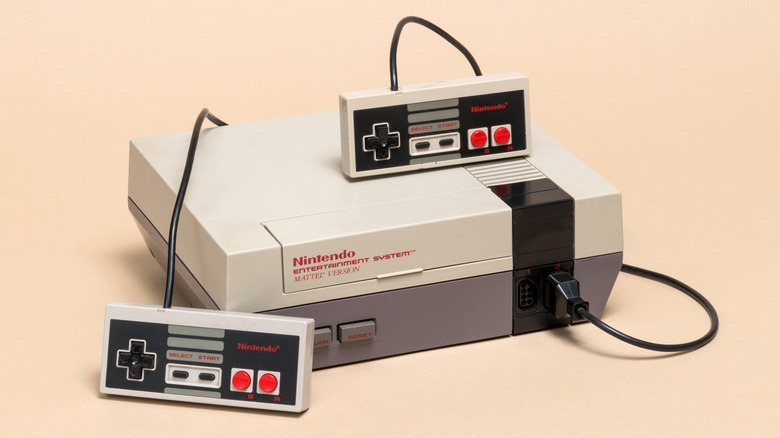
Nintendo's rich console history is quite deep and interesting, even if not all of its gaming systems made it outside of Japan. In some cases, Nintendo didn't find the market strong enough to warrant a global release, and in others, some of the company's inventions were simply too niche. Looking back, Nintendo's diverse portfolio is intriguing, given how large its global gaming presence became, compared to when the company first established its console lineup. Today, it would be highly unusual to see any Nintendo console or similar invention be permanently stuck in Japan.
For example, Nintendo and Panasonic released a very rare Nintendo GameCube edition that was Japan-exclusive, dubbed the Panasonic Q GameCube. This item, if sold today, can fetch well over $1,000, depending on the condition and what's included. It turns out that this limited-run edition had very few units sold in Japan – less than 100,000 – and is considered a rare collector's item. But this also meant that there was basically no chance that this niche product would ever leave the country.
1. Twin Famicom
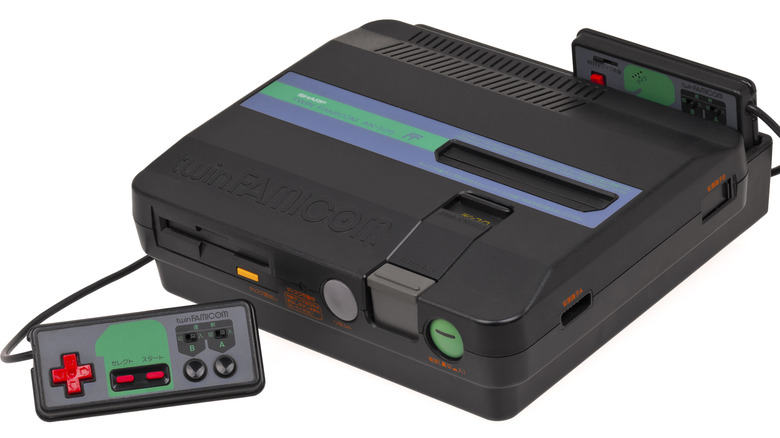
The Twin Famicom, also known as the Sharp Twin Famicom, is a 2-in-1 console designed by Sharp in 1986. The Japan-exclusive system combines Nintendo's Family Computer, also known as the Famicom, cartridge slot and the Famicom Disk System (FDS) into one package. These units were released in two slightly different color schemes: red with black trim or black with red trim. The system also included built-in RCA connectors, while still including an external RF modulator as an add-on. Previous Famicom systems were also RF-only, so this one technically offered an audio and video upgrade if the TV could support it. The back of the console also includes two hard-wired controllers with a D-pad and face buttons — though turbo switches were later added to the AN-505 models and the controllers had longer cables.
If you want to procure a Twin Famicom, you can do so on eBay. Conditions will vary, as most sellers have them used and without the original retail box. You may also find the console in a retro store in Japan, or you can import one through Enjoy Game Japan online.
2. Panasonic Q GameCube
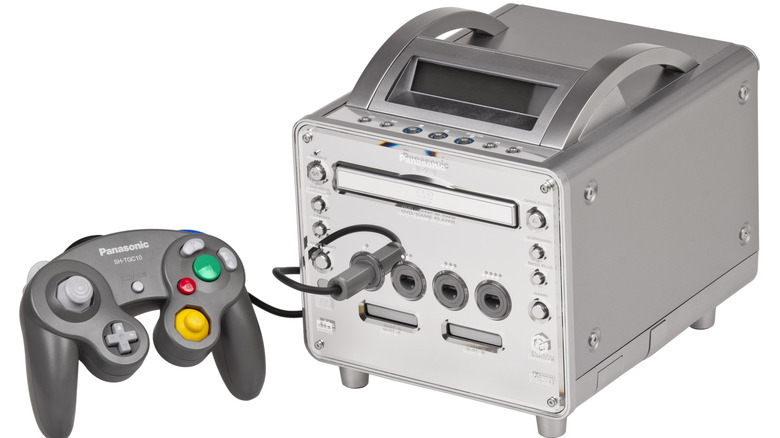
The Panasonic Q GameCube was definitely a special-if-not-quirky gem released in the early 2000s, based on a Nintendo collaboration with Panasonic. It was also Nintendo's answer to a console that could natively play DVDs/CDs, much like its Sony rival. However, this premium console see as much success as one could hope. One reason is because its launch price was nearly ¥41,000 to ¥46,000, and Japanese consumers found it cheaper to buy a GameCube and a DVD player separately. Nintendo didn't fully advertise the product when the regular GameCube launched, and Panasonic also didn't give it the proper marketing it needed to get off the ground — plus, it didn't help that the regular Nintendo GameCube was also a commercial failure. Then, of course, while the chassis has a nice, shiny, unique coating and structure — looking almost like a metallic mini stereo and oven — it wasn't compatible with many accessories. All of that combined, essentially made this rare collector's item a commercial failure, which is why it likely never left Japan.
Finding a Panasonic Q GameCube at a reasonable price is trickier because of its rarity. You can find these units sold internationally on eBay, but at a hefty premium for a working model, and cheaper if you buy one for parts.
3. The Nintendo AV Famicom
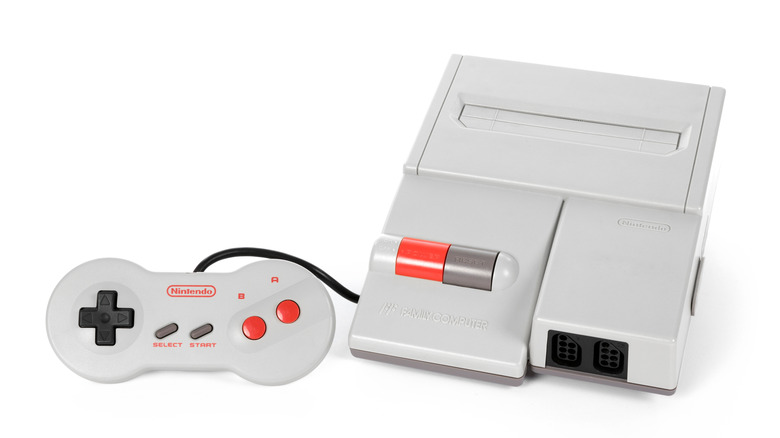
When mentioning the Famicom, or any iteration of it, things tend to get a little confusing, because the Nintendo Entertainment System (NES) is technically just the westernized version of the Famicom. That's why it makes more sense to look at specific Famicom editions that never made it to the west, like the Nintendo AV Famicom. The Nintendo AV Famicom was released in 1993. It was considered a rebuild of the 1983 Famicom. The major difference came from the technical specs of the console: Nintendo used this revision to replace the old RF-only TV hookup with standard composite AV multi-out ports. That's also why the Nintendo AV Famicom differs from the newer NES (NES-101) that came overseas in 1993; Nintendo decided to cut the AV ports and reverted to a strict RF modulator output. This was likely down to a financial decision to cut costs and maximize profit at the end of the Famicom/NES era, since the SNES was already out in Japan and America in 1990 and 1991, respectively.
The Nintendo AV Famicom isn't too difficult to find since it isn't as old as some of the other Japanese-exclusive consoles on this list. The easiest place to look is eBay, where you can search for the model (HV-101), or you can use Enjoy Game Japan to import one.
4. The Color TV-Game series
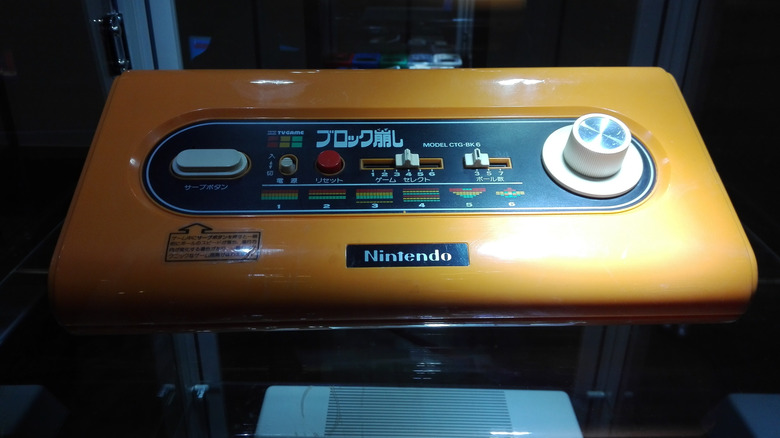
Nintendo's origin is Japan. So it's no surprise that Nintendo's original console, the one that predates the original Famicom, also never left Japan. The Color TV-Game has a whole series that started in the late 1970s and continued until 1980, and it was developed alongside Mitsubishi Electronics. More notably, it wasn't like a traditional gaming console where you bought cartridges and loaded them to play; these came with preloaded games.
The Color TV-Game 6, released in 1977, included six variations of "Pong," including hockey, volleyball, and light tennis. Later, the Color TV-Game 15 came out, with 15 variations and detachable controllers. The Color TV-Game Racing 112, followed in 1978, featuring a top-down racing game. In the following years, 1979 and 1980, the Color TV-Game Block Breaker and Computer TV-Game (based on the arcade game "Computer Othello") focused more on specific arcade titles. It also makes sense that Nintendo never exported these inventions outside Japan because, at the time, the company was still focused on the domestic market and lacked the resources to go international. Nintendo of America was only established in 1980.
The Color TV-Game series is a little trickier to secure today. It is quite old, but it also lives up to its name. You can buy them separately on eBay, but you will have a hard time finding the Color TV-Game Block Breaker and Computer TV-Game. Fortunately, museums also preserve the latter two systems, such as the Centre for Computing History for Color TV-Game Block Breaker and the Mario Museum for Computer TV-Game.