

What Is The AUX Port On Your Alexa Echo Speakers For?
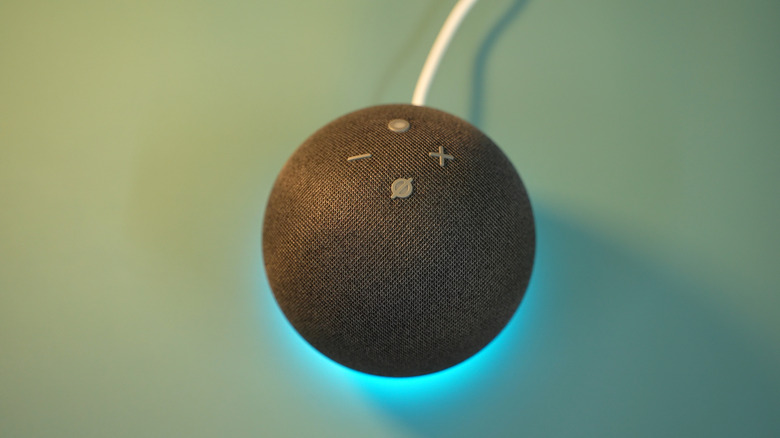
Amazon Echo speakers are among the most popular and versatile smart home devices. Not only can you use them to automate other internet-connected tech with voice commands, but they're also a great way to stay on top of your to-do lists, calendar events, news and weather, and so much more. There are a lot of features and settings to sort through — so many, in fact, that you may have completely missed the fact that some Echo speakers include a 3.5mm auxiliary port, too.
That's all well and good, but what's that analog connection doing on a smart speaker? Depending on the Echo device you own, the AUX port may function as an output (most common) or input (less common). The fourth-gen Echo Dot has an AUX output, and its main purpose is to route audio to an external speaker. The Dot packs a pretty mean punch for its size, but if you want bigger, better sound, use the AUX port with a secondary speaker.
An Echo AUX may also function as an AUX input, which bodes well for those of us who don't want to pair devices via Bluetooth to an Echo speaker. Simply put, an AUX input lets you connect an audio host device (such as a phone, tablet, or laptop) using a 3.5mm auxiliary cable. The original Echo Studio is the only speaker with an AUX input; the fourth-gen standard Echo (now discontinued) has an AUX port that you can assign as output or input in the Alexa app.
Bluetooth is convenient, but it adds compression that you typically won't hear with wired audio
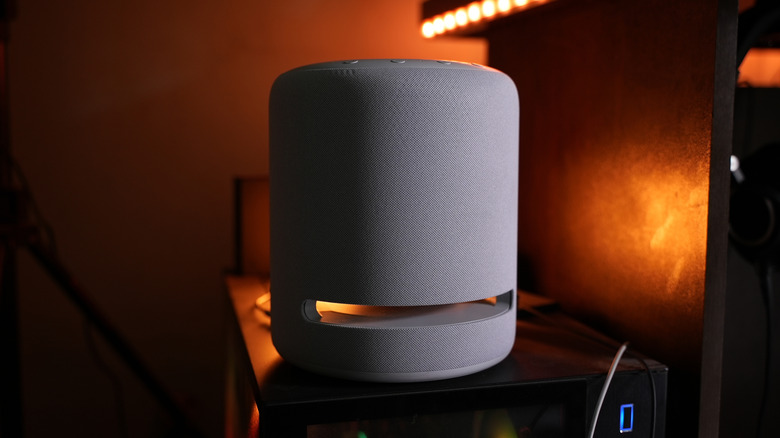
Amazon's first-gen Echo Show included an AUX port, but the latest versions of the smart display dropped the connection. That said, if AUX is a must, you'll need to stick with Echo smart speakers; you'll also have to go out of your way to find older-generation Echo hardware, since nothing in the current lineup has an AUX port. And unlike other smart speakers on the market, the Echo lineup doesn't mess with USB-C, so you can't even purchase a USB-to-3.5mm adapter.
Truth be told, if you own the latest version of the Echo Studio or the Echo Dot Max, you might forget all about the missing AUX port. Both speakers sound great right out of the box, and both support lossless audio streams and acoustic optimization; the newest Studio can even decode Dolby Atmos. While the Max supports less audio bandwidth than the Studio, it still tops out around 16-bit/44.1kHz, which gets you very close to CD-audio quality.
It's hard to deny how convenient Bluetooth is, but as far as Echo speakers go, the wireless protocol sits on the bottom rung of the quality ladder. Amazon tech doesn't support codecs like aptX Adaptive, so there's no way to enhance Bluetooth audio streams. An AUX port (or USB-C) would serve as a solid middle ground between lossy Bluetooth and top-tier, lossless playback on an upper-midrange to flagship Echo speaker, but these are the cards we've been dealt, friends.