

Rocket Engines Are Mostly 3D Printed Now

3D printing comes in many shapes, forms, and materials. Most people think of popular brands like Bambu Lab and Prusa Research, which extrude plastic one microlayer at a time, but some printers can quickly produce metal components more intricate than those made by traditional manufacturing methods and at a fraction of the cost. This is perfect for industries that are as explosive as the space exploration sector, in every sense of the word.
In the old days, rocket engines were built from countless parts, manufactured piecemeal, then bolted and welded together like the world's largest jigsaw puzzle. The result was time-consuming and heavy (or several tons). To solve these problems, organizations like NASA began exploring 3D printing technologies. This investment allowed NASA to build rocket engines just as big as the legacy ones, but without all that extra mass weighing them down. 3D-printed components are not only easier to install, but also more fuel-efficient because rockets need less thrust to lift off.
3D printing also offers advantages beyond physical properties. The speed of the 3D printing process lets users mass-produce components. An impossible feat for traditionally built engines. While organizations aren't using 3D printing to build a fleet of rockets a la Starfleet from "Star Trek" (even if the show predicted the rise of technologies like 3D printers), they can use these engines to test new designs. And if the engine blows up — as they often do during the prototype phase — engineers can quickly build a new one in a few days. Now, if only engineers could solve the problem of exploding rockets threatening the safety of commercial airlines.
Defying long-held beliefs and myths
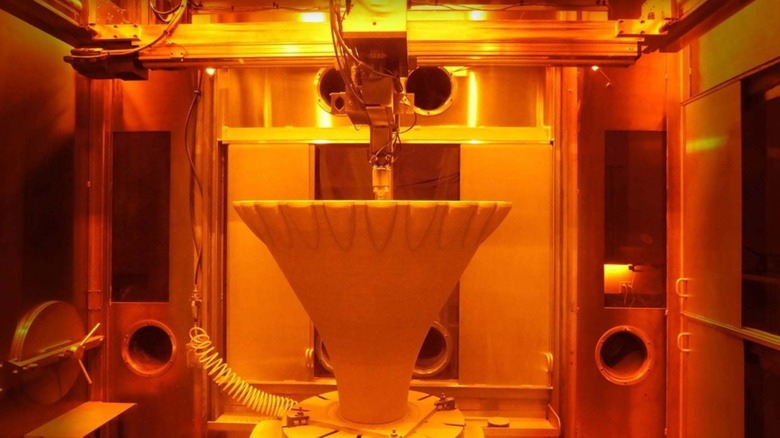
As 3D printing technology has evolved, so have the items it produces. 3D-printed parts are more reliable than ever before, but there are certain items you should never 3D print. The more strenuous the purpose, the less likely a 3D-printed part will survive, so why would anyone rely on them to shoot rockets into space? Because new alloys were invented just for the process.
Elementum 3D, the company NASA collaborates with for 3D printing, was founded to pioneer new methods to print metals that are hard to work with. Elementum 3D's solution was a new form of Reactive Additive Manufacturing (reactive printing for short) that adds special particles to aluminum and triggers a chemical reaction during printing. The result was a new aluminum alloy that is strong and heat-resistant without weighing down rockets. More importantly, the alloy is inexpensive compared to traditional manufacturing methods and can be welded to other parts. Not that you need many welds, since 3D-printed products can be shaped almost however engineers desire.
Aluminum alloys aren't the only rocket engine material to come out of 3D printers. SpaceX, for example, created a nickel-chromium alloy called Inconel for its early SuperDraco engines. Like NASA's 3D-printed aluminum alloy rockets, Inconel is strong and lightweight, and the process lets engineers build complex components while minimizing welding and other joining techniques, which speeds up construction.
You can't print everything
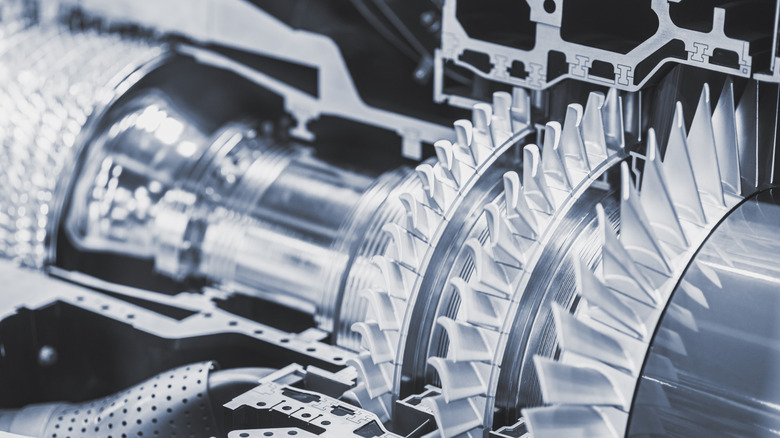
When you clicked on this article, you might have noticed that the title read "Rocket Engines Are Mostly 3D Printed Now." That was not a typo. While we have discussed how NASA (and SpaceX) use 3D printing to rapidly manufacture rocket engines, we need to temper your expectations with the reality that some parts are still made the old-fashioned way. 3D printing is downright futuristic, but has some limitations.
According to the calculations of outlets such as 3DPrintersBay, modern rocket engines include around 80% 3D-printed parts. Specifically, rocket engines manufactured by companies such as Ursa Major and Relativity Space consist of 80% and 85% 3D-printed components, respectively. These mostly consist of parts such as oxidizer and propellant tanks, combustion chambers, fuel injectors, pumps, and valves. However, that still leaves 15-20% of parts at minimum for traditional manufacturing.
Instead of asking what parts rocket engineers don't 3D print, you should ask what purposes these pieces serve. The answer is anything that goes beyond the limits of what 3D printing can produce. Yes, Elementum 3D designed an aluminum alloy that is strong and heat-resistant, but if a component needs to survive even more extreme temperatures and stresses, engineers can't use Reactive Additive Manufacturing or any other 3D printing process. The same is true for components that must resist certain chemicals or maintain unerring dimensional consistency. You could say that 3D printing only works for rocket engine components when the phrase "It's not rocket science" accurately describes the level of manufacturing difficulty.