

Why Floorstanding Speakers Might Still Need A Subwoofer
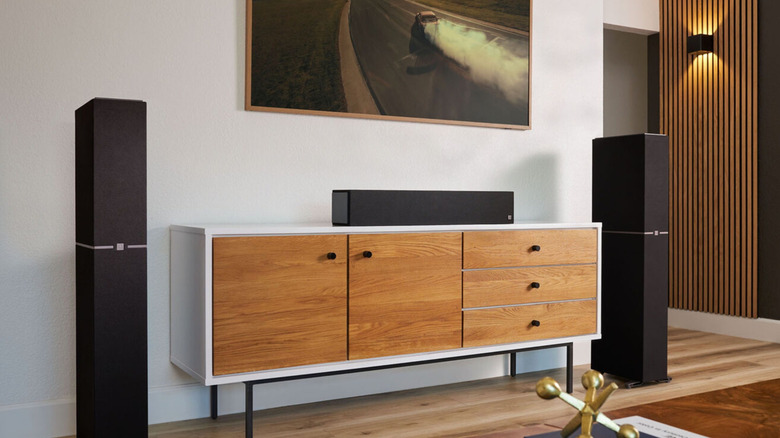
You can do a lot with a great pair of floorstanding speakers. On the one hand, just two of these speakers alone can make for an incredible hi-fi setup, especially when they're paired with a great amplifier. A pair of floor-speakers placed at the front of a home theater system can be particularly impressive for movies, TV shows, and video games. Whatever the use case, your towering titans of sound shouldn't disappoint; that is, unless you're dedicated on getting as much low-end performance as possible.
Yes, floorstanding speakers are capable of putting out a decent amount of bass, and likely more than most bookshelf speakers. But when it comes to producing the deepest, most earth-shattering bass frequencies, floor speakers can struggle for a couple of reasons. One is that towers need to manage all frequencies (treble, midrange, and low end) across an array of drivers and woofers. A dedicated subwoofer is exclusively tasked with channeling the lowest of the lows — often down to the 30-40Hz range.
Depending on how your floor speakers are tuned and engineered, ultra-low frequencies might not even be possible. Plus, a true subwoofer is best equipped to process the audio that stems from a surround sound's LFE (low-frequency effects) channel. If your main intent with a speaker system is watching movies, the front channels simply aren't designed to bring the same type of thump and rumble as an active subwoofer with an integrated amp.
Subwoofers are often a good addition to your audio setup
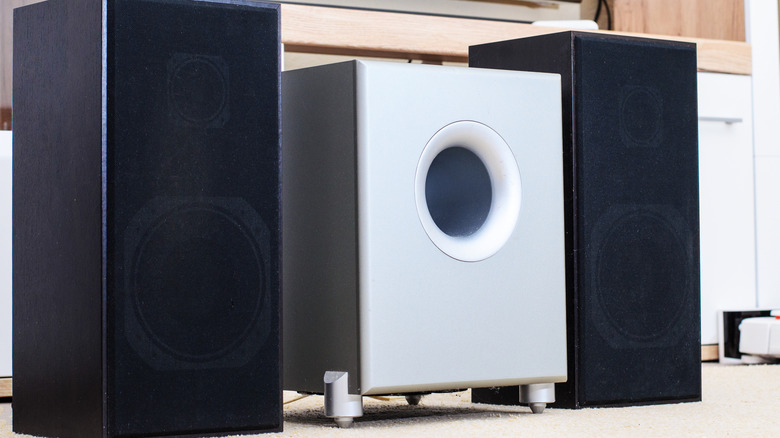
Another reason floor speakers may call for a dedicated woofer is the overall bass extension of your system. Traditionally, tower speakers are placed at the front of a surround sound setup. Even if your towers are putting out enough bass, most front-facing drivers and woofers are only going to fire these frequencies in one direction: right toward you.
Cinematic lows are lows you can feel all around you; and conveniently, a standalone, powered subwoofer can be placed just about anywhere in your theater space. And a big part of dialing in the best subwoofer sound is locating the "dead spots" in your room that experience the least amount of bass. Even if you can't put a woofer right in the middle of a bass-lacking zone, placing it as close as possible to the problem spot can still make a big improvement.
This isn't to say that floorstanding speakers aren't capable of bringing bass to the party. Companies like Definitive Technology actually make floor speakers with built-in subwoofers, which can be plugged in for power or routed through an AV receiver by way of the LFE output. We simply belong to the "the more you know" camp, and now and then, even some of the most monolithic tower speakers can use a helping hand.