

This Anti-Drone Tech Has An Unintentional Impact On Local Wildlife
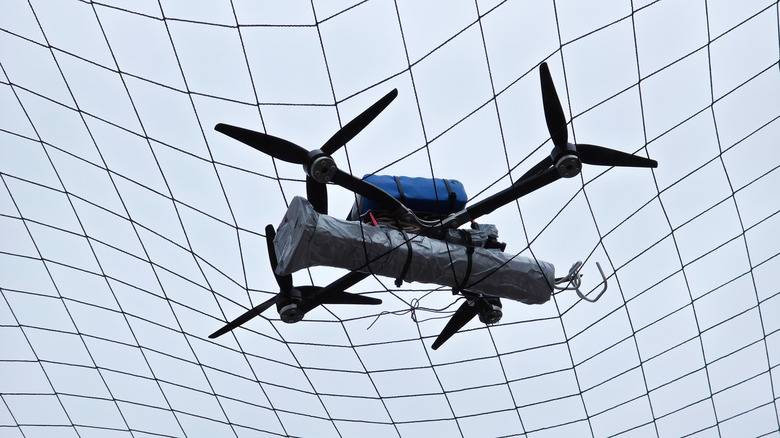
Warfare is a cycle of technological escalation. Currently, we are stuck in a battle between drones and the weapons that take them down. While some armies use anti-drone smart scopes, others rely on the effective simplicity of a net to stop the flying bots. Yet, much like how fish trawlers occasionally catch dolphins and other protected species by accident, these nets can snag more than just drones.
In order to counter the drones Russia uses, Ukrainian forces set up a wide canopy of nets, some of which are repurposed fishing nets. The idea is that, even though many Russian drones are downright unjammable because they're controlled using fiber-optic cables instead of radio signals, by the time the remote pilots see the nylon barriers, it's too late. The drones smash into them and get hopelessly caught — mostly because the nets tangle around the rapidly spinning propellers. However, birds are just as vulnerable to these nets and frequently get caught, too. In fact, nets of all stripes are dangerous to birds because they either don't perceive nets as a physical barrier or literally can't see them. Either way, birds will often fly headlong into a net, proving that what you don't know can indeed hurt you.
Depending on your internet search history and where you live, you might have seen pictures of or come across, say, an owl caught in a soccer net. Because these animals are struggling against something they don't understand (and might not see), they tend to get even more tangled during their wild flailing, and the same is true of animals caught in Ukrainian anti-drone nets.
The lesser of two evils?
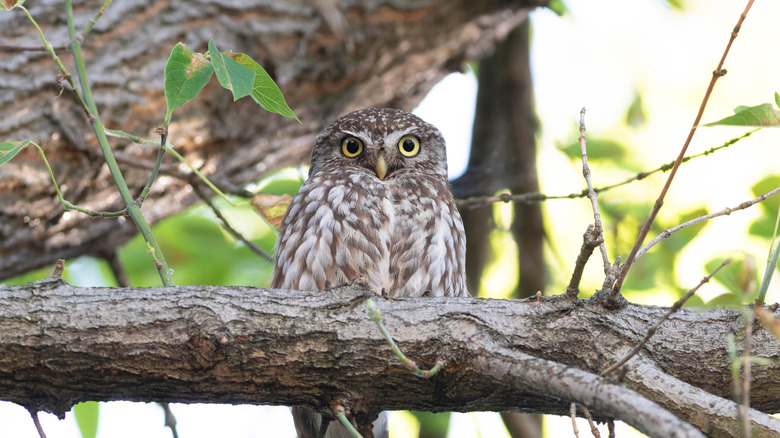
Since birds will thrash every which way to try and escape nets, their injuries can be as unintentionally self-inflicted as they are random. Broken bones are a common result, but death is just as likely due to strangulation. In fact, one could argue death is the most likely outcome because, unless someone just happens to come along and rescue the animal, it can become hopelessly trapped and starve to death.
On the off chance that someone finds a still-living bird tangled in an anti-drone net, often the only solution is to cut the animal loose. Easier said than done, since animals tend to struggle even harder when humans approach — and because Ukrainian Samaritans have to watch out for nearby attack drones. Even when it's free, a bird's injuries might be so severe they must live the rest of their lives in an animal sanctuary, or suffer with its physical impediment in the wild.
So, what are Ukrainian soldiers to do to combat drones? Sure, they have alternative weapons, such as a drone-hunting buggy and a laser that can shoot down enemy aircraft, but those need to be deployed in order to function. The anti-drone nets are a passive defense that are always active. They only pose a constant threat to wildlife because they pose a constant threat to enemy drones. It's a bit of a no-win scenario, where one population will suffer no matter what.