

14 Forgotten Technologies That Tried To Replace The Floppy Disk
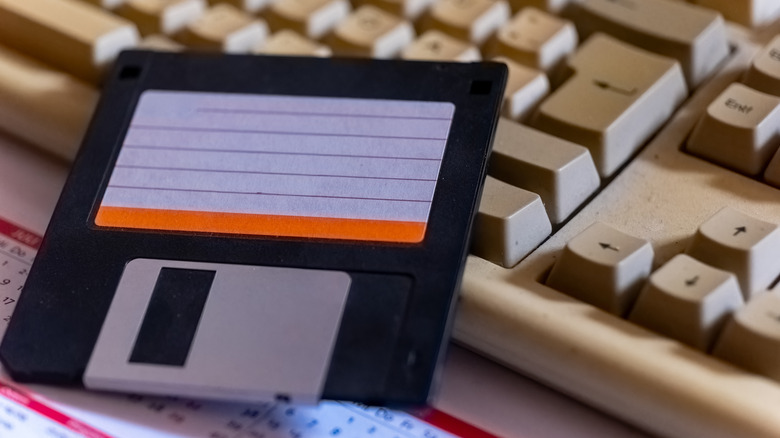
The humble floppy disk — which, despite appearances, is rather aptly named — ruled the world of removable storage for decades. IBM began developing the technology in 1967, and the last floppy manufacturing holdout run by Sony ended production in 2011. These disks went from holding a fraction of a megabyte to 1.44MB in the 3.5-inch disks that Sony introduced in 1981. Even now, though, floppies are instantly recognizable to most; after all, they serve as the graphical basis for the "save" icon in many software apps. Such is the cultural impact of the floppy.
The floppy had many problems throughout its lifespan, however. Even later versions with hard casings were notoriously fragile. An ill-fated brush with a fridge magnet, marginally rough handling, and the phase of the moon were enough to cause data loss in floppies.
Numerous companies attempted to create the next floppy, but the advent of cheap CD-R discs and flash memory thumb drives ultimately forced the humble floppy (and its competitors) into retirement. Not a complete retirement, though. The tech is still used in some old infrastructure, and even airplanes still use floppy disks. If history had gone a little bit differently, though, then one or more manufacturers of floppy alternatives may very well have ushered in the new removable storage standard of the '80s or '90s.
Iomega Zip
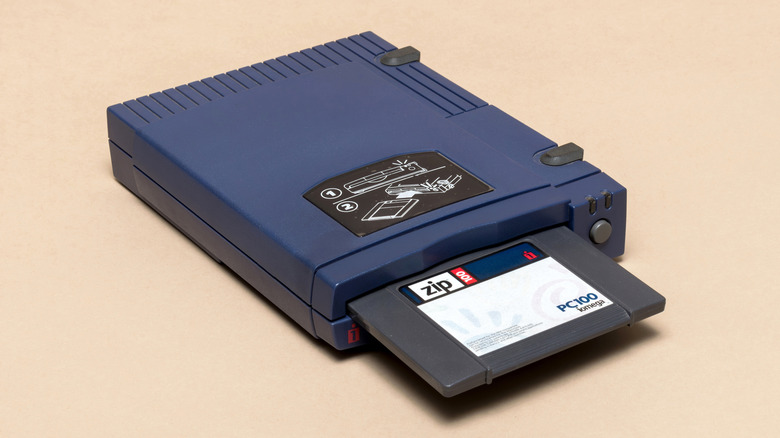
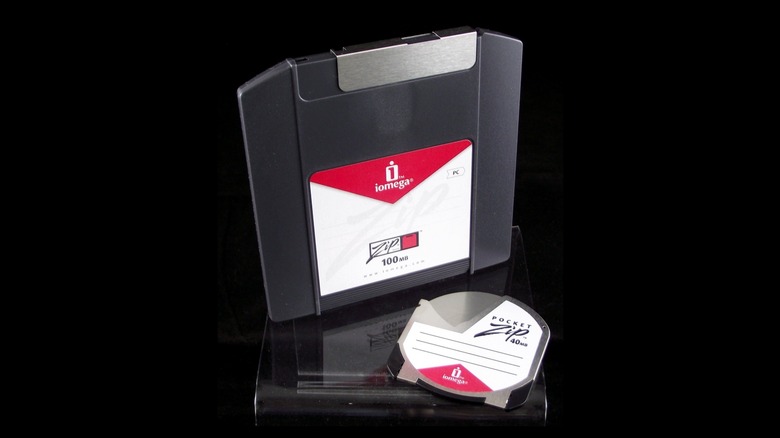
The original Iomega Zip disk held 100MB, or around 69 times what a 1.44MB floppy does. The company started shipping these disks in 1995 and would eventually sell millions of Zip drives and hundreds of millions of disks.
The middle of the '90s was exactly when home and professional computers started transitioning from having hard drives measured in tens of megabytes to ones with hundreds of megabytes (or, in some cases, more than a gigabyte of storage). Imagine bringing 100MB of data home from work in a suitcase full of floppies! Many professional computer users latched onto Zip disks, which also came in capacities of 250MB and 750MB.
However, Zip drives had one major flaw: They weren't cross-compatible with floppy drives, meaning users had to install an additional computer drive to use them. So, rather than being a replacement for floppies, Zip drives were a parallel storage solution. They weren't commercial failures at all, but they did fail at gaining the same universal adoption that floppies did. Add to this some notorious reliability problems, and Zip drives enjoyed only a bright-but-brief spark in the history of computer storage.
Iomega Jaz
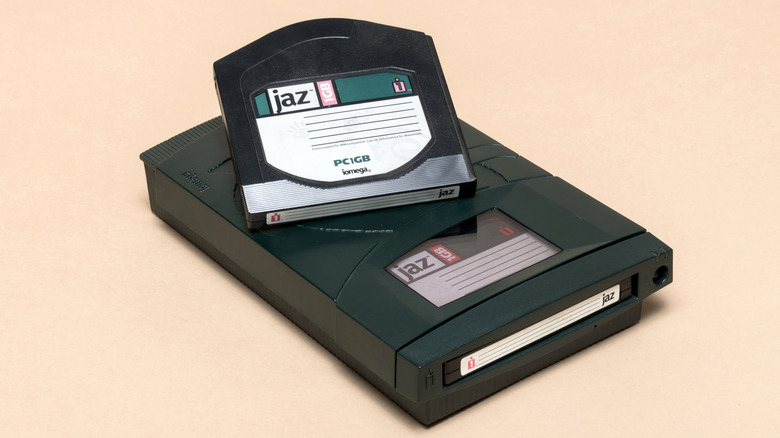
Iomega didn't put all its eggs in one basket. In 1995, the company introduced Jaz drives, which brought a larger class of storage capacity to the table. Initially, Jaz disks were 1GB in size — ten times that of the first-generation Zip drives. This made Jaz drives perfect for various industries, such as computer graphics, desktop publishing, CAD, and video production.
These drives were fast for the time, too, clocking data transfer rates of 2Mbps according to a 1996 review on Windows Magazine, which wasn't much worse than the 3Mbps speeds the reviewer measured on the test computer's own hard drive. This technology wasn't aimed at a mainstream audience the way Zip drives were, though — according to that same review, one Jaz drive and a single 1GB cartridge would run you 499 crisp 1996 dollars, with each additional 1GB disk adding $99 to that bill. Not a big deal for large organizations that needed the flexibility, but price tags like that didn't win over too many home users.
Jaz technology didn't last very long. Iomega discontinued the now-forgotten drives in 2002, although it did keep making and supporting the disks for some time after that.
Imation SuperDisk/LS-120
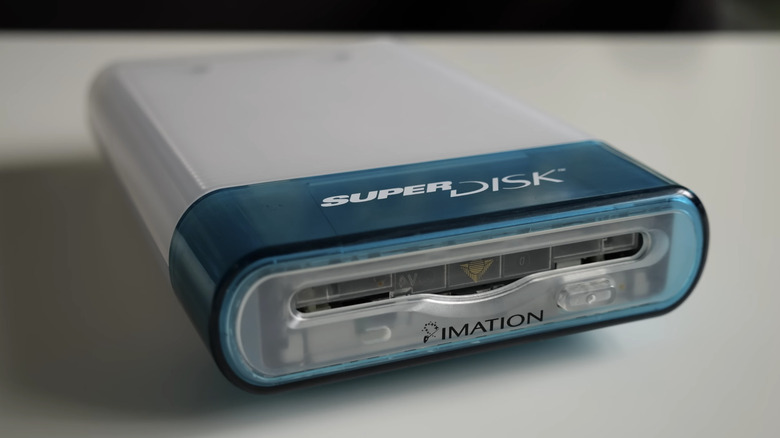
The SuperDisk is perhaps the closest we ever got to a direct floppy disk replacement, and the LS-120 drive directly addressed the biggest problem with Zip drives: They couldn't read a standard floppy. SuperDisk drives could read all your existing floppy disks, which meant you could do away with your old floppy drive — or, if you'd bought a new computer, you'd only have had to buy a single drive, not two.
So, on paper, the LS-120 had a shot at being a true floppy replacement. However, reality had different plans. A 1997 article in EDN Magazine outlines the issues. While LS-120 drives replaced both floppy and Zip drives, they were still more expensive than buying both drives separately. Furthermore, Imation could not ramp up production enough to catch up to the millions of Zip drives that had already been sold. As the article's author pointed out, affordable CD-ROM drives were coming in hot, and by the time Imation would actually have LS-120s widely available, it was in competition with those disks as well — not just floppies and Zip disks.
In 2001, Imation announced that the SuperDisk was dead. The company had developed a USB version of the SuperDisk for Apple computers, but it didn't offer the tech on PCs. News articles at the time specifically pointed to the popularity of CD-Rs as the key factor in the demise of large-capacity floppies.
Sony HiFD
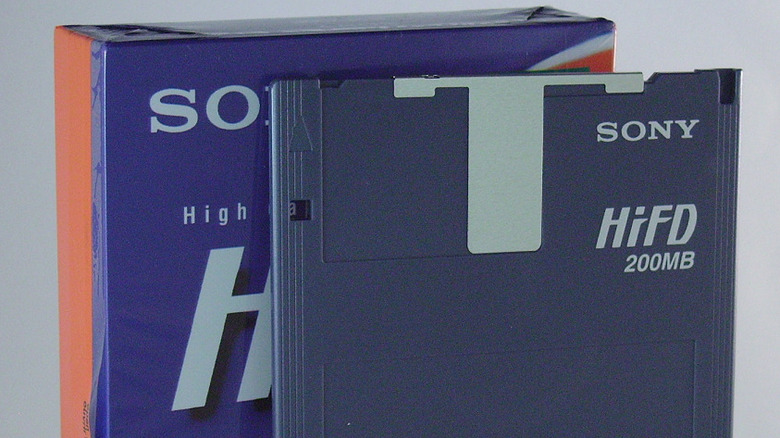
Announced as a joint project between Sony and Fujifilm, HiFD disks offered 200MB of capacity in a familiar 3.5-inch form factor. HiFD drives became available in the U.S. in November 1998 for $199, and — like LS-120 drives — they were compatible with floppy disks. Each 200MB disk cost $14.99, and 3-pack bundles were also available for $39.99. $15 was a modest chunk of money in 1998, but consider how many floppies you'd have needed to buy for equivalent storage capacity. In 1998, a 1.44MB floppy cost around $0.50, and buying 139 of them (for a total of 200MB) would have cost about $70 — so, $15 for a 200MB disk was a bargain!
Unfortunately, Sony pulled hundreds of HiFD drives off the market after some reliability gremlins popped up. Sony planned to reintroduce HiFD in the latter half of 1999, but Iomega had already introduced its 250MB Zip drive the year prior, thereby taking the wind out of HiFD sales. 200MB disks certainly sounded great compared to 100MB Zip disks, but Sony wasn't able to leverage capacity as a trump card like it could have before. Since customers searching for a floppy substitute would have had to buy a new drive either way, it was more likely for them to choose the 250MB Zip drive, especially if they were already Zip users who needed access to their existing Zip disks. Moreover, backward compatibility on the Zip 250 wasn't perfect, and it came with caveats like slow write times.
Caleb UHD144
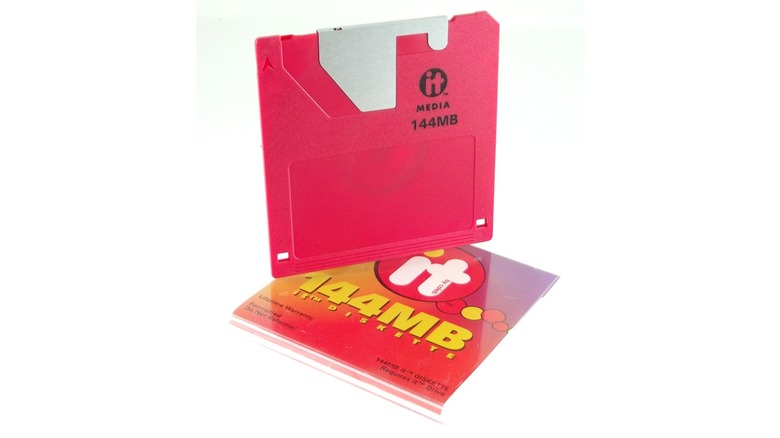
This is one of the more obscure contenders, but the UHD144 (marketed as the "it drive,") was perhaps among the most explicit floppy replacements of them all, simply because its name directly referenced the 1.44MB capacity of typical floppies. In other words, it was "100 floppies" in a single disk.
Value was a key selling point for this product, and that value was also reflected in its pricing. In 1999, you could buy an internal UHD144 drive for $79; the external version cost $99. That's substantially less than $149 for a SuperDisk drive or $180 for a 250MB Zip 250.
While the drives and disks were cheap, 1998 was far too late to make a dent in the incumbent market led by Iomega, especially because CD-R and CD-RW technology would soon wipe out the whole super-floppy market. Caleb Technology would go bankrupt in 2002. Perhaps if the product had launched at the same time as the 100MB Zip drives — but at a much lower price — the UHD144 would have been a household name instead of an obscure footnote.
Insite Floptical
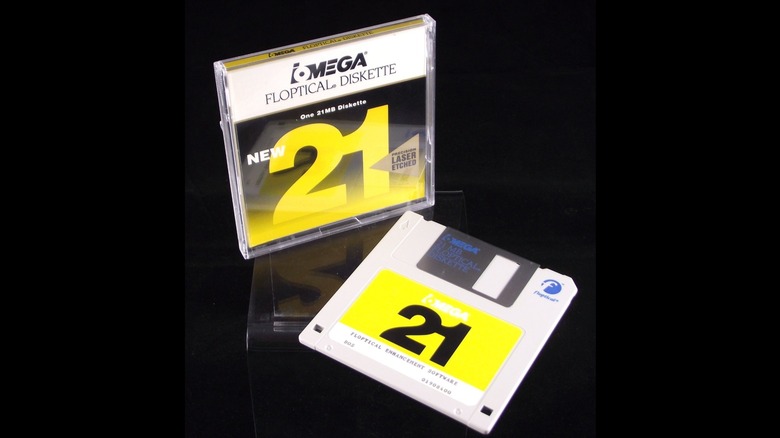
Insite's 1989 "Floptical" drive, which was among the earliest contenders for the floppy crown, offered around 21MB of usable capacity after formatting. The term "Floptical" comes from the fact that these drives and disks used a combination of magnetic and optical technology to write and read data. With this increased precision, it was possible to pack more data onto a single disk.
While 21MB was a substantial increase over the 1.44MB or 720KB floppies that remained widely used in 1989, the capacity boost wasn't enough to incite large-scale adoption, even though major players like Iomega had adopted the tech. It's a pity, because the underlying Floptical technology really advanced how traditional magnetic floppies worked.
While this early Floptical drive didn't gain much traction, it had an influence on later attempts. Imation's LS-120 was a direct evolution of Insite's technology, but it was also the final attempt at a Floptical consumer storage solution before flash memory and CD-Rs took over.
Brier Flextra
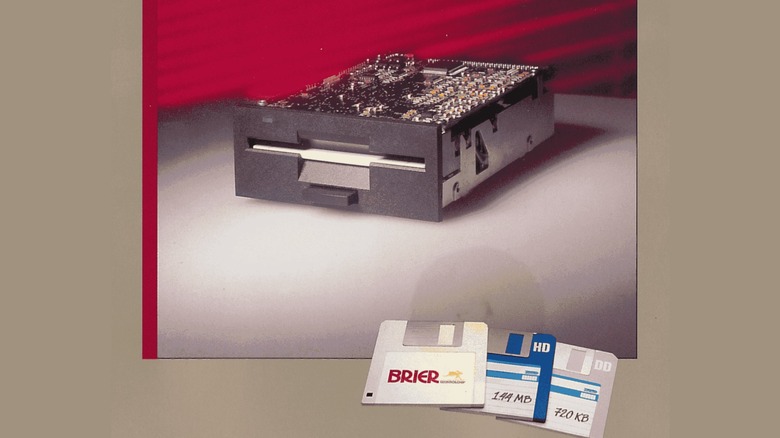
Brier Technology was founded in 1986 by a startup of just five people. First-generation Brier Flextra disks promised a formatted capacity of 21.4MB, while a 43.2MB Flextra II would follow in the third quarter of 1989, half a year after the technology's debut (and hot on the heels of the Insite Floptical disks). These diskettes cost $20 and $30, respectively, because they were — at the time — high-capacity storage options compared to standard 1.44MB floppies.
The Flextra and Flextra II drives had OEM pricing of up to $400 and $500, respectively, and they could support disks up to 100MB in size. And, as Storage Newsletter once pointed out, until that point you'd only get that sort of capacity from fixed disk drives. The key invention in the drives was "Twin-Tier Tracking," which made use of two magnetic layers, each with data tracks that were embedded into the disks and used all possible surface real estate.
On page 167 of the March 1992 issue of Byte Magazine, the publication noted that Insite's Floptical tech was better positioned than the Brier Flextra to gain widespread adoption owing to its superior compatibility. But, as we've already seen, Insite's Floptical went nowhere. Naturally, Flextra tech has also been forgotten.
Iomega Clik!/PocketZip
We take it for granted that there are so many USB accessories you can use with both your laptop or desktop, whether for storage or otherwise. SD card readers, DVD burners, thumb drives, portable SSDs, you name it — you can easily use them with your stationary rig or your portable laptop.
This was not the case in the '90s, and the Iomega Clik! (later known as the PocketZip) wanted to fill the gap left by less-than-portable Zip drives with a compact storage medium. Sure, external Zip drives used USB and parallel port interfaces, but they still needed external power and took up substantial space in a laptop bag. The Clik! drive fit in a PCMCIA card form factor. So, a card the size (albeit not the thickness) of a credit card could simply slide into a slot in your laptop and support removable 40MB disks.
However, the Clik! was initially targeted toward digital camera users, and the drives were introduced too late for camera makers to have built them into their cameras. If that had happened, it would have been more likely for notebook owners to buy Clik! drives to make media transfers easier between their laptops and cameras. By 2002, however PocketZip was done, having failed to gain traction and marred by prior reliability issues that became known as the "click of death," a mechanical failure of the drive that ultimately led to a class-action lawsuit.
SyQuest EZ135
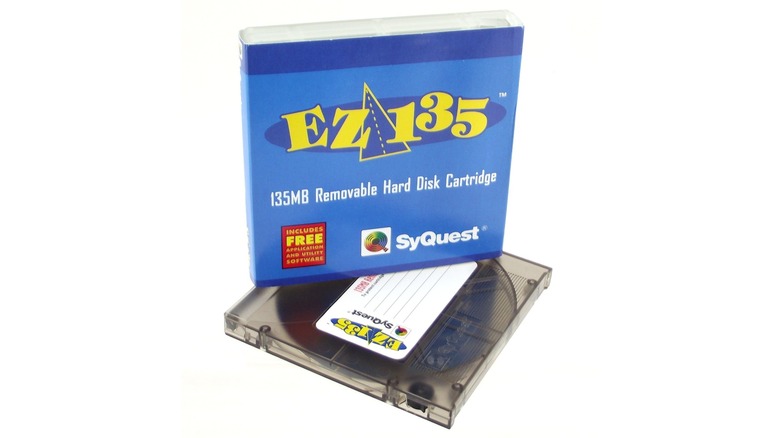
SyQuest was a well-known name in the '90s, and the EZ135 was a direct challenger to the Zip drive, albeit with a much less catchy name. The EZ135 was introduced in 1995 and offered a 135MB capacity, as the name indicates. That's 35MB more capacity than first-generation Zip disks had, in case anyone is keeping score.
SyQuest's advantage wasn't just in capacity. Rather than just being beefed-up floppy disk technology, EZ135 disks were removable hard drive platters. The "drive" was effectively a hard disk with no platters, and you could insert or remove disks as needed. Because it used a form of hard disk technology with a spinning platter, EZ135s had a distinct speed advantage over Zips, which made it easier to access and edit files on them directly without first having to copy them to an internal drive. While Zip drives offered transfer speeds of 1.4MB/s, the EZ135 could sling data around at speeds up to 4MB/s.
The EZ135, however, would be an extremely short-lived product. It was gone the very next year, overtaken by the 230MB SyQuest EZFlyer. Luckily, this new drive was backward compatible with EZ135 disks, but that was not enough to keep SyQuest in the game.
SyQuest SyJet
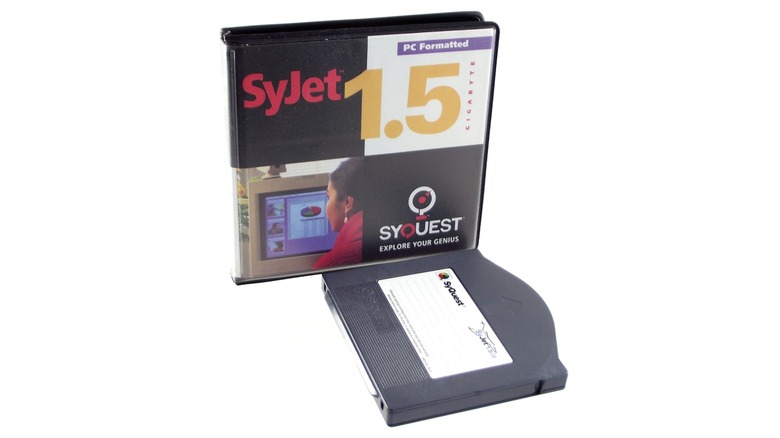
Not dissuaded by the lackluster response to the EZ135 or the EZFlyer, SyQuest pushed the envelope with removable 1.5GB SyJet hard drive cartridges. Not only did these cartridges offer more capacity than 1GB Jaz drives did, but they also had over twice as much space as standard 700MB CD-Rs did. The SyJet was thus set to compete against super floppies and the rise of optical storage media.
However, SyQuest itself delayed the product. The official reason came down to concerns about reliability when using a SyJet as primary storage. Either way, by the time the 1.5GB disk hit the market, Iomega had already sold a substantial number of Jaz drives. It didn't help that the SyJet had similar pricing to the Jaz, which made it even less likely that it would steal any of Iomega's market share.
It's not like SyQuest had much of a choice, though; it was a financially difficult time for the company. In a 2006 interview with SyQuest founder Syed Iftikhar (via Computer History Museum), Iftikhar recalled that the drive they sold for $200 cost them $190 to make. Marketing budgets were also meager, and in 1998, the company was effectively bankrupt.
Avatar Shark 250
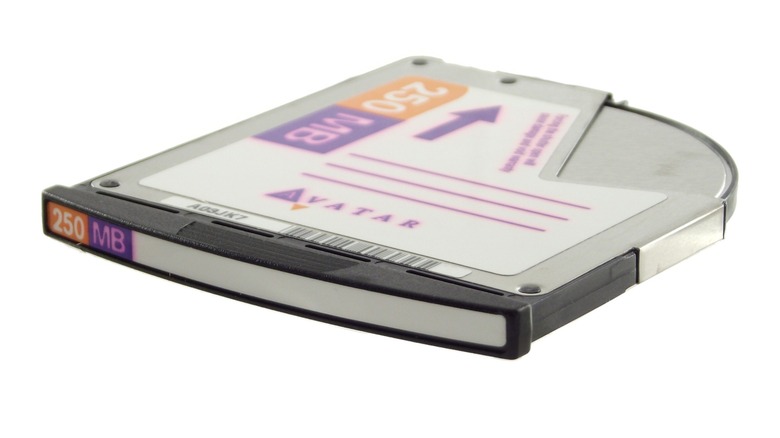
This one certainly gets full marks for the name alone. Iomega's "Zip," "Clik!," and "Jaz" products may have had the catchiest names, but they don't sound nearly as cool as "Avatar Shark" does. We digress — the Avatar Shark 250 "HARDiskette" offered 250MB of unformatted space (hence its name), which dropped down to 236MB after being formatted.
The big selling point here was how compact and portable the media was. The HARDiskette could fit in a shirt pocket, and, perhaps most importantly, the drive itself did not require external power. While it sent data across a parallel port, it also had a passthrough for your desktop or laptop computer's PS/2 port. Today, PS/2 is one of those obsolete ports that just refuses to die, but it was near-universal in the '90s.
The main downside to this product was that, if your laptop was running on battery power, the Shark could shorten its runtime noticeably. Considering that laptop battery life in the '90s was dismal at the best of times, that was quite a drawback.
Sony MD Data
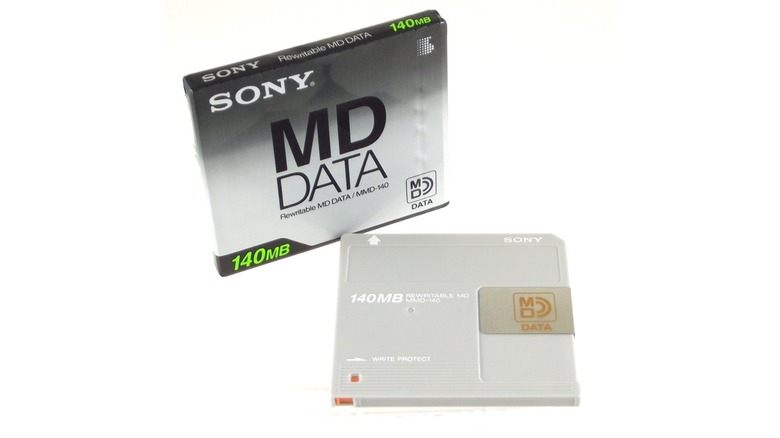
Sony's MiniDisc players were quite popular in Japan, and they gained some traction in the West among enthusiasts who loved the near-CD-like audio quality in a more compact, robust form factor. However, what you may not know is that there was a data storage-focused iteration of the technology called "MD Data."
MD Data was a magneto-optical system (unrelated to Floptical systems) whose disks offered 140MB of storage capacity. It was made available to equipment manufacturers in 1994 as a candidate for removable, portable computer storage. Using the $699 MDH-10 drive with a cable connection to a desktop or laptop PC, you could simply pop in the disc you wanted to read or write to, and it would just work.
The musical version of MD still has enthusiastic collectors today, but while CDs are making a broad comeback, that same revival hasn't been in the cards for any version of MiniDisc. High cost, slow speeds, and lengthy access times didn't do MD Data any favors, and Sharp's 1995 attempt to revive the now-forgotten format was met with failure.
2.88MB Extended-Density floppies
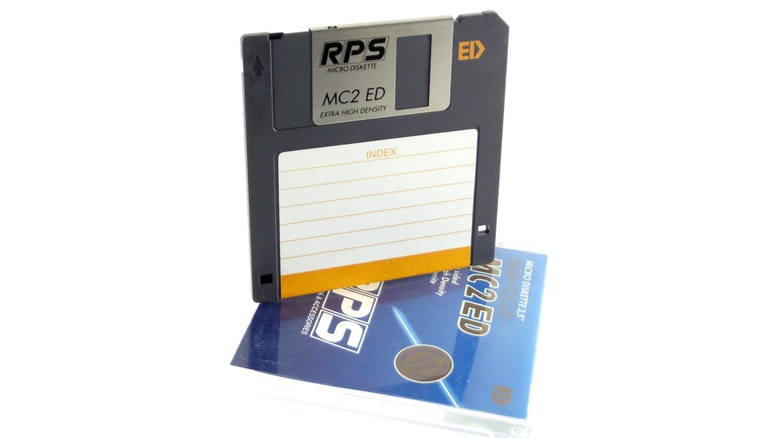
Many alternative floppy attempts tried to win over users with extra-large capacities. However, a humbler, more straightforward approach to a better floppy could have done the trick — if only it had happened earlier. The 2.88MB (4MB unformatted) "Extended-Density" disks, which were driven by Toshiba's research, came out in the early '90s and used a special magnetic coating to allow more data to be packed into the same space without losing cohesion.
While the tech was promising, IBM's 2.88MB drives (manufactured by Toshiba and Sony) were initially only usable on IBM PS/2 computers, and they hit the market about a year too late, despite Toshiba's confidence the product would do well — on page 30 of the August 1991 issue of Byte Magazine, the author outlined Toshiba's prediction that 5 million 2.88 disk drive units would be sold in 1991 and 200 million by 1994.
What actually happened differed. The drives were scarce and expensive, and 2.88MB floppies never got off the ground. Although they were backward compatible with 1.44MB and 720KB floppy disks, a doubling of capacity wasn't enough to motivate anyone to move on from regular floppies.
Castlewood Orb
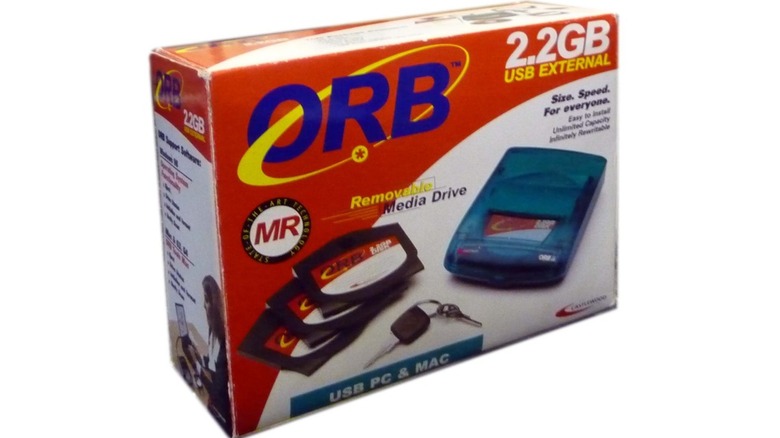
The Castlewood Orb is perhaps the biggest swing taken by any drive on this list. Made by a company founded by the same Mr. Iftikhar who brought us SyQuest, this is another system based on removable hard drive platters, but with two key edges over the existing alternatives.
Unlike their direct competitors, Iomega Jaz cartridges, Orb cartridges used just one platter, not two, which reduced costs. Moreover, that single platter was pushed all the way to 2.2GB of storage space. Pricing was also aggressive; the external SCSI drive cost $199, and each disk cost $29.95. In 1999, that was considered a lot of space for a great price.
The problem was adoption. Orb disks were fantastic for personal storage and data expansion, but if you handed one of these cartridges to someone else, they were unlikely to have anything that could read them. Page 95 of MacWorld UK's September 2000 issue showcased some high praise for the Orb for its affordability, but the writeup's author only recommended it to those who didn't need storage solutions for data-sharing purposes.