

Are Lithium-Ion Battery Fires Really A Big Problem?

Lithium-ion batteries power a wide range of products, from vehicles (electric cars, e-bikes, and scooters) to consumer electronics (smartphones, tablets, laptops, watches, earphones, and power banks) and other devices (cordless tools, vapes, drones, cameras, and battery energy storage solutions). While they're generally safe, these batteries can still catch fire. Though the incidents are rare, battery fires are increasing in frequency because the number of battery-powered products in use is substantial — and growing. Consumers should know that a battery fire can indeed be a significant problem.
Lithium-ion batteries feature a negative electrode made of graphite and a positive electrode made of a lithium compound. The two are separated to prevent a short circuit, with an electrolyte allowing ions to move between them. Batteries can also have components that help ensure the current and temperatures are within acceptable parameters. However, those protections can fail due to a manufacturing defect, overheating, or damage to the battery. If there's a failure, a short circuit may form, leading to a thermal runaway event. The ensuing chemical reaction results in increased heat. Gases then form and can escape violently as the pressure rises, causing battery explosions. That heat can impact nearby cells, which may go through the same process.
A variety of scenarios can lead to a lithium-ion battery fire and pose significant danger to people. For example, a power bank's battery may overheat as it's charging a device, a phone can be caught between seats on an airplane, or a Tesla battery can be damaged in an accident.
Battery fires involving electric cars, bikes, and scooters
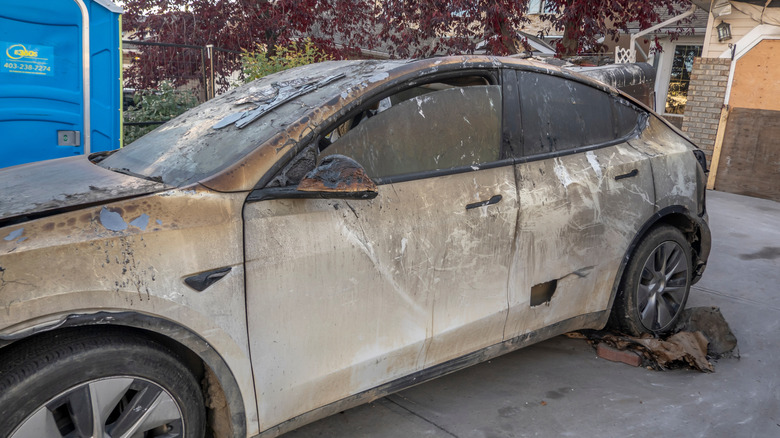
In March 2026, the U.S. National Institute of Standards and Technology published a study that estimated about 198,000 lithium-ion battery fires occurred inside structures in the U.S. between 2011 and 2023, and separately estimated about 5,700 EV and plug-in hybrid fires. The research also showed that consumer battery fires saw an annual growth of about 10%, with plug-in vehicle fires growing by about 45%. Importantly, the number of EVs has increased significantly in recent years. The International Energy Agency says electric car sales reached 20 million units in 2025, about a quarter of all new cars sold globally.
Tesla has its own figures regarding vehicle fires. For the 2012–2024 period, the company says one fire incident happened in the global Tesla fleet for every 140 million miles. It also notes that a fire occurs every 17 million miles when taking into account every vehicle on U.S. roads, citing data from the National Fire Protection Association and U.S. Department of Transportation.
The London Fire Brigade says that lithium batteries are the "fastest growing fire risk" in the city. In 2025, the LFB recorded 521 incidents, or an increase of 28% compared to 2024. Out of those, 91 fires involved EVs and 228 concerned e-bikes; other batteries caused 94 fires (18% of the total), and e-cigarettes were responsible for another 2%. Separately, the Office for Product Safety and Standards highlighted the risk of battery fires in e-bikes and e-scooters in the United Kingdom. In 2025, 119 fires out of the 267 reported occurred indoors, including 26 events in sleeping areas. In 86 cases, fires started when vehicles were charging, and batteries ignited when they were not charging in 92 cases.
Battery fires involving phones, laptops, and power banks
A thermal runaway event can require professional emergency response, and users should alert the authorities, whether that means the fire department in most instances or the airplane personnel during a flight. A battery fire involving a Tesla may require thousands of gallons of water to control, as the thermal runaway event can be self-sustaining and the chemical reaction can restart the fire. Phones and power banks have smaller batteries, but the fires can still be dangerous as they can occur at home (as seen in the video above) or on a plane. Users should be aware of the potential signs that a lithium-ion battery may catch fire.
In early October 2026, CTV News reported on a fire involving a lithium-ion battery in a power bank that was charging a cellphone on a bed. The fire took seconds to spread in the home. The event is now used by the Ottawa Fire Services as a fire-safety awareness video shown in local cinemas.
Battery fires are a significant risk on airplanes because they can spread just as fast, posing a danger to everyone. The UL Standards & Engagement Thermal Runaway Incident Program recorded 123 thermal runaway events involving batteries on participating airlines in 2025, a 15% increase compared to 2024. Power banks were the main cause for incidents, responsible for 30% of the cases. Airlines already have strict regulations about portable chargers, such as requiring travelers to pack them in carry-ons and limiting chargers to no larger than 100 Wh unless approved. It's not just smartphones and power banks that pose risks, either. In August 2026, an American Airlines flight landed safely at Dallas Fort Worth International Airport after a laptop fire erupted.