

Steven Spielberg Influenced One Of Star Trek: TNG's Most Challenging Episodes
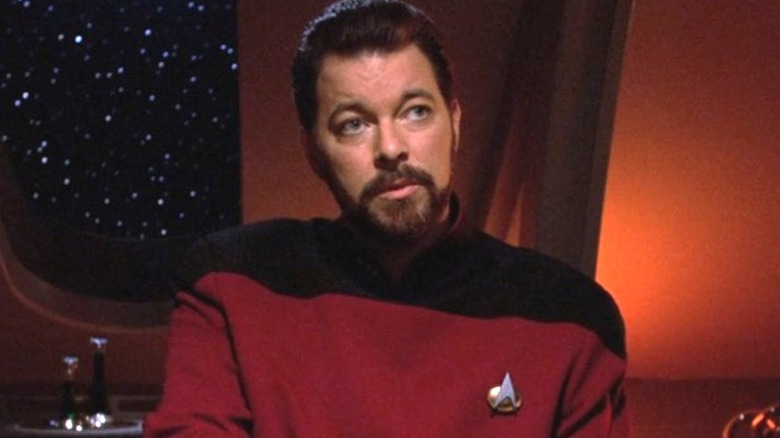
Science fiction has long been fascinated with time loop stories, and "Star Trek: The Next Generation" got in on the action with S05E18 "Cause and Effect." In this episode, the Enterprise crew is forced to relive a catastrophic collision with another ship until they realize what's going on. Director Jonathan Frakes claims that it was a difficult episode to make as it risked becoming repetitive. However, techniques borrowed from Steven Spielberg allowed him to change the visual language, ensuring that the episode remained fluid and exciting.
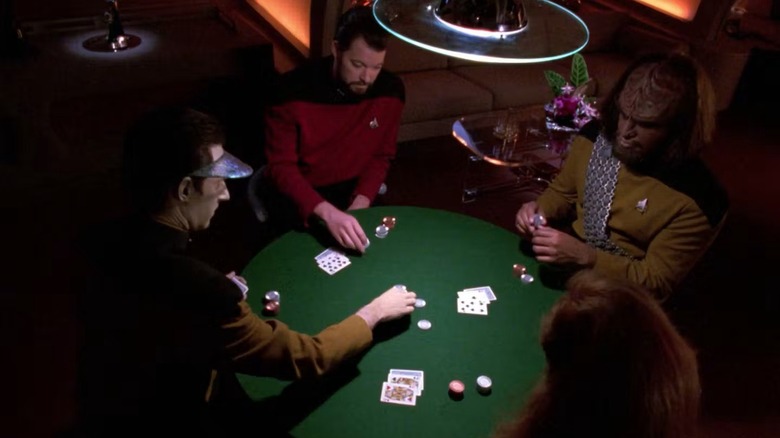
"We did a lot of those Spielberg-style push-ins and close-ups," Frakes told The Hollywood Reporter. "We started with Crusher figuring it out [the time loop] first, then [Michael] Dorn (Worf) as he figures it out during a poker game. And then Picard, later in a scene, we push in on him reading a book as he realizes he's read that section before. So there were enough kind of signature, visual metaphors for [the characters] figuring it out and agreeing on what was going on."
Push-ins are a hallmark of some of Steven Spielberg's best movies. The technique involves the camera moving closer to the subject's face via a medium shot before ending on a close-up. They're effective for creating tension and emphasizing a character's internal feelings, as evidenced by "Cause and Effect." These days, "Cause and Effect" is one of the most highly regarded episodes of "Star Trek: The Next Generation," with IMDb listing it as the 11th best of the entire bunch. However, the episode wasn't met with widespread enthusiasm back when it originally aired.
Everyone thought Cause and Effect was a mistake at first
"Cause and Effect" boldly went where no other "Star Trek: The Next Generation" episode had been before. Gene Roddenberry wasn't interested in time travel stories at the time, so Brannon Braga opted for a loop-focused story after being inspired by Akira Kurosawa's "Rashomon." So, how did the cast and viewers react to the off-kilter episode?
"[T]he reactions to the script were similar to the reactions that the audience had, which was confusion," Braga told Syfy Wire. "Because when you're reading that script, you're like: 'Wait. This has to be a mistake.' And this was back when people would call into TV stations, I guess, they would call a lot of affiliates. The show was syndicated, as you know, and the affiliates were getting phone calls during the broadcast [saying] something was wrong with the broadcast."
Such a bold experiment could have led to "Cause and Effect" becoming one of the most hated episodes of "Star Trek: The Next Generation." Fortunately, the great writing and Spielbergian influence helped turn it into a classic. It just took a moment for audiences to realize that the episode's repetitive scenes were intentional.