

3 Useful Anker Power Stations You Should Keep For Emergencies
We may receive a commission on purchases made from links.
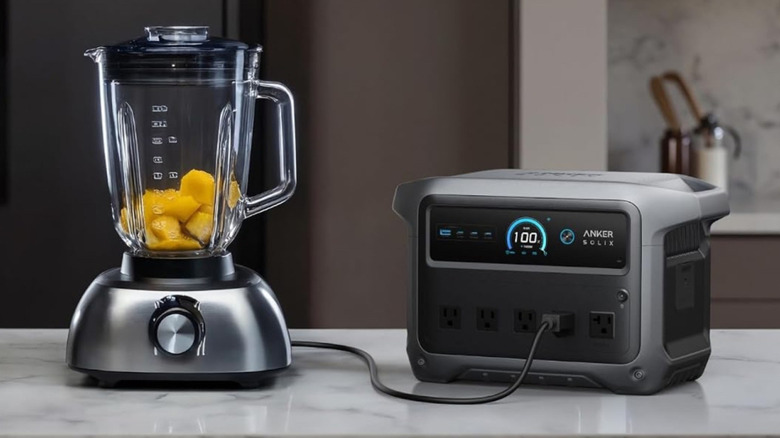
It can be hard to put a finger on the when and why of electrical failures, but the details aren't going to matter as much when your HVAC system isn't working in the dead of winter. This is why many homeowners will invest in emergency power solutions, and brands like Anker can supply the hardware. What you'll want to look for is called a power station (not a portable power bank), a pretty hefty-looking device that's often equipped with handles or wheels.
You won't find Anker power stations on the company's main website; you'll either need to head to the Anker-Solix site (Anker's backup power sub-label) or search on Amazon for a particular product. That said, we advise doing so; when it comes to emergency power, the Anker-Solix lineup is a force to be reckoned with. But your home's power needs could be wildly different from your neighbor's, which is why we're glad that Anker offers multiple power station tiers and models.
With numerous options to choose from, we thought we'd make things a little easier by homing in on what we consider to be the three best Anker power stations. We'll be kicking things off by discussing the C1000 Gen 2, which is the lightest of the three power generators we selected.
Anker SOLIX C1000 Gen 2
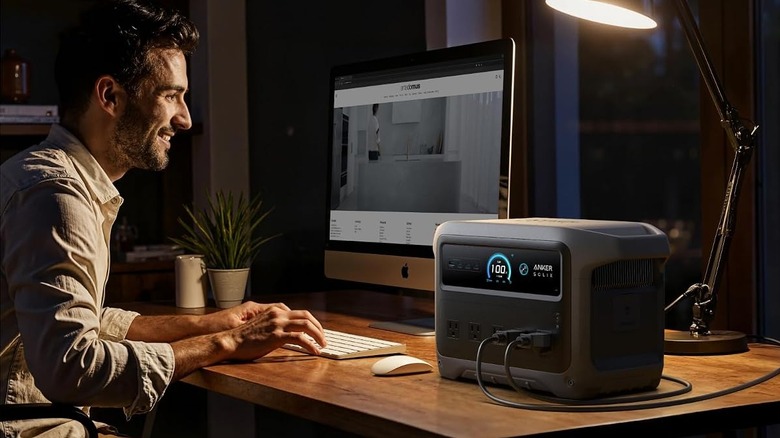
Not every power station needs to power your entire home, and the $800 Anker SOLIX C1000 offers a solid middle ground between "whole home" and "power bank for your phone." At the time of writing, the C1000 was on sale for $550, which is one of its lowest recorded prices. Delivering up to 2,000 watts of continuous power, the C1000 includes multiple AC outlets and USB ports — one of which can output up to 140 watts.
When fully depleted, it only takes about 49 minutes to recharge the C1000 from zero. We also like that the station contains a 600-watt solar input for topping off with a set of portable panels. If the C1000 is configured for Uninterruptible Power Supply (UPS) functionality, Anker claims that it takes less than 10 milliseconds to switch from the electrical main to the C1000's battery.
At 24.9 pounds, the C1000 is the lightest power station on our list. Unfortunately, you can't add an expansion battery (you can with the other two products we chose), and to enable UltraFast charging, you'll need to download the Anker app. But none of that was enough to warrant a bad Amazon rating; the C1000 scored 4.6 out of 5 stars, based on over 1,700 user reviews.
Anker SOLIX S2000
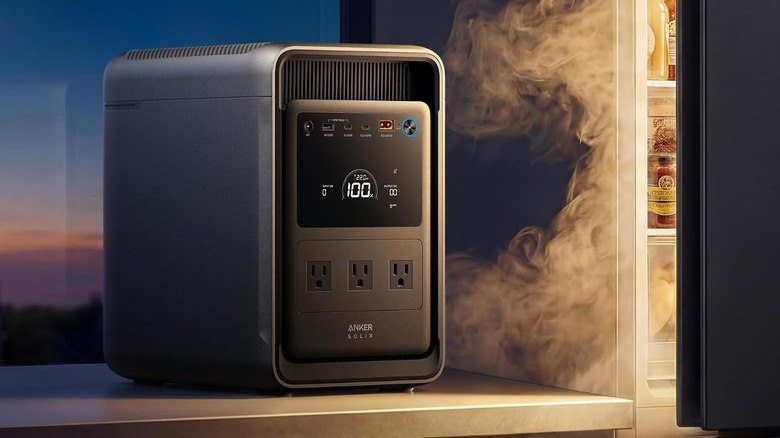
At first glance, you probably already noticed that the $1,200 Anker SOLIX S2000 has a smaller chassis than the C1000. Spec-wise, it also delivers less AC power — up to 1,500 watts, compared to the C1000's consistent 2K. It even has a less powerful solar input (400 watts), so why would you spend an extra $400 on this model? The overall battery capacity. Clocking in at 2,010 watt-hours, the S2000 offers double the charge capacity of the C1000.
This means you'll be able to keep your critical tech and other electrical gear powered for longer. The station has five AC outlets, two USB-C ports — one of which can output up to 100 watts — and a USB-A connection. While the C1000 has higher output capabilities, it's the S2000 you want for keeping multiple low-wattage appliances operating when the power goes down.
On Amazon, the S2000 scored 4.7 out of 5 stars, based on over 500 user reviews. Most feedback was at the 5-star level, and a majority of customers liked how powerful and versatile the power station is. A few folks thought the internal fan ran a bit noisy at times, but this didn't seem to be an overarching complaint.
Anker SOLIX F3000
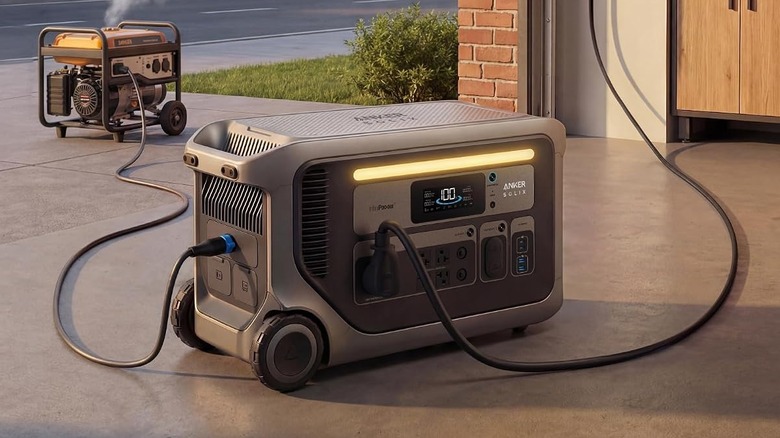
Now for the power station that has the potential to rescue your entire home's electrical system should the grid go down. The $1,700 Anker SOLIX F3000 delivers a beastly 3,600 watts of continuous power and up to 7,200 watts at its peak. That beastly power carries over to its battery capacity, too; you'll get up to 3,072 watt-hours to work with, and the station accepts expansion batteries.
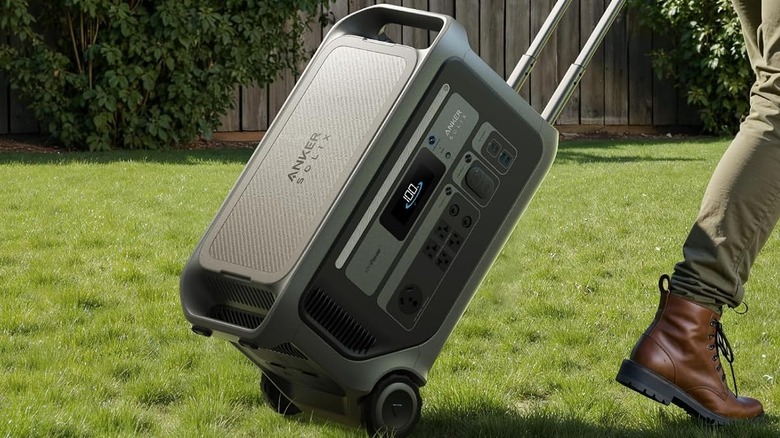
It's less portable (91.5 pounds) than the other two Anker-Solix products we've discussed, but it has a pull handle and built-in wheels to cart it around. It's also the only power station on our list where the manufacturer recommends charging it with a 120-volt generator. You can also recharge it via its 2,400-watt solar input, and you can connect up to four rigid panels in series. We did read user feedback claiming the 400-watt solar panel Anker provides (not with this version of the power station) generates only around 200 watts.
Port variety includes multiple AC outlets and USB ports, plus a TT-30R RV outlet and a DC connection. The F3000 kicks in quickly, too; once your electrical goes down, the UPS function triggers within 20 milliseconds. More than 250 Amazon shoppers wrote in about this model, earning it a 4.5-star rating out of 5.
How we chose these power stations
When it comes to backup power, Anker is one of the most trusted brands in consumer tech. We're willing to bet that every product in the SOLIX family is good for one reason or another, but we wanted to home in on the best of the best. That meant scoping out battery capacity, power features, port variety, and recharging methods (including solar panels).
We also wanted to highlight three models that naturally scaled up from each other, and we didn't want things to get too expensive (some Anker stations cost upwards of $3,000). Lastly, we wanted all three products to be available on Amazon, and as usual, we didn't choose to feature an item if it scored less than 4 stars from users.