

11 Clever Ways You Can Use A VPN
Virtual private networks, commonly known as VPNs, have become a popular service in the modern digital age. With users more worried than ever before about unwanted third parties surveilling and tracking their online activities, VPN services provide them with an added level of security to help them browse the internet worry-free. Of course, this is far from the only way a VPN can augment your digital experience. In fact, with some research, you can use a VPN service to make your life easier, regardless of whether you're gaming, streaming content, or using an online banking app.
We recommend against using free VPNs because they lack strong encryption protocols, don't provide any guarantee about how they're using your browsing data, and can be a bit too slow to be feasible for most users. In some instances, these shady VPNs install malware on your system! Don't be stingy when it comes to spoofing your network — trust us when we tell you that a premium VPN service is worth the subscription fee. NordVPN, ExpressVPN, and Surfshark are three popular and reliable VPN services that will safeguard your network, guarantee that your personal information isn't sold to the highest bidder, and let you use them in clever ways. Just do yourself a favor and don't opt for a lifetime VPN subscription because there are a lot of caveats attached to that plan.
Stream geo-blocked content

Streaming services have become a very convenient way to binge-watch your favorite movies and TV shows. These companies go out of their way to secure licensing agreements and streaming rights for both new and existing shows. As a result, it's not unheard of for customers to be subscribed to multiple streaming platforms to access as much content as possible. While a subscription to the big hitters like Netflix, Amazon Prime, HBO Max, Disney+, and Apple TV should be enough to cover all bases, there is one undesirable situation that viewers have to deal with constantly. Most streaming companies deal with regional content rights, meaning that a show you're watching on Netflix in the U.S. may not be available in other regions.
This can be frustrating if you're on the move or trying to access a show that is available on your streaming platform of choice in another region, but not where you live. Geo-blocking can seem downright arbitrary at times, which is why VPNs can be pretty useful when it comes to circumventing these restrictions. These services disguise your IP address and let you choose the region you want to redirect your traffic through, letting you fool streaming services into displaying content that isn't available in your country. Smart usage of a VPN service means that you can easily subscribe to one or two streaming services and enjoy a massive content library. While these companies are trying to crack down on VPNs to adhere to regional content restrictions, a paid VPN service shouldn't be flagged unless you're using the same server for too long.
Make your hotel bookings cheaper than ever
If you've been browsing TikTok for travel tips, then you must've heard about how using a VPN to check out airplane ticket prices from other regions can unlock discounts. This seems like a nifty trick, but multiple attempts to try and replicate this "hack" uncovered that these discounts either don't exist or are so negligible that you're better off avoiding this headache altogether. There are also legitimate concerns about airlines flagging tickets if they detect any dubious activity. Thankfully, there is a way that a VPN can make your travel bookings cheaper.
Price discrimination happens online all the time, especially for hotel bookings. This is a reality both inside and outside the U.S. — San Francisco natives will be especially peeved off to find out that hotel bookings from the Bay Area are ridiculously expensive in comparison to other regions, with price hikes exceeding a hundred dollars in some instances. Thankfully, using a VPN to mask your IP address and pretend that you're logging in from another location will help you avoid these unfair prices and secure the best deal on your hotel booking. You might have to switch your location to multiple areas before you find the best bang for your buck, but this is a worthwhile endeavor, especially for frequent travelers.
Find the best online shopping bargains
We've already touched on price discrimination before, and this isn't limited to hotel bookings alone. If a company decides that you live in an affluent region where people have a higher spending capacity, then they'll hike up the prices of the products you can purchase from these locations online. This is understandably a situation that any customer would prefer to avoid, but you can use this dynamic pricing to your advantage with a VPN.
By using a VPN service to pretend that you're logging in from a different region, you can turn the tables on these e-commerce platforms and find an area where the prices are at their lowest. If you're lucky, you might even access some regional discounts not available where you live. To maximize the effectiveness of this approach, delete any cookies from the site you're browsing and open these pages in incognito mode. This may be a time-consuming approach, but it's worth it for people who are adamant about securing the best deal possible when buying something online that caught their eye.
Bypass arbitrary internet restrictions
Any student or working professional who logs into their organization's Wi-Fi has seen how these networks usually restrict access to certain sites. Streaming services and social networking sites are the usual suspects, although other websites can also be blocked at an employer's or educational institution's behest. These restrictions may be justified in their eyes, but it's far from ideal if you've been working or studying for hours on end and just want to unwind online for a few minutes. Sure, you can use your mobile data to browse the web instead, but this can be a bit inconvenient, especially if your network speed is slow or coverage is lacking.
Once again, VPNs arrive to save the day, helping you bypass these constraints and browse the internet without worrying about what your employer can see when you use the company Wi-Fi. By rerouting internet traffic from your device, hiding your IP address, and using encrypted data packets, you can browse whatever sites you wish. Double-check that you aren't in violation of your employment agreement. We don't want anyone to follow our advice only to be in breach of contract.
Browse region-locked websites
Companies and educational institutions aren't the only organizations that implement internet restrictions. Sometimes, governments go out of their way to geo-block certain websites, citing a multitude of reasons. In case you think that the U.S. isn't egregious in this department, let us dispel these notions. The country has blocked over 1.2 billion web domains since 2010 alone, and this data is 5 years old. Logically speaking, this number must've risen over time, raising concerns over governments and their unethical attempts to censor the internet.
If you don't want your internet freedom to be hampered by your country's unjustified digital restrictions, then a VPN is perfect for you. A trustworthy, paid VPN service will do a great job of spoofing your location, letting you access websites in regions where these domains are banned. Given how many people speak out against any government's attempts at internet censorship, people who don't want the powers that be dictating their internet-browsing behavior will find VPNs quite liberating in this department.
Torrent lost media safely

Piracy is a hot topic. Companies and consumers alike have polarizing opinions about acquiring any form of digital media via so-called "illegitimate means." Some organizations argue that the media they spend a lot of money making shouldn't be downloaded for free because it cuts into their revenue and can prevent certain works of art from enjoying the success they deserve. These are valid criticisms, but what about lost media? Any movie, TV show, video game, or any other similar form of entertainment that isn't available digitally and has ceased production can be a downright nightmare to find legally. Sometimes, the only way to acquire these products is by torrenting them, which doesn't sound unethical.
If companies aren't making older entertainment media accessible on modern platforms, then they shouldn't stop users from pirating the same. Unfortunately, because of the dubious legality of torrenting in most locations, you may get a Digital Millennium Copyright Act (DMCA) notice if your IP address is flagged for piracy. To avoid this, use a VPN service that supports torrenting along with your preferred torrent client to conceal your activities. Doing this will let you torrent any lost media that catches your eye without any fear of legal repercussions. To make things easier in this regard, check whether the VPN you use doesn't throttle your internet speeds and has a military-grade AES-256 encryption. Keep in mind that at least one user has reported that their VPN provider blocked their connection after they received a DMCA notice, so make sure your research is sound if you don't want to regret subscribing to a VPN that doesn't let you torrent with impunity.
Optimize network performance for gaming

People who love multiplayer gaming will jump at any opportunity to improve their internet speeds when playing online. While the general consensus is that VPN services lead to slower internet since your connection is being rerouted via a different IP address, this isn't a universal situation. In fact, in some situations, using a VPN for multiplayer gaming can actually decrease latency if the server utilized is better optimized than what your ISP offers. If you're already using a paid VPN service, then there's nothing wrong with turning it on and seeing whether your latency is lowered during competitive multiplayer games.
This is an excellent perk, especially because you'll kill two, or maybe even three birds with one stone. Aside from minimizing lag, your VPN service pulls double duty by protecting your connection from any possible DDoS attacks, which is way more common in multiplayer gaming than you'd expect. You can also access servers aside from the one your region is assigned to, which is perfect for users who are in a location where player counts are abysmally low. However, using an IP address of a completely different location can end with you getting banned if the video game in question flags your VPN-rerouting shenanigans as suspicious behavior.
Maintain anonymity on the internet

In this digital age, consumers are warier than ever about their browsing activities being tracked. So, it's only natural to try to hide your digital footprint if you don't want third parties who have no business analyzing your personal data to see it. And while a VPN can definitely help your online activities become more discreet, it's not a one-stop solution to guarantee anonymity on the internet. Sure, it encrypts your data and reroutes your traffic via a different server, but a VPN alone isn't as safe as you might think. The metadata linked to your online activities can still be accessed, and VPN providers can be forced to disclose their data if ordered by the government.
If total anonymity is non-negotiable for your internet browsing activities, then you need to take other measures. An encrypted browser, such as Tor, adds another level of security and anonymity to your online activities. Using different emails unrelated to your personal accounts, utilizing ad blockers, avoiding social media, disabling cookies, and limiting permissions all go a long way toward making you as anonymous as possible on the internet.
Use public Wi-Fi safely
Free public Wi-Fi can be pretty convenient, especially in areas where your mobile data is slow. However, it doesn't take an expert to know that these public networks are major security risks. Both the public Wi-Fi's owner and its internet provider can see what you're doing online. Along with this, these public Wi-Fi hotspots are goldmines for hackers, who can compromise their networks and gain access to any network user's data, including yours. Sometimes, these malicious individuals go a step further and install malware on devices connected to them, negatively impacting your digital safety in the long run.
If you absolutely have to use the airport Wi-Fi network without exposing yourself to any hidden dangers, a VPN is the perfect solution. As stated many times before, this virtual private network will hide your online activity with a spoofed IP address, ensuring that any nosy individual or unethical hacker can't snoop on you.
Safeguard your online banking activities
There's no denying that the convenience of online banking has made managing finances easier than ever before. Replacing physical bank visits with simple actions you can take at home to carry out a wealth of banking activities — no pun intended — is certainly useful. However, this enhanced convenience comes at a cost — again, no pun intended. A person's data is always subject to risk if an unscrupulous individual gains access, and this is especially debilitating when it comes to your financial details. Just ask Barbara Turner from Victoria, Australia, who logged into her banking app over public Wi-Fi and ended up losing all her life savings.
Sure, people can comment on how you should never engage in online banking activities over unsecured public networks, but hindsight is 20/20. Even your home Wi-Fi can suffer such attacks, which is the last thing you need from a banking app. Regardless of the network you use to connect to the internet and manage your finances, using a VPN to safeguard your activities in this department is highly recommended. That said, never — and we do mean never — use a free VPN when using an online banking app. These services are notoriously lackadaisical about user data. Ignore this advice, and you may as well give your house keys to any potential home intruder.
Avoid ISP throttling
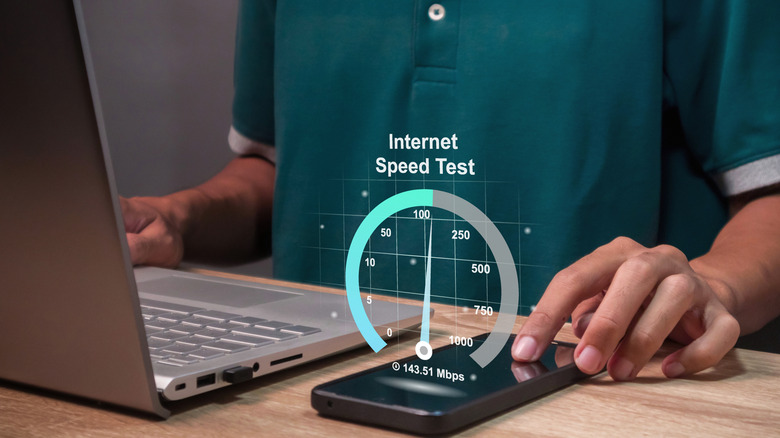
When you pay the big bucks for a high-speed internet connection, the last thing you want to experience is suboptimal network speeds that result in gaming lag, buffering streams, or unreasonably long download times. More often than not, the culprit here is bandwidth throttling. During peak hours, most ISPs throttle internet speeds to manage high internet activity, which is a frustrating restriction to deal with when you're not at fault for this overpopulated network traffic in the first place. To make things even worse, some ISPs prioritize traffic to certain websites and slow down speeds for others, which is deeply unethical and a huge reason why net neutrality is important. ISP throttling can also happen if you reach the data cap of your network plan, which is far more justifiable ... but irritating, nevertheless.
If you don't want to be subject to the whims or fancies of your internet service provider, then use a VPN that helps disguise your internet activity. This isn't a universal solution, and you'll still experience slower speeds if bandwidth is throttled either during peak internet usage or if you've exceeded your plan's data cap. However, if your IP address is hidden, then your ISP can't track what sites you're browsing, preventing it from limiting internet speeds on sites that haven't opted for paid prioritization. This enables high internet speeds and helps you work around what is easily one of the most unethical steps any ISP has taken.