

4 Reasons You Should Install Multi-Room Audio Systems In Your Home

A well-researched and thoughtfully assembled multi-room audio system is a thing of beauty. Gone are the days of fiddling with volume control switches and individual amplifiers for each room you want speakers in. Nowadays, most folks are apt to spend their money on wireless speakers that connect to Wi-Fi, and this type of technology has made it much easier to house all your speaker and equipment controls under one roof.
Many multi-room systems will even let you incorporate your existing speakers and AV components, so you won't have to box up your prized home theater. Investing in a series of audio zones may sound like a daunting feat, but you'll be able to get a number of these products up and running in just minutes. Sticking with Wi-Fi speakers is also a great way to avoid running speaker wire, and you also won't have to worry about how large of a speaker selector you'll need.
We put together a small list of reasons for installing a multi-room audio system in your home. When you're done reading, we hope you'll feel inspired to start creating your own setup, but we'll settle for just feeling more educated, too.
Listen to the same song everywhere, or something different in each room

Listening to music and podcasts throughout your entire home is a great way to stay motivated throughout the day. But having your audio confined to headphones or earbuds can start to feel uncomfortable if you've been wearing them too long. With a multi-room audio system, you'll be able to enjoy your favorite artists and playlists without a pair of cans or buds, and so will everyone else.
Whether you're using Wi-Fi speakers like the Sonos Arc Ultra or connecting passive speakers to an AV receiver with dual- or triple-zone capabilities, multi-room audio will often let you play the same content on every speaker in the home. This can make it seem like audio is seamlessly following you between rooms and floors. Depending on your setup, you may also be able to have multiple sources playing simultaneously, which bodes well for parties where not everyone has the same taste in tunes.
The only reason we said "often" and "may" is that some AV receivers will limit you to one source for multiple zones. To that end, it pays to know exactly what features you want a multi-room system to be capable of before buying any hardware.
One controller to rule them all

One of the best parts of owning a multi-room audio system is being able to manage all your equipment and content from a single app or device. The centralized controller might be as simple as an app for your phones or tablets, or complex enough to require a universal remote with custom programming. Many audio products support digital assistant tools like Alexa, Google Gemini, and Siri, too, which usually means voice commands are on the table.
The Alexa, Apple Home, Google Home and Sonos apps all allow you to group their associated speakers into audio zones, as well as separate them for individualized control. You're also able to pick what content is playing on what speakers, and can even adjust the volume for each zone. Versatility is the name of the game, and the best multi-room systems make it easy to quickly make a change to a single speaker, or every speaker in the house, with a couple of taps or a short voice command.
Some multi-room setups will even let you manage your audio using a smart TV or streaming device. If your TV or streamer has Google TV, there's a good chance you'll be able to use Gemini to orchestrate your playlists. Similarly, devices that use Fire TV should be compatible with Alexa controls.
Build your dream system one piece at a time
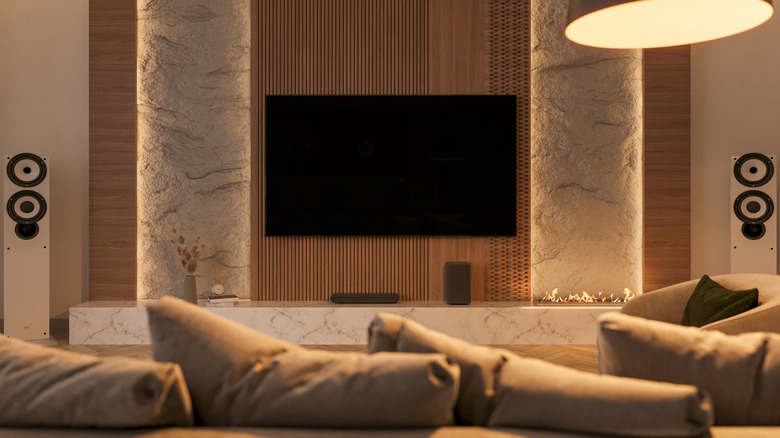
Dropping a boatload of cash on a dizzying amount of AV components can be a fast path to buyer's remorse. Fortunately, most multi-room audio systems on the market can be added to and upgraded over time. Instead of worrying about getting speakers in every room on the second floor (long-term goal), you can shift your focus to one room or one speaker at a time.
Not only will this likely save you money on up-front cost, but the "one piece at a time" approach will also let you dedicate more research hours to the parts of your system that matter most. And if you already own speakers and other audio gear, you'll also have more time to think about how (or if) you'd like to integrate your preexisting equipment into your multi-room system.
Now, let's say you want to purchase a complete home theater system for one room, and want the ability to add wired speakers to a second room down the line. For scenarios like this, it might actually make more sense to purchase and install everything at once. That way, all the wire runs are already completed, so even if you don't put speakers in your second room right away, the connections will be there when you're ready.
Make it easier to hear what's important

Keeping the lines of communication open between you and your family is the best way to run a household. Multi-room audio systems will often let you use smart speakers as a room-to-room intercom, and all you'll usually need to do is speak into one of those speakers or use your phone's built-in mic to issue an announcement. This is particularly convenient for homes with more than one floor, a detached garage, or some type of in-law unit. Those on the receiving end of an intercom announcement should also be able to share a response.
We mentioned headphones at the start of this piece, and while we can certainly appreciate an audiophile-grade headset, over-ear and in-ear audio products can make it difficult to hear and interact with the world around you. With multi-room speakers, you'll still be able to enjoy all the music and podcasts you listened to with headphones, but in a way that's less isolating.
Not only is this better for communicating and staying in the now, but it's also safer. While most noise-canceling headphones are designed to let some amount of sound in, multi-room speakers make it all the easier to hear glass shattering, a baby crying, or a smoke alarm going off.