

How Fast Can NASA's Artemis II's Spacecraft Orion Reach Space?
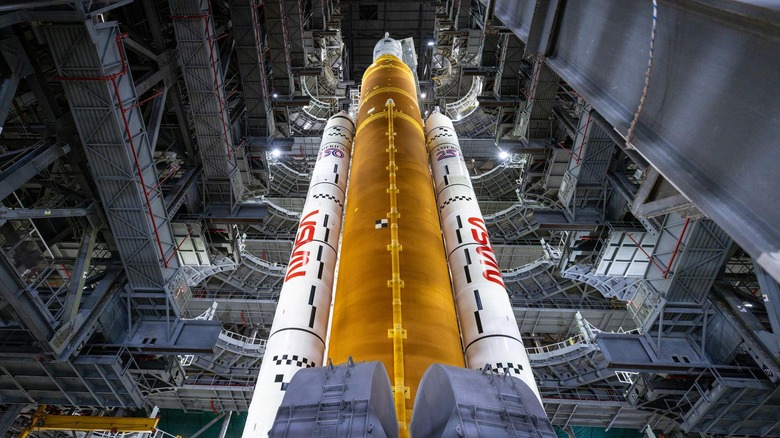
Artemis II is ready for its historic lunar mission. The massive rocket and Orion spacecraft are now sitting at the Launch Complex 39B after an hours-long, four-mile journey from the assembly building, where they underwent final checks. This was not NASA's first rollout for the Artemis II mission, but NASA hopes it will be the last. Mission planners are targeting an April 1, 2026 launch window. Once ignition starts, it'll take about three minutes to reach NASA's defined edge of space, and eight minutes to reach orbit.
The launch requires 8.8 million pounds of thrust, which is about the same output as 326 F-16 fighter jet engines. Around one minute into ascent, the rocket throttles down for about 25 seconds at Max Q, the point of maximum aerodynamic pressure, as it pushes through the dense lower atmosphere. Once clear, Orion will continue to accelerate, reaching nearly 3,200 miles per hour. At about 2:09 into the flight, the solid rocket boosters detach before Orion reaches the edge of space.
How fast Artemis II reaches space after liftoff
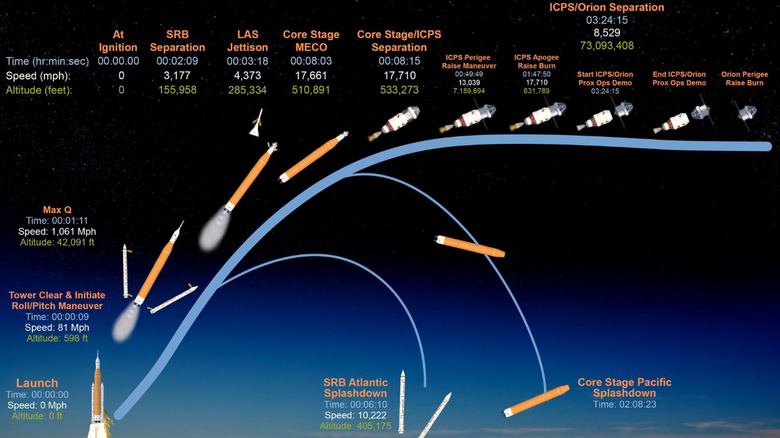
The next phase is where the power of the shuttle era kicks in. Four RS-25 engines, refurbished from the shuttle program, will push the spacecraft up to 17,500 mph, the minimum speed needed to maintain a stable orbit around Earth. This phase spans from the edge of space into orbit, nearly 100 miles above Earth. Most of the thrust is pushing it forward, not up.
As the crew enters microgravity just eight minutes into their 10-day journey, the RS-25 engines will shut down, and the crew will become weightless. The spacecraft will coast in orbit for about 24 hours, waiting for the precise moment when Orion's Orbital Maneuvering System Engine (OMS-E) fires the translunar injection (TLI) burn that sends Orion toward the moon.
The crew will travel more than 230,000 miles to the moon, taking about three to four days to reach its orbit. The Artemis II mission doesn't call for landing. Instead, the crew will stay about 4,000 to 6,000 miles above the surface because NASA wants to test whether Orion can safely support a crew in deep space while also giving them an opportunity to practice navigation and control systems. Once it rounds the moon, Orion will head home, splashing down in the Pacific Ocean near San Diego about ten days after liftoff.
Why Artemis II matters
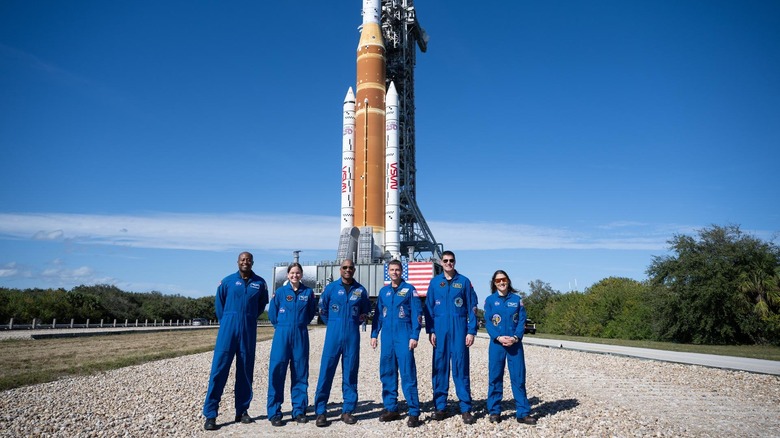
NASA has had to delay the mission several times to make sure the spacecraft remains intact and operational during its early phases. The most recent Artemis II delay was caused by a helium pressurization issue. There's a lot on the line because Orion will carry four astronauts around the moon for the first time since 1972. Aboard Orion are Christina Koch, Victor Glover, and Jeremy Hansen, who will be the first woman, first person of color, and first Canadian, respectively, to reach the vicinity of the moon. NASA veteran Reid Wiseman will lead.
The rocket uses engines from the space shuttle program, but they'll help do something those shuttles never could: Reach speeds of nearly 25,000 mph as it returns from the moon. Artemis II will be an enormous step forward in sustaining a human presence on the moon. For now, it's unclear when — or if — the next mission, Artemis III, will take humans to the moon. NASA announced it was delaying the planned trip in early March 2026 due to setbacks with Artemis II.