

11 Of The Weirdest Products Ever Made By Nintendo
We may receive a commission on purchases made from links.
Nintendo has always been at the forefront of hardware innovation, with major successes like the Wii and Nintendo Switch proving their fruitful approach. 2026 is no exception, with Nintendo planning some big changes this year. Nevertheless, not all of Nintendo's experiments have received unanimous praise. Their hardware eccentricities have led to situations where Nintendo has jumped the gun with ideas so innovative that the hardware at the time simply couldn't support them. In other instances, time at the top led to a sense of complacency, causing Nintendo to take unnecessary risks and release weird products that puzzled the masses.
Still, in an era of gaming where AAA companies have done everything in their power to avoid any kind of risks and to wring video games through a rote, tired formula that players are slowly getting tired of, Nintendo's innovative approach in the gaming industry should always be celebrated. Even when it came to a genre as saturated and done-to-death as the infamous open-world sandbox, Nintendo made sure that The Legend of Zelda: Breath of the Wild stood out with its multifaceted gameplay, organic exploration, and emergent systems, making this game equal parts weird and epic. It's an approach that applies to their hardware offerings as well, developing cool gadgets that arguably belong in every gamer's setup... and others that were way too bizarre for their own good.
Robotic Operating Buddy, AKA R.O.B.
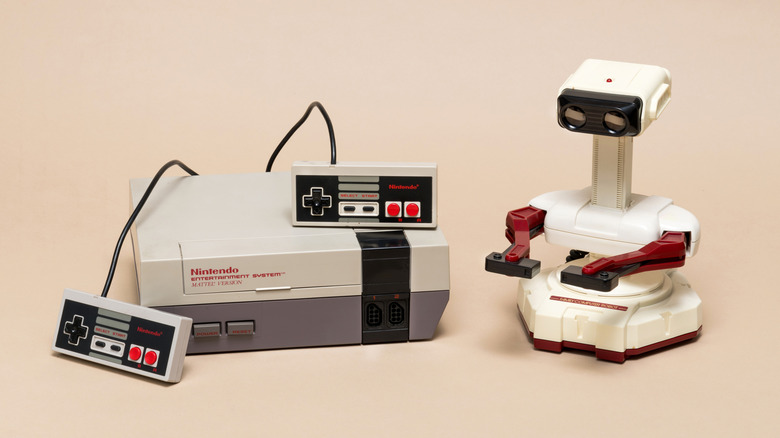
Only Nintendo can think of turning a CPU-controlled second player into a toy that players can bond with. The most fascinating part about R.O.B.'s existence is that it was released for the Nintendo Entertainment System (an '80s console darling that predates the era of PlayStation and Xbox). For the company to try and gamify the player experience right out of the gate is remarkable and a testament to Nintendo's innovative design ethos. The Robotic Operating Buddy, or R.O.B., could read optical flashes in supported games and take actions accordingly, making it feel far more alive than an invisible second player. For a mere toy, the engineering that went into making R.O.B. was pretty competent. It had space to support five accessories based on the game you were playing, and a special eye filter helped improve R.O.B.'s performance when playing on TVs with brighter screens.
Unfortunately, despite R.O.B.'s weird yet captivating stylings, it was a major sales dud. The fact that it didn't support any game other than Gyromite and Stack-Up was the ultimate nail in the coffin for this product, but there's a silver lining here — R.O.B. has continued to be an enduring part of Nintendo's mascot lineup, appearing in their long-running franchises like Pikmin, Super Smash Bros., Mario Kart, and WarioWare. It's also slated to make an appearance in The Super Mario Galaxy Movie, making it clear that Nintendo wants to keep this mascot alive despite its initial failure.
Game Boy Printer
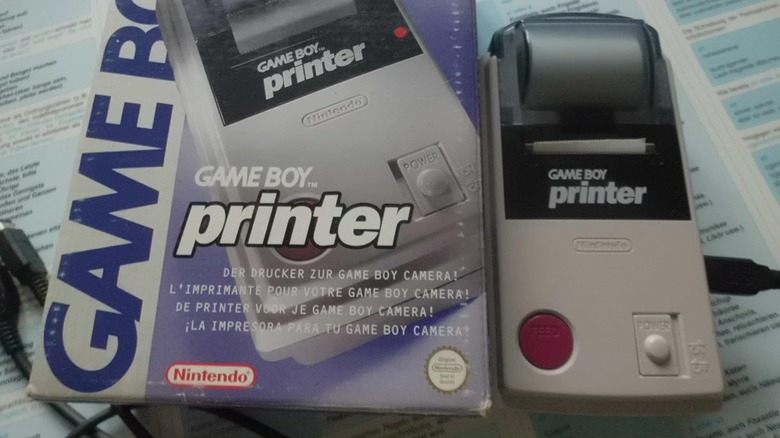
Before the selfie camera was even a thing, Nintendo was already hard at work manufacturing an accessory that could accomplish a similar task... with the Game Boy, no less! The Game Boy Camera, labeled the smallest digital camera at the time by The Guinness World Records (yet another technological marvel by Nintendo), was a neat accessory that plugged into the handheld console's cartridge slot and let you access a wealth of minigames. It's also notable for its creepy Easter eggs, but that's a topic for another day. This accessory was pretty cool in and of itself, but it also supported one of the weirder products released along with it — the Game Boy Printer.
The very idea of a special printer specifically to print out images from a particular console is odd, but the Game Boy Printer ran with this concept and did a pretty good job, all things considered. This small accessory connected to the camera via a Link Cable and could print out small black-and-white photos on 27mm X 23mm thermal paper. It was a novel way to memorialize your gaming memories in popular titles like the Game Boy Pokémon games, The Legend of Zelda: Link's Awakening DX, Donkey Kong Country, and Super Mario Bros. Deluxe.
DK Bongos
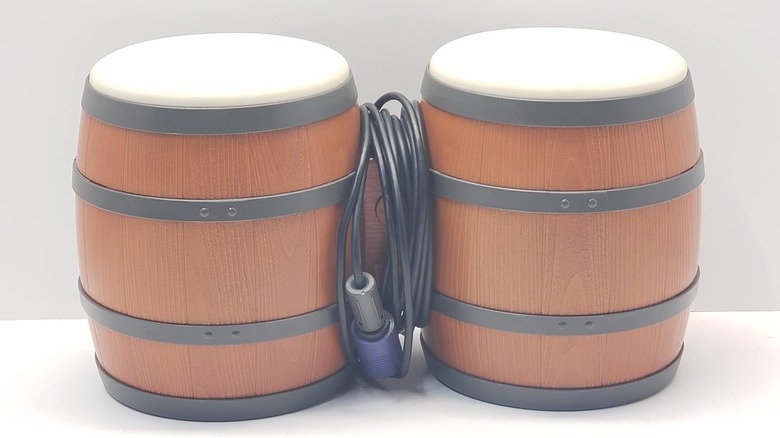
People into rhythm games are familiar with Taiko no Tatsujin, a series where players play a special taiko drum and try to hit notes perfectly to complete an array of tough stages. These fans will be surprised to know that Nintendo also took a crack at this "controller" in 2003. The end result was the DK Bongos, which were made for the Nintendo GameCube. This controller was compatible with all Donkey Kong games on the GameCube — the three Donkey Konga games and Donkey Kong Jungle Beat. For the Donkey Konga rhythm games, the DK Bongos were perfect and made the gameplay more immersive.
Where Nintendo added their patented sense of weirdness was for Jungle Beat. Sure, this game supported a regular GameCube controller, but the real fun was in using the DK Bongos to control everyone's favorite ape. Players had to hit the left or right drum individually to make Donkey Kong move in that specific direction and strike both drums at once to jump. The controller's built-in microphone could detect when the players clapped their hands together, giving Donkey Kong the means to defend himself. Sure, this game was easier to make up for this controller's inherent awkwardness, but it's still one of the most unique platformers that Nintendo has developed... and that's saying something. While the DK Bongos didn't support other games and became an obscure accessory not long after, its legacy still persists. Donkey Kong's Final Smash in Super Smash Bros. Brawl and Super Smash Bros. for Nintendo 3DS and Wii U sees this beloved character pull out the DK Bongos and wail on them to damage surrounding characters.
Virtual Boy
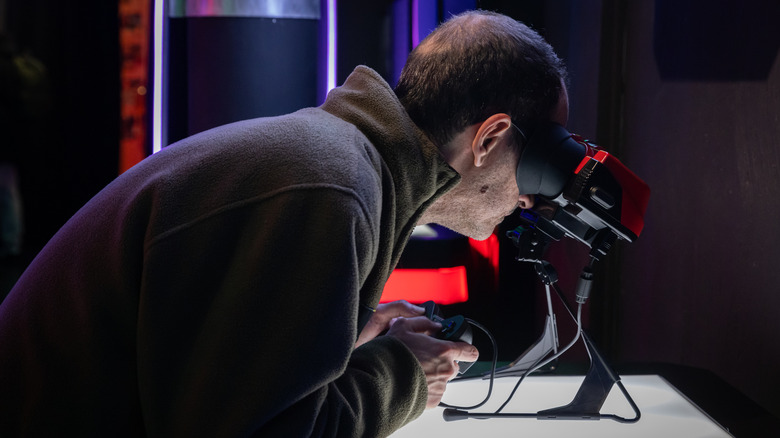
Nothing personifies Nintendo's willingness to innovate and take risks more than the Virtual Boy. People think that VR technology will still take a long, long time to become a mainstream part of gaming right now, so you can only imagine what the perception of the Virtual Boy was back when it launched. Gunpei Yokoi, the creator of the Game Boy, had a novel idea with the creation of this device, but the Virtual Boy is the very personification of a device that was way, way ahead of its time. The red and black visor was the cheapest solution available at the time to recreate stereoscopic 3D visuals, but this came at a major cost. The Virtual Boy was unwieldy, hurt the player's eyes, and had horrible-looking graphics that made it one of the worst video game consoles of all time.
This resulted in one of Nintendo's highest-profile hardware failures. The worst part was that the console failed to sell in Japan, a country where Nintendo has witnessed success across the board, which speaks volumes about how poor the Virtual Boy was received. Even the controller for this console was pretty weird, serving as the only Nintendo controller to have two D-Pads. As disappointing as the console was, fans are glad to see that Nintendo isn't burying this piece of hardware. Switch and Switch 2 owners can purchase the Virtual Boy for $99.99, letting them enjoy classic Virtual Boy games on a modern console... provided they have a Nintendo Switch Online subscription.
Nintendo e-Reader
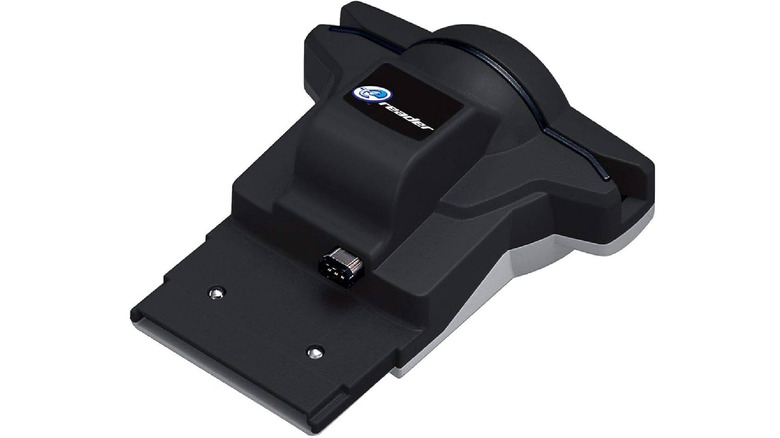
A card reader for the Game Boy Advance was probably not on anyone's bingo card in 2002, but leave it to Nintendo to craft yet another weird accessory that would become a collector's item in no time. The GBA is one of the most legendary handhelds developed by this company, which also released a card reader that could plug into the console's Game Pak Slot and let you enjoy everything from secret levels to unique minigames.
Perhaps the best use of this bulky e-Reader was to play full-blown NES games by swiping cards that housed titles like Donkey Kong Jr., Excitebike, Donkey Kong, and Mario Bros. All of these games had a '-e' suffix to highlight their e-Reader compatibility. While this accessory was discontinued in foreign markets because of low sales in 2004, it gained a strong foothold in Japan and continued production for four more years before Nintendo finally laid this weird product to rest.
Nintendo Labo
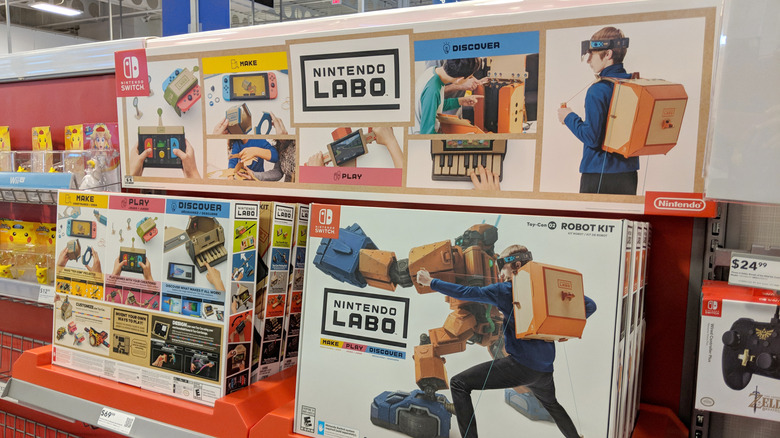
Despite Nintendo's sizeable adult fanbase, the company has always prioritized welcoming younger fans. Encouraging creativity in young minds is an approach that Nintendo hasn't forsaken since its early days of being a toy company, leading to the release of the Nintendo Labo. At a glance, paying up to $89.99 for these elaborate pieces of cardboard seems like a rip-off, but there's something endearingly weird about the Nintendo Labo that makes it worth checking out for people into unique products that push the gaming medium in interesting directions.
The Nintendo Labo comes in various kits, letting you craft interactive toys like a piano, house, motorcycle, RC car, fishing rod, robot, submarine, plane, and steering wheel. Initially, only three kits were announced, but Nintendo surprised players with a fourth Labo kit that brought virtual reality to the Switch. All of these kits are a blast to set up — for both kids and adults — and unlock quirky gaming experiences that make the Switch even more of a memorable console than it already is.
Pokewalker
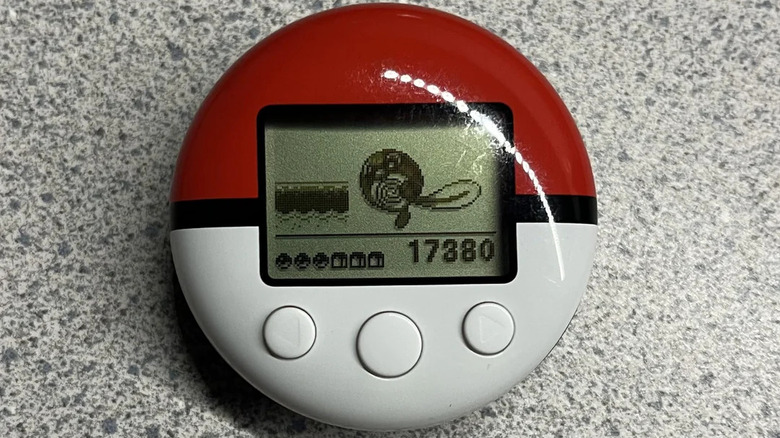
If you ever wanted to turn your steps into a tangible resource that helps your Pokémon become stronger, then the Pokewalker is tailor-made for you. This weird accessory was packaged along with copies of Pokémon HeartGold and SoulSilver. It lets you store up to three Pokémon and items that you can acquire during your so-called "travels". For every 20 steps, you gain one watt, a resource used to interact with other features in your Pokewalker. For the cost of anywhere between 3 and 31 watts, you can use the Dowsing Machine, which is basically an elaborate item finder. Meanwhile, using anywhere between 10 and 31 watts lets you access the PokeRadar, which brings the trainer to the screen where you choose one of four patches of tall grass to find a Pokémon you can battle and capture. Any items or Pokémon you find can be transferred to your DS via an infrared connection, which you should do regularly if you don't want to reach a limit and replace your hard-earned rewards over and over again.
The lengths that the Pokewalker went to gamify the simple act of walking are pretty admirable. Depending on the number of watts you store, your Pokémon will travel across various kinds of regions. Using a compatible Pokémon type for each region increases the chance of acquiring valuable items and encountering a rare Pokémon. It has a hard limit of 10,000 steps, so syncing this Pokewalker regularly is highly recommended if you don't want hours of walking to go to waste. Another unique feature of this device is the ability to connect with other Pokewalkers, letting them acquire items or watts.
Family BASIC
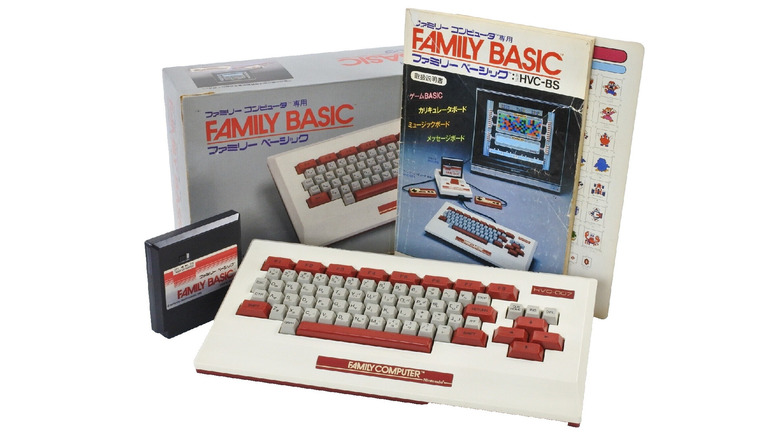
The Family BASIC was an accessory for the Famicon that never made it past Japanese shores. It lets players develop simple games using the BASIC programming language. It's a shame that the West never got a chance to mess around with this peripheral, since the rampant success of the Super Mario Maker games is proof enough that gamers love to channel their inner programmer and craft unique gameplay experiences.
Utilizing a special cartridge and the Famicom keyboard, players could follow the instruction manual to craft simple games before moving on to create more complex experiences. It included sprites from several Nintendo games, although the most notable has to be the iconic plumber that won over the hearts of fans all over the world. The Family BASIC V3 was an upgraded version of this peripheral that came packed with four mini-games, giving players an even better idea of what they could achieve once they mastered the BASIC programming language.
Wii U
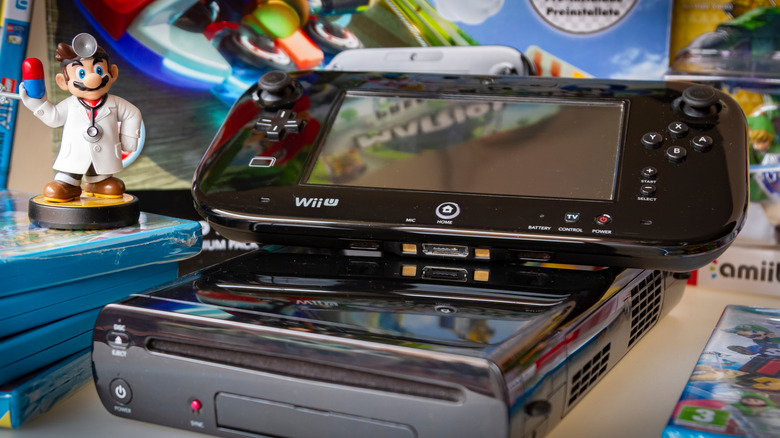
To this day, Nintendo fans are thankful that the monumental failure of the Wii U didn't lead to the company exiting the console market, if not shuttering its gaming division for good. Its precursor, the Wii, became one of the highest-selling consoles of all time that successfully catered to a casual audience and made motion controls mainstream in a way no one thought possible. Unfortunately, a sense of complacency caused Nintendo to royally drop the ball with the Wii U, which is arguably their biggest hardware failure by quite some margin. A mainline console with a chunky gamepad that lacked proper third-party support, the Wii U was such a colossal disappointment that it only managed to push a meager 13.56 million units before being discontinued. Compare this to its eighth-gen competitors, the PlayStation 4 and Xbox One, which sold 117.2 million and almost 58 million units, respectively.
People can point fingers at so many factors that contributed to the Wii U's downfall. The underpowered hardware is definitely to blame here, as is the atrocious marketing campaign that alienated both casual and hardcore gamers. That being said, it's hard to argue against the clunky, weird gamepad being the biggest reason for the Wii U tanking. The controller felt like a dated, underutilized accessory, which made it hard for anyone but the most ardent Nintendo fan to get on board with what Nintendo was trying to achieve with this console. If you were one of these customers, then look on the bright side — your old Wii U still has some unique uses if you're willing to tinker with its hardware and software.
Circle Pad Pro
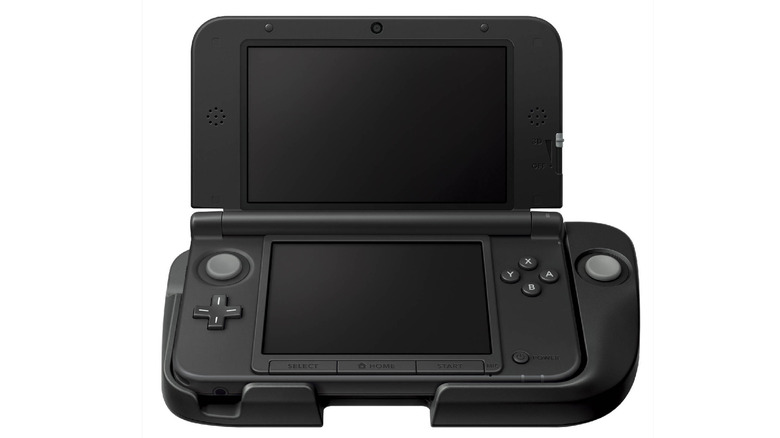
With the Wii U burning a huge hole in Nintendo's coffers, it was up to the 3DS to salvage Nintendo's reputation and keep it afloat during this rough period. The company went all out with this product, releasing so many different versions.. It also had a decent number of accessories to augment your gameplay experience, including the Circle Pad Pro. This peripheral added two additional shoulder buttons — ZL and ZR — and another circle pad. On paper, this sounds like a great way to make the 3DS compatible with more games that have complex control schemes. Unfortunately, because of how inherently weird the Circle Pad Pro was, many people simply couldn't justify paying $19.99 for this accessory.
For starters, this accessory was very bulky, perhaps unnecessarily so. It also needed a AAA battery to operate, which added to the unwieldiness of this device. The list of supported games is also pretty meager, although titles like The Legend of Zelda: Majora's Mask 3D, Dragon Quest X, Final Fantasy Explorers, Kid Icarus: Uprising, Luigi's Mansion, Kingdom Hearts 3D: Dream Drop Distance, and numerous Monster Hunter games benefited from its added functionality. However, the New Nintendo 3DS models came with a C stick and additional shoulder buttons, which led to some games — notably, Super Smash Bros. — supporting this new version of the 3DS instead of the Circle Pad Pro, further limiting its usefulness.
Talking Flower

Super Mario Bros. Wonder is an amazing 2.5D platformer that clearly has a lot of love put into it. The Wonder Flowers added a refreshing touch to levels, completely changing their dynamic and encouraging players to check out stages multiple times to acquire all the Wonder Seeds possible. Still, as game-changing as these Wonder Flowers were, their voice was notably jarring. What made things worse was when people replayed stages and heard the same canned responses over and over again, which is why they preferred to turn their dialogue off altogether in settings.
Anyway, leave it to Nintendo to turn what many people consider to be the worst part of Super Mario Bros. Wonder into a physical toy. The Talking Flower is a weird $34.99 toy that, true to its name, will keep yapping throughout the day, either trying to be funny or motivational with its quips. It's easily one of the stupidest things Nintendo has developed... and yet, there's something charming about this Nintendo-coded pet that makes it appealing to kids and adults alike. It speaks multiple languages, can function as an annoying alarm clock by adjusting to your sleep schedule, play music, and let you know the day, time, and temperature. However, we haven't mentioned the best feature — if you hold down the Talk button for two seconds, this Talking Flower will shut up and turn into a quirky video game collectible instead of an embarrassing one.