

8 Valuable '60s Gadgets That Might Be Hiding In Your Grandparents' Attic
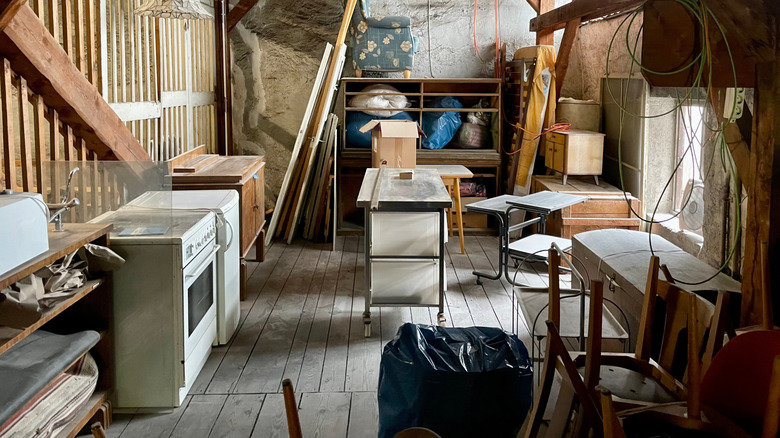
So, your grandparents are moving down to Florida to retire, and they don't want to take all their junk with them. Gramps has said you can have anything from the attic, as long as you get rid of it all. This is either a thankless chore or your chance to discover some real treasure.
Every era has some valuable artifacts to dig up, but unless your grandparents were intrepid archeologists, you're probably not going to find Incan gold or a priceless ancient Chinese vase. If they were at prime "buying stuff" age during the '60s, however, you should keep an eye out.
The 1960s represent a golden age of home appliances. Advanced electronics were still a few decades away, but the transistor had quickly begun supplanting the vacuum tube, and some of these early devices from the latter half of the 20th Century can be worth a pretty penny to the right collector.
The Sony TV8-301
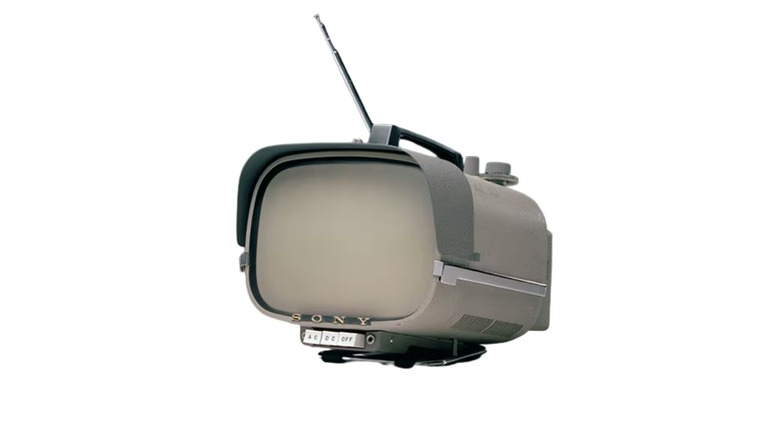
It's easy to think of small, portable tube TVs as technology from the '80s, but the Sony TV8-301 (nailed the name again, Sony) is from the early '60s and is a true pioneering device. This is not only a tiny TV you can power from the mains or a battery and take with you wherever you go, but also the first all-transistor TV in the world.
That's not all it did first. This little wonder is also the first "direct-view' (as opposed to projection) CRT transistor TV. To cap it all off, this is the first Japanese TV to be sold in the U.S.! Technically, it came out in 1959 in Japan, but in the U.S., it was sold from 1960 to 1962. It must have seemed like future space magic to folks back then, for whom a TV was usually a heavy wooden box in the living room with a relatively small screen. It's not a stretch to say that this little TV set was Sony's entry into the American market, and without it, we may have never seen the Emmy award-winning Trinitron tube. Ironically, Sony has been slowly pulling out of the TV business, and you'd be surprised who actually makes Sony TVs these days.
As for the TV8-301, if you find one of these gathering dust somewhere, you might be in for a decent payday. Even an untested "as-is" unit can sell for a few hundred dollars online.
Thorens TD-124 MKII
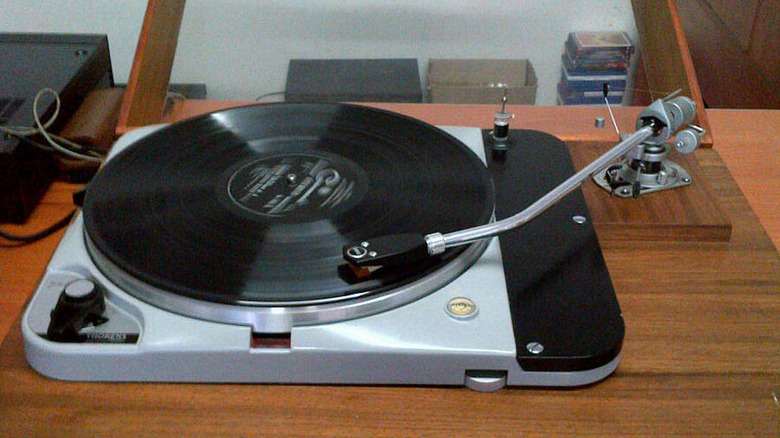
Audiophiles choose turntables over record players every time, and among the turntables that will turn the average audiophile's head all the way round is the Thorens TD-124 MKII. It was a high-end turntable in the '60s, and surprisingly, it remains a sought-after high-end turntable today. It's an improved version of the original TD-124 from the '50s, making several key changes, such as swapping the cast-iron platter for a non-ferrous material.
This Swiss-made turntable has an interesting hybrid idler-and-belt drive system, an integrated spirit level, a clutch system, and the aforementioned heavy platter. It has a suspended sub-chassis and was designed to work with a wide range of tonearms, so, in a way, it's modular too. Honestly, we don't "get" it, but audiophiles can't get enough of this thing and how it sounds.
Which is good news for you if you find one in the attic. Actually, you don't even have to find a complete one. Just good parts can fetch reasonable prices as enthusiasts try to maintain or restore their own units. If you have a TD-124 Mark II that's been restored, you're looking at thousands of dollars to the right buyer. We've seen mint-restored units listed for over $5,000, but, of course, there are many factors that influence price. Incidentally, Thorens sells a modern version called the TD 124 DD, which sells for just over $9,000 when converted from Euros. Just buy a CD player already!
Nikon F Photomic
If you think audiophiles like to overpay for ancient equipment, wait till you meet the average photography nut. These are people who scour eBay or local pawnshops looking for vintage "glass" (the lenses) or film cameras, because they have that analog look and feel.
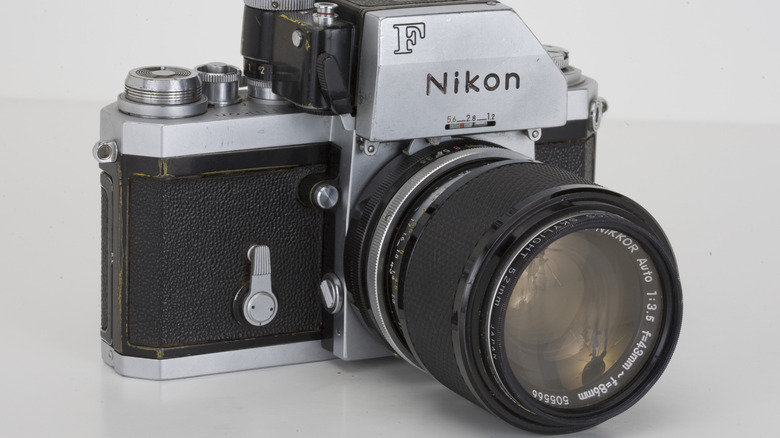
The Nikon F Photomic is one particularly sought-after shooter. The 1959 Nikon F was the famous photography company's first single-lens reflex (SLR) camera. That's also what DSLR means on modern cameras, it's just the "D" for "Digital" that's been added. The Nikon F and other SLRs of the '60s, of course, used film. Nikon introduced the Nikon F Photomic in 1962. The "Photomic" bit refers to the revolutionary viewfinder, which allowed the photographer to measure the scene's exposure right then and there.
The original Nikon F developed a reputation for being tough and reliable, even working on the Mount Everest U.S. expedition. It was a staple of journalists, and famously took a bullet saving the life of war photographer Don McCullin. Any Nikon F is desirable today, but the Photomic and later Photomic T models are much more usable today thanks to that viewfinder. The value of these cameras differs by condition. The body's value can increase from $400 to $1,600 as it goes from average condition to mint. If you have a body and a lens, that range goes from $500 to $3,000. However, this camera isn't all that rare, and fair examples go for a few hundred dollars on sites like eBay.
Zenith Royal 3000 Trans-Oceanic
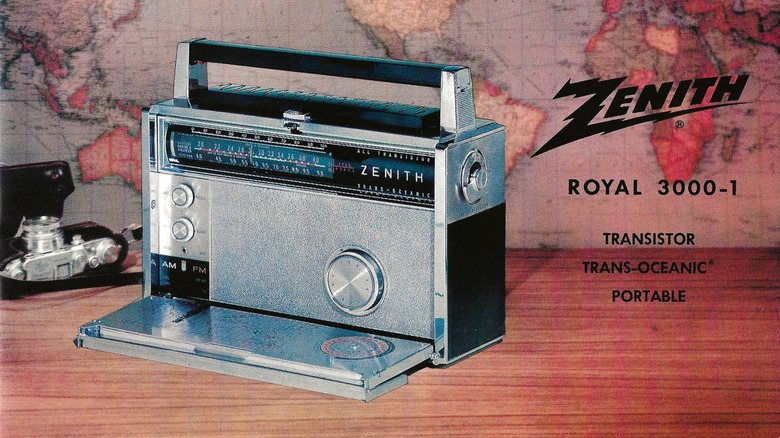
In a world where video killed the radio star, it's hard to imagine just how important radio technology was. With a radio, you could listen to radio dramas, the latest news, and new music, all using one device. The Zenith Royal 3000 Trans-Oceanic was highly advanced for its time. A portable transistor radio, this could receive AM, FM, and shortwave bands. Which meant it could tune into radio stations from around the world, hence the name "Trans-Oceanic". Interestingly, FM capability was introduced to the series in this model.
These days, analog radio doesn't take center stage anymore. Countries are switching to digital radio standards, and most people would probably use an app for listening to radio stations. Having this portable radio in the '60s must have felt like owning the first Walkman or iPod. You get the freedom to tap into the airwaves anywhere and at any time.
The design alone is quite evocative of the era, and it remains a desirable item for collectors. Of course, being a mid-60s transistor radio, it's not really that rare, but you'll still find a nice working model in good shape going for hundreds of dollars.
The original IBM Selectric
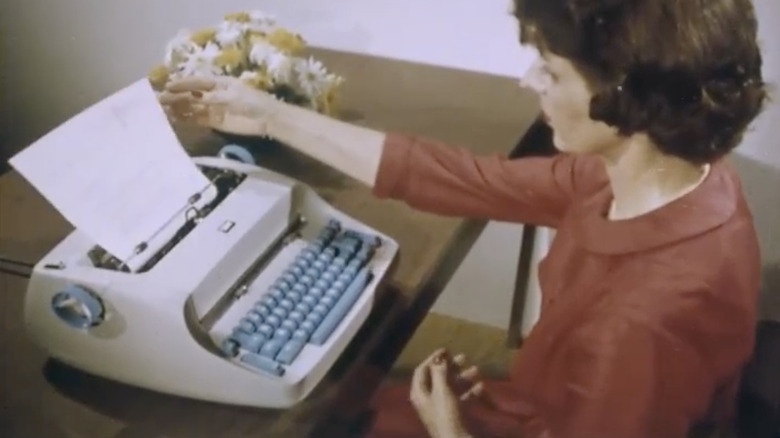
The IBM Selectric electronic typewriter was an office machine that ruled the '80s, but decades earlier, the original Selectric was unleashed on the world in 1961. With no electronic components, this typewriter uses electric power to assist typists. If you've ever used a classic mechanical typewriter, you'll know that operating one is physically tiring. You're the power source, after all.
The Selectric has no type bars and no hand-movable carriage. So you don't have to reach over at the end of each line to reset things. If you look at the keyboard of the Selectric, you'll see a precursor to the keyboard found on the IBM PC of the '80s! What we know as the "Enter" key is also known as the "Return" key, which is short for "carriage return." That same key is on the Selectric, and if you press it, the typing element returns to the start of the next line.
The Selectric made it possible for people to type faster and for much longer. It's like the equivalent of power steering in a car. You only need to point in the right direction, and the machine provides the muscle to pull off the maneuver. If you find one of these original 1961 Selectrics, you're holding a piece of history that could be worth a chunk of cash. A fully restored 1961 Selectric goes for over $1,600, and even ones in rougher shape go for a few hundred.
Revox A77 Reel-to-reel tape deck
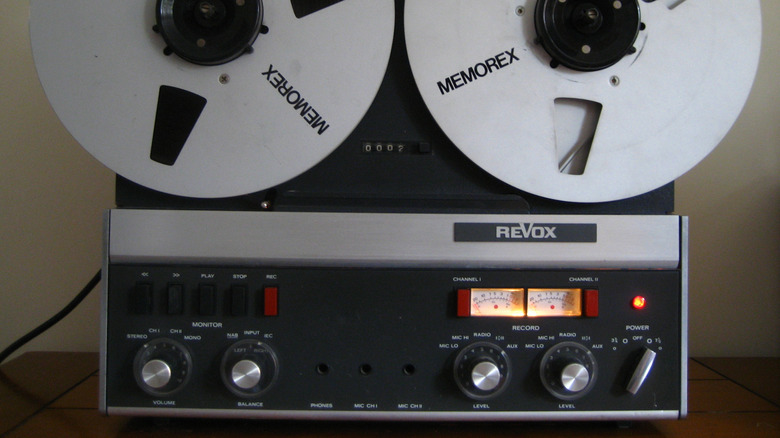
The Revox A77 had a rather prophetic name, because it was released in 1967 and stayed in production until 1977. There are several variants, ranging from the MK I to the MK IV, and about 450,000 units were produced.
This is a "semi-professional" recorder, and while cassette tapes were also contemporary to this machine, the fidelity possible with compact tapes was nowhere near what a big reel-to-reel machine could do. So you'd find these in small studios or used by upper management to record dictation. The A77 is known for its high levels of fidelity, and later models had additional features, such as an anti-flutter tension arm, that refined the first model even more.
Surprisingly, cassette tapes are making a comeback, but even more surprising is that the A77 is still in use, which means there are some enthusiasts out there looking to buy. A unit in good condition can fetch over $1,000. That's at the higher end, though, and we've seen A77S listed for hundreds rather than thousands of dollars. The appeal here isn't just for analog recording fans; some people have reel-to-reel tape recordings that they have no way of playing, and the A77 is an excellent device to help transfer those tapes to a digital format at high fidelity.
Olivetti Programma 101 Desktop calculator
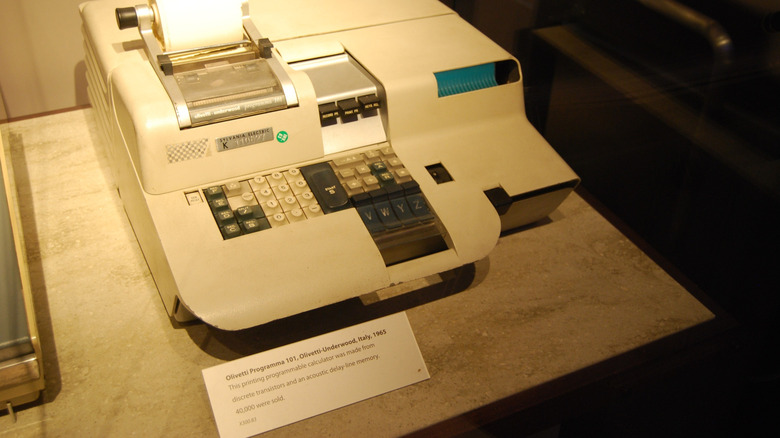
The IEEE called it "The Calculator that helped land men on the Moon." Introduced in 1965 and selling over 40,000 units, this was a literal computer in the sense that it crunched numbers and could run programs. The Moon connection comes from the fact that NASA bought a bunch of Olivetti Programma 101s to help the engineers working on the Apollo 11 mission.
Hilariously, a major selling point was how "compact" and "portable" the 101 was. That's a little laughable in the post-pocket-calculator era, but consider that the Programma 101 used transistors and was therefore much smaller and much less fragile than the very non-portable computers that required their own buildings, and it's clear to see how revolutionary it was.
The 101 had a built-in printer, and you could save programs on magnetic cards. Unless your grandpa or grandma worked on the space program or was some other type of high-level engineer in the latter half of the '60s or early '70s, you're probably not going to find one of these devices gathering dust in the attic. However, if by some miracle you do gain ownership of a 101, you'll be pretty happy. These seem relatively rare, and the only listings we could find were well over $15,000. That sounds ridiculous, but those listings were being watched by a significant number of people and were even sitting in a few virtual checkout carts!
Hickok 6000A Tube Tester
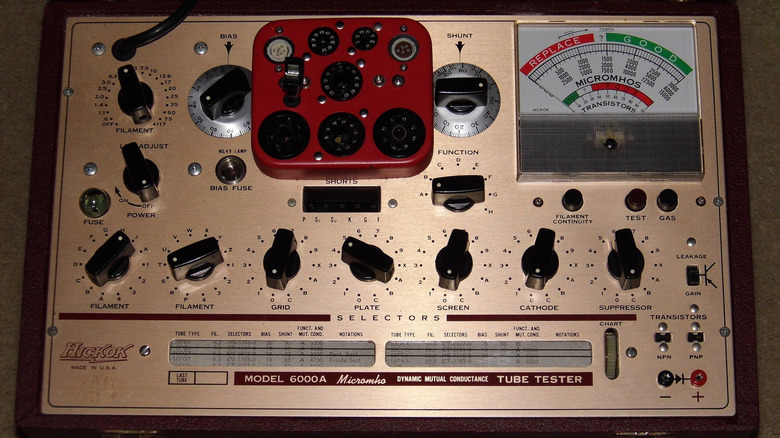
While the '60s were the age of the transistor, plenty of people had radios, TVs, amps, and many other types of devices in their homes that used vacuum tubes. Just like an incandescent light bulb, a vacuum tube eventually wears out and needs replacement. But a device might have dozens of them, so how do you know which ones have to be replaced? They aren't cheap!
This is why technicians loved the Hickok 6000A tube tester. All you had to do was plug a vacuum tube into the right socket and then test whether it was behaving within spec. If not, the little dial on the upper right would tell you if the tube needed replacing.
People buying these tube testers today aren't just doing it because they look cool (which is absolutely true), but because they still need to test vacuum tubes! If you love old valve guitar amps, radios, and other vintage audio or video gear, a tube tester like this can help you diagnose problems and determine whether buying new tubes is a waste of money. There are various models of tube testers from the company, and they range in price. In general, we've seen the 6000A go for around $500 in working condition. Just remember that it can't test all tube sizes. If you're buying and not selling, get the model that matches the tubes you want to test.